
Introduction
Meta titles and meta descriptions are small but important elements of an SEO strategy. They help search engines understand the subject of a webpage and can influence how a page is presented in search results.
Creating effective metadata for a large website can become repetitive, especially when hundreds of pages, products, services, and articles need optimized titles and descriptions.
MagicAI can help simplify this process by generating multiple title and description ideas from a page topic, target keyword, search intent, and relevant content.
However, generating metadata with AI is not simply about asking for a title and description. The best results come from providing clear instructions, relevant keywords, appropriate context, and specific SEO requirements.
This guide explains how to use MagicAI to create useful, compelling, and SEO-friendly meta titles and descriptions.
What Are Meta Titles and Meta Descriptions?
What Is a Meta Title?
A meta title is the title associated with a webpage in search engine results and browser contexts.
It should quickly communicate:
- What the page is about
- What users can expect
- Why the result may be relevant
- The main topic or keyword
A useful title is clear, specific, and relevant to the page.
Example
Weak:
“Home”
Better:
“AI Content Writing Tools: Complete Guide for Beginners”
The second title gives both search engines and users considerably more context.
What Is a Meta Description?
A meta description is a short summary of a webpage.
It can help users understand what they may find after clicking the search result.
A useful description can communicate:
- The main topic
- The page’s value
- Important information covered
- A reason to click
For example:
“Learn how AI content writing tools can help create articles, product descriptions, website copy, and SEO content with practical tips for beginners.”
Why Use MagicAI for SEO Metadata?
MagicAI can assist with metadata creation in several ways.
Generate Multiple Ideas
Instead of creating one title manually, you can ask MagicAI to generate several variations and select the strongest option.
Incorporate Keywords Naturally
You can provide a primary keyword and ask MagicAI to incorporate it naturally without unnecessary repetition.
Match Search Intent
Metadata can be written differently depending on whether the searcher wants:
- Information
- A comparison
- A tutorial
- A product
- A service
- A review
- A definition
Improve Existing Metadata
MagicAI can rewrite titles and descriptions that are unclear, repetitive, or poorly structured.
Scale SEO Work
For large websites, structured prompts can help create metadata for many pages more efficiently.
What Makes a Good SEO Meta Title?
A strong meta title should generally be:
- Relevant to the page
- Specific
- Easy to understand
- Concise
- Keyword-aware
- Useful to searchers
- Different from other page titles
The exact display length can vary because search engines may truncate titles based on rendered width rather than a fixed character count.
Therefore, focus on clarity and relevance rather than trying to hit one exact character limit.
What Makes a Good Meta Description?
A useful meta description should:
- Accurately summarize the page
- Match search intent
- Include relevant keywords naturally
- Communicate a benefit
- Encourage qualified clicks
- Avoid unnecessary repetition
- Avoid unsupported claims
Search engines may sometimes generate their own snippet instead of displaying the exact meta description, so metadata should support the page rather than attempt to control every search-result appearance.
Step 1: Identify the Main Page Topic
Before creating metadata, clearly identify what the page is about.
For example:
Page Topic: How to Create Product Descriptions with MagicAI
Primary Keyword: how to write product descriptions with MagicAI
Search Intent: Informational
This gives MagicAI the context it needs.
Step 2: Identify the Primary Keyword
Choose the main phrase that best represents the page.
For example:
Primary Keyword: MagicAI SEO content
Supporting phrases might include:
- MagicAI SEO writing
- AI SEO content
- MagicAI content optimization
- SEO content with AI
Do not overload the title or description with every keyword.
Step 3: Understand Search Intent
Search intent should influence metadata.
Informational Intent
Example:
“How to Create SEO Meta Titles and Descriptions”
The metadata should promise useful information or a guide.
Commercial Intent
Example:
“Best AI Writing Tools for SEO Content”
The metadata can emphasize features, comparisons, or benefits.
Transactional Intent
Example:
“Buy Automatic Packaging Machine”
The metadata should clearly communicate the product or service and relevant buying information.
Navigational Intent
Example:
“MagicAI Login”
The metadata should be direct and focused on the destination.
Step 4: Create the Meta Title with MagicAI
Give MagicAI the page topic and primary keyword.
Basic Prompt
Create 10 SEO-friendly meta title options for the following webpage.

Page Topic: [TOPIC]
Primary Keyword: [PRIMARY KEYWORD]
Search Intent: [SEARCH INTENT]

Requirements:
- Make each title clear and relevant.
- Use the primary keyword naturally where appropriate.
- Keep the titles concise.
- Make each variation meaningfully different.
- Avoid keyword stuffing.
- Do not make unsupported claims.
- Make the titles suitable for search results.
This produces several options rather than forcing you to accept the first generated title.
Step 5: Select the Strongest Meta Title
After generating options, compare them based on:
- Relevance
- Keyword placement
- Clarity
- Search intent
- Differentiation
- Click appeal
- Accuracy
For example:
Option 1:
“MagicAI SEO Guide”
Option 2:
“How to Create SEO Meta Titles with MagicAI”
Option 2 communicates the topic and intent more clearly.
Step 6: Create the Meta Description
Once the title is selected, ask MagicAI to create descriptions that accurately support the page.
Meta Description Prompt
Create 10 SEO-friendly meta description options for this webpage.

Page Title: [PAGE TITLE]
Primary Keyword: [PRIMARY KEYWORD]
Search Intent: [SEARCH INTENT]

Requirements:
- Clearly explain what the page offers.
- Use the primary keyword naturally where appropriate.
- Highlight a useful benefit.
- Encourage qualified clicks without clickbait.
- Keep each option concise.
- Avoid keyword stuffing.
- Do not make claims that are not supported by the page content.
Step 7: Combine Title and Description
Metadata works best when the title and description complement each other.
Example
Meta Title:
How to Write Product Descriptions with MagicAI
Meta Description:
Learn how to create SEO-friendly product descriptions with MagicAI using practical prompts, keywords, customer benefits, and human editing.
The title identifies the topic while the description explains what the reader will learn.
Step 8: Match Metadata to the Actual Page
One of the most important rules is simple:
Do not promise something the page does not provide.
If the title says:
“Complete Guide to MagicAI SEO”
the page should actually provide a substantial SEO guide.
Avoid misleading titles such as:
- “The #1 AI Tool”
- “Guaranteed Google Rankings”
- “Instantly Rank #1”
- “100% Guaranteed SEO Results”
unless such claims are genuinely supported, which they usually are not.
Step 9: Create Metadata for Different Page Types
MagicAI can create metadata for many types of pages.
Blog Posts
Focus on the topic, question, or learning outcome.
Example:
“How to Create Website Content with MagicAI”
Product Pages
Focus on the product and important differentiating information.
Example:
“Automatic Coffee Grinder | 500 g Commercial Model”
Category Pages
Focus on the product category and user intent.
Example:
“Commercial Coffee Grinders | Explore Available Models”
Service Pages
Focus on the service and customer benefit.
Example:
“AI Content Writing Services for Businesses”
Landing Pages
Focus on the offer and intended action.
Example:
“AI Content Generator for Faster Website Copy”
Step 10: Optimize Titles for Click Appeal
A title should be relevant first and compelling second.
Useful elements can include:
- Numbers
- Benefits
- “How to”
- “Complete Guide”
- “Best”
- “Tips”
- “Comparison”
- Current year when genuinely useful
For example:
Basic:
“SEO Meta Titles”
More descriptive:
“How to Create SEO Meta Titles: Complete Beginner’s Guide”
The second option gives the searcher more context.
Step 11: Optimize Meta Descriptions for Clicks
A good description can communicate a specific value proposition.
Instead of:
“Learn about SEO meta titles and descriptions.”
Try:
“Learn how to create SEO-friendly meta titles and descriptions with practical MagicAI prompts, keyword strategies, examples, and optimization tips.”
The second description provides a clearer reason to visit the page.
Step 12: Ask MagicAI to Remove Repetition
AI-generated metadata may repeat the same wording across multiple pages.
Use this prompt:
Review these meta titles and descriptions for repetition.

Identify titles or descriptions that use overly similar wording.
Rewrite the repetitive versions while preserving the correct page topic and keyword intent.

Make every option distinct, natural, and relevant.
This is particularly useful when working with large websites.
Step 13: Create Metadata in Bulk
For websites with many pages, provide MagicAI with structured information.
| Page | Primary Keyword | Intent |
|---|---|---|
| Product Guide | product descriptions | Informational |
| SEO Guide | SEO content | Informational |
| Product Category | coffee grinders | Commercial |
| Service Page | AI content writing | Commercial |
| Product Page | automatic coffee grinder | Transactional |
Then ask MagicAI to create metadata for each page.
Bulk Metadata Prompt
Create an SEO meta title and meta description for each webpage listed below.

For every page:
- Use the supplied primary keyword naturally.
- Match the stated search intent.
- Make the title and description unique.
- Keep the copy concise and readable.
- Avoid keyword stuffing.
- Do not invent information.
- Make the metadata accurately reflect the page content.

Return the results in a table with:
Page | Primary Keyword | Meta Title | Meta Description
Step 14: Optimize Existing Metadata
MagicAI can also audit existing metadata.
Audit Prompt
Audit the following meta titles and meta descriptions.

Check each one for:
- Relevance
- Search intent
- Keyword usage
- Clarity
- Repetition
- Click appeal
- Accuracy
- Conciseness

Then provide an improved version where necessary.

Do not change accurate information or add unsupported claims.
Step 15: Use MagicAI to Create A/B Variations
You can create multiple variations for testing.
For example:
Version A: Benefit-focused
Version B: Problem-solving
Version C: Guide-focused
Version D: Feature-focused
This gives an SEO team several options for optimization.
However, changing metadata should be evaluated based on actual performance rather than assumptions.
Step 16: Avoid Common Metadata Mistakes
Keyword Stuffing
Poor:
“MagicAI SEO Meta Titles | MagicAI SEO Descriptions | MagicAI SEO Meta Tags”
This is repetitive and unnatural.
Generic Titles
Poor:
“Welcome to Our Website”
This gives users little useful information.
Duplicate Titles
Multiple pages should not unnecessarily share identical titles.
Misleading Descriptions
Do not promise information that the page does not contain.
Excessive Capitalization
Avoid writing metadata entirely in capital letters simply to attract attention.
Unnecessary Symbols
Too many symbols can make metadata look unprofessional.
Unsupported Claims
Avoid claims such as:
- Guaranteed rankings
- Guaranteed traffic
- Instant SEO success
- Guaranteed conversions
Step 17: Create a Metadata Review Workflow
A practical MagicAI workflow is:
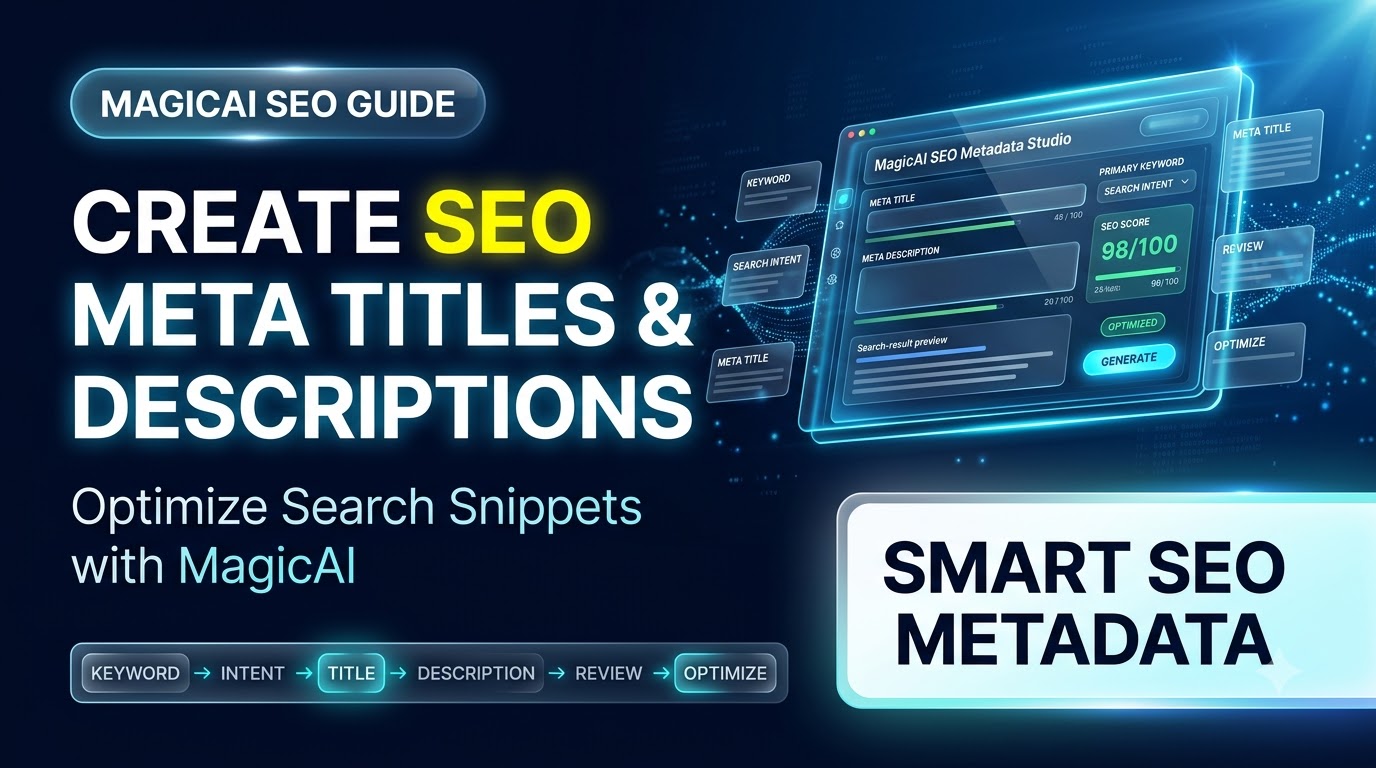
PAGE CONTENT → SEARCH INTENT → PRIMARY KEYWORD → MAGICAI → TITLE OPTIONS → DESCRIPTION OPTIONS → HUMAN REVIEW → SEO CHECK → PUBLISH → MONITOR
This approach keeps AI generation connected to the actual webpage.
MagicAI Master Prompt for Meta Titles and Descriptions
Use this reusable prompt whenever you need metadata:
Act as an experienced SEO specialist and content strategist.

Create an SEO meta title and meta description for the webpage described below.

PAGE TOPIC:
[TOPIC]

PAGE TYPE:
[BLOG / PRODUCT / CATEGORY / SERVICE / LANDING PAGE]

PRIMARY KEYWORD:
[PRIMARY KEYWORD]

SECONDARY KEYWORDS:
[SECONDARY KEYWORDS]

SEARCH INTENT:
[INFORMATIONAL / COMMERCIAL / TRANSACTIONAL / NAVIGATIONAL]

TARGET AUDIENCE:
[AUDIENCE]

PAGE SUMMARY:
[SUMMARY]

Create:
1. 10 meta title options
2. 10 meta description options
3. Your recommended title
4. Your recommended description

Requirements:
- Keep the metadata accurate to the page.
- Use the primary keyword naturally where appropriate.
- Match the search intent.
- Make every option unique.
- Prioritize clarity and relevance.
- Make the copy compelling without clickbait.
- Avoid keyword stuffing.
- Avoid unsupported claims.
- Do not invent information.
- Keep the language natural and professional.
SEO Metadata Quality Checklist
Before publishing, review each title and description.
- Does the title accurately describe the page?
- Is the primary keyword relevant?
- Does the title match search intent?
- Is the title concise?
- Is the description accurate?
- Does the description explain the page’s value?
- Is the keyword used naturally?
- Is the copy unique?
- Is there unnecessary repetition?
- Does the metadata avoid clickbait?
- Are unsupported claims removed?
- Does the metadata match the actual page content?
- Has a human reviewed the final version?
Example Metadata Workflow
Suppose you have an article titled:
How to Write Product Descriptions with MagicAI
The primary keyword is:
how to write product descriptions with MagicAI
MagicAI could generate several title options.
Recommended Title
How to Write Product Descriptions with MagicAI
Recommended Description
Learn how to create SEO-friendly product descriptions with MagicAI using practical prompts, keywords, customer benefits, and human editing.
The result is clear, relevant, and closely aligned with the actual article.
Benefits of Using MagicAI for Metadata
When integrated into an SEO workflow, MagicAI can help:
- Generate multiple title ideas
- Create meta descriptions faster
- Match metadata to search intent
- Incorporate relevant keywords
- Rewrite weak metadata
- Reduce repetitive manual work
- Create bulk metadata drafts
- Generate category-specific variations
- Support ecommerce SEO
- Improve content production efficiency
AI vs Human SEO Metadata Workflow
| Task | MagicAI | Human |
|---|---|---|
| Generate Ideas | Excellent | Good |
| Create Variations | Excellent | Time-consuming |
| Keyword Integration | Useful | Review |
| Search Intent | Can assist | Final judgment |
| Accuracy | Depends on input | Essential |
| Brand Voice | Can follow instructions | Final approval |
| Bulk Generation | Excellent | Review required |
| Final Selection | Helpful | Essential |
The most effective process combines AI-generated options with human SEO judgment.
FAQs
Can MagicAI create SEO meta titles?
Yes. You can provide a page topic, primary keyword, search intent, and audience and ask MagicAI to generate multiple meta title options.
Can MagicAI create meta descriptions?
Yes. MagicAI can generate concise descriptions based on page content, keywords, search intent, and customer benefits.
Should I use the exact keyword in every meta title?
Not necessarily. The keyword should be used naturally when it accurately represents the page. Clarity and relevance should remain the priority.
How many meta title options should I generate?
Generating several options, such as 5–10, can make it easier to compare different approaches before selecting the strongest one.
Can MagicAI optimize metadata in bulk?
Yes. With structured page data, MagicAI can generate metadata drafts for multiple pages. Each result should still be reviewed before publishing.
Does a meta description guarantee higher rankings?
No. A meta description is not a guarantee of rankings or traffic. Search engines may also generate a different search-result snippet.
Should every page have a unique meta title?
Important pages should generally have descriptive titles that clearly distinguish them from other pages. Avoid unnecessary duplication across pages.
Final Verdict
MagicAI can make SEO metadata creation faster and more systematic. By providing the page topic, primary keyword, search intent, audience, and content summary, you can generate multiple meta title and description options and then select the most relevant versions.
The strongest approach is not to let AI make the final SEO decision automatically. Instead, use MagicAI for ideation, generation, variation, and optimization, followed by human review for relevance, accuracy, search intent, and brand consistency.
A practical workflow is:
PAGE CONTENT → KEYWORD → SEARCH INTENT → MAGICAI → OPTIONS → HUMAN REVIEW → SEO CHECK → PUBLISH → MONITOR