
Introduction
Coming up with fresh blog topics consistently can be challenging. Even experienced writers and marketers can eventually run out of ideas or struggle to decide which topics are worth publishing.
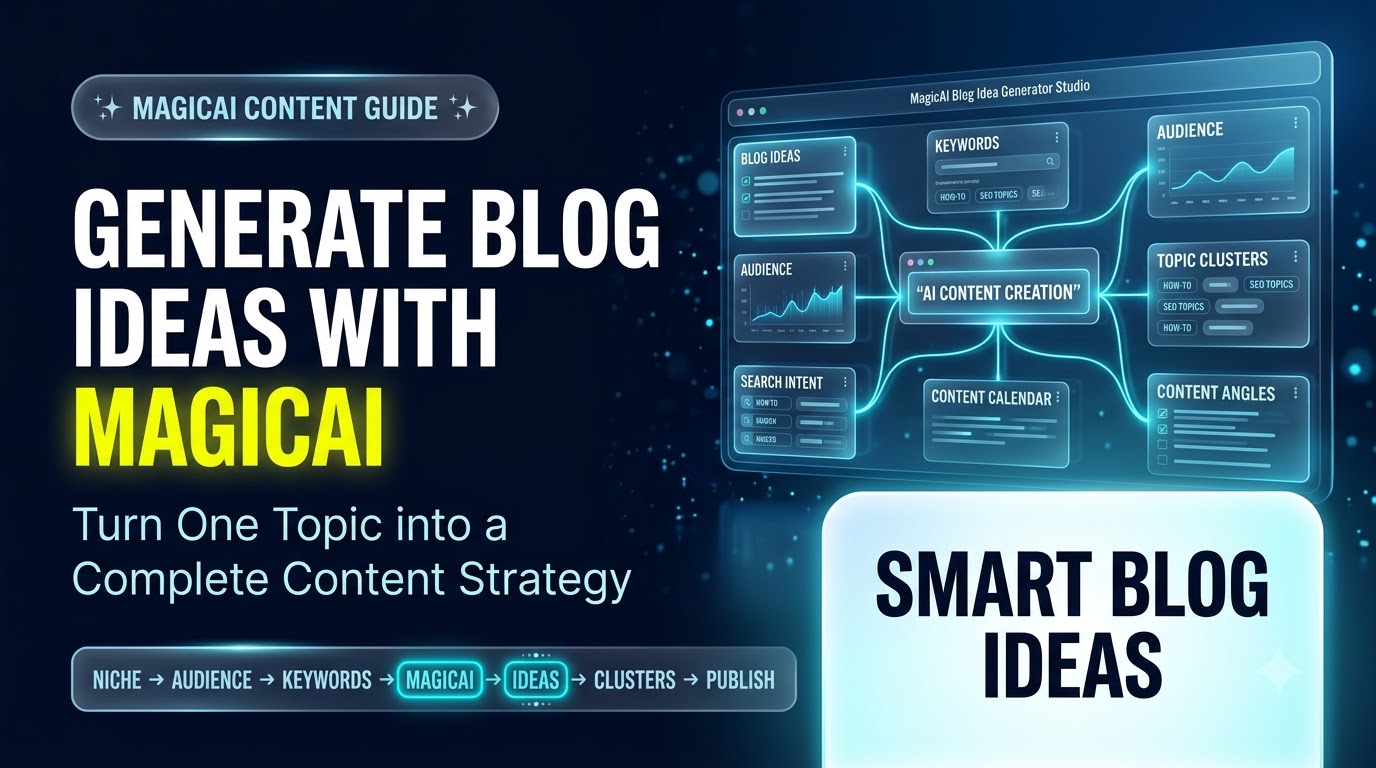
MagicAI can make the brainstorming process faster by generating blog ideas from a niche, target audience, keywords, customer problems, search intent, and content goals.
However, generating a large list of random topics is not the same as building a useful content strategy. Strong blog ideas should solve real problems, match audience interests, support search intent, and fit into the broader goals of a website.
This guide explains how to use MagicAI to generate better blog ideas, organize them into topic clusters, prioritize the strongest opportunities, and turn ideas into a practical SEO content plan.
What Is a Blog Idea?
A blog idea is a specific topic or content concept that can be developed into a useful article.
A good blog idea usually addresses at least one of the following:
- A question
- A customer problem
- A learning need
- A search query
- A comparison
- A practical task
- An industry trend
- A product-related question
- A common mistake
- A knowledge gap
For example, instead of using a broad topic such as:
“AI Writing”
you could create a more focused idea:
“How to Use AI Writing Tools to Create Better Product Descriptions”
The second topic gives the writer a clearer audience, purpose, and direction.
Can MagicAI Generate Blog Ideas?
Yes. MagicAI can be used as a brainstorming and content-planning assistant.
You can provide information such as:
- Website niche
- Industry
- Target audience
- Primary keywords
- Secondary keywords
- Customer questions
- Customer problems
- Existing content
- Business goals
- Search intent
- Product or service information
MagicAI can then generate:
- Blog topics
- Article titles
- Question-based ideas
- How-to topics
- Comparison topics
- Problem-solving articles
- Topic clusters
- Content angles
- Content-calendar ideas
The quality of the results depends heavily on the quality of the information included in the prompt.
Why Use MagicAI for Blog Ideas?
Faster Brainstorming
Instead of spending hours trying to think of new subjects, MagicAI can produce an initial collection of ideas quickly.
This gives writers a starting point that can then be researched and refined.
Multiple Content Angles
A single subject can produce many different article types.
For example, the broad topic AI content creation can become:
- Beginner’s guide
- How-to tutorial
- Benefits article
- Mistakes-to-avoid article
- Comparison
- Use-case guide
- FAQ
- Advanced strategy
- Workflow guide
Better Content Planning
MagicAI can help organize ideas into categories and topic clusters rather than leaving them as an unstructured list.
SEO-Focused Ideation
By providing keywords and search intent, you can ask MagicAI to generate ideas that are more closely aligned with your SEO strategy.
Content Scaling
Once you establish a useful prompt, the same framework can be adapted for multiple categories and content campaigns.
Step 1: Define Your Niche
Start by telling MagicAI exactly what your website or content strategy is about.
For example:
Niche: AI content creation
Instead of asking:
Give me blog ideas.
Use a more specific instruction:
Generate blog ideas for an AI content creation website targeting marketers, bloggers, small businesses, and content teams.
This provides context and helps MagicAI generate more relevant topics.
Step 2: Define Your Target Audience
The same subject can produce completely different blog ideas depending on the audience.
For beginners, useful topics may include:
- What is AI content writing?
- How does an AI writer work?
- How can beginners use AI writing tools?
For experienced marketers, topics may include:
- AI content workflows
- Content optimization
- SEO automation
- Content scaling
- AI-assisted editorial processes
Always tell MagicAI who the intended reader is.
Audience Prompt
My target audience is [AUDIENCE].

Generate blog topic ideas that address their common questions, problems, goals, and challenges.

Prioritize practical and educational topics instead of generic subjects.
Step 3: Start With a Broad Topic
Choose a broad subject related to your website.
For example:
Broad Topic: MagicAI
Possible subtopics include:
- MagicAI for beginners
- MagicAI for SEO
- MagicAI for ecommerce
- MagicAI for bloggers
- MagicAI for businesses
- MagicAI for product descriptions
- MagicAI for website content
These subtopics can become the foundation of a larger content cluster.
Step 4: Generate Different Content Angles
Ask MagicAI to approach the same subject from different perspectives.
Generate blog ideas about [TOPIC].

Create ideas across these content angles:

1. Beginner guides
2. How-to tutorials
3. Problem-solving articles
4. Tips and best practices
5. Mistakes to avoid
6. Comparisons
7. FAQs
8. Advanced strategies
9. Use cases
10. Industry-specific applications

Make every idea specific and useful.
This produces a more diverse content plan than simply requesting a list of titles.
Step 5: Use Keywords to Generate Blog Ideas
Keywords can provide useful starting points for content ideation.
For example:
Primary Keyword: MagicAI
Related Keywords:
- MagicAI AI writer
- MagicAI content generator
- AI content creation
- MagicAI SEO
- AI website content
- AI product descriptions
You can ask MagicAI to transform these keywords into meaningful article concepts.
Keyword-Based Prompt
Generate blog ideas based on the following keywords:

[KEYWORD LIST]

For each idea:
- Create a specific article topic.
- Identify the primary keyword.
- Suggest relevant secondary keywords.
- Identify the likely search intent.
- Avoid duplicate or overly similar topics.
Step 6: Focus on Search Intent
Search intent describes what a person is trying to accomplish when searching.
Common categories include:
| Search Intent | User Goal | Example Topic |
|---|---|---|
| Informational | Learn something | What Is AI Content Generation? |
| Navigational | Find a specific resource | MagicAI Login Guide |
| Commercial | Compare or evaluate | Best AI Writing Tools |
| Transactional | Take an action | AI Content Generator for Websites |
Ask MagicAI to identify the likely intent for each topic.
This can make your content planning more strategic.
Step 7: Generate Question-Based Blog Ideas
Questions are an excellent source of blog topics because they reflect information people may want to understand.
Use this prompt:
Generate 50 questions that beginners, customers, marketers, and business owners may ask about [TOPIC].

Group the questions into:

- Beginner questions
- How-to questions
- Problem-solving questions
- Comparison questions
- Advanced questions
These questions can become individual articles or sections within larger guides.
Step 8: Generate How-To Topics
How-to content focuses on helping readers accomplish a specific task.
Examples include:
- How to Generate Blog Ideas with MagicAI
- How to Create Website Content with MagicAI
- How to Write Product Descriptions with MagicAI
- How to Create SEO Meta Titles with MagicAI
- How to Improve Existing Content with MagicAI
Use a practical prompt:
Generate 30 how-to blog ideas about [TOPIC].

Each idea should solve a specific problem or help the reader complete a practical task.

Avoid vague topics and make each idea specific enough to become a complete article.
Step 9: Generate List-Style Topics
List articles can make useful and easy-to-scan content.
Examples:
- 10 Ways to Use MagicAI for Content Creation
- 15 Blog Writing Tips for Beginners
- 20 AI Content Ideas for Small Businesses
The number itself should not be the main attraction. Every item should provide meaningful value.
Step 10: Generate Comparison Topics
Comparison content can be useful for readers evaluating different options.
Examples include:
- MagicAI vs Traditional Content Creation
- AI Writing vs Manual Writing
- MagicAI vs Other AI Writing Tools
- AI Content Generation vs Freelance Writing
Comparison articles should use accurate information and clearly defined criteria.
Step 11: Generate Mistake-Based Topics
Mistake-based articles address common problems and show readers how to avoid them.
Examples:
- Common AI Content Writing Mistakes
- SEO Mistakes to Avoid When Using AI
- Product Description Mistakes That Reduce Content Quality
- Common Blog Writing Mistakes for Beginners
Prompt
Generate blog topics about common mistakes people make when using [TOPIC].

Focus on practical problems and explainable solutions.

Avoid exaggerated or fear-based titles.
Step 12: Build Topic Clusters
One of the most useful ways to use MagicAI is to turn one broad subject into a connected group of articles.
Pillar Topic
MagicAI Content Creation: Complete Guide
Supporting Topics
- How to Write Articles with MagicAI
- How to Generate Blog Ideas with MagicAI
- How to Create Product Descriptions with MagicAI
- How to Create Website Content with MagicAI
- How to Create SEO Meta Titles with MagicAI
- How to Improve AI-Generated Content
- Common AI Content Writing Mistakes
These articles can be internally linked to create a stronger topical structure.
Step 13: Generate Content Clusters With MagicAI
Use a prompt like this:
Create a complete SEO content cluster around the main topic:

[MAIN TOPIC]

Provide:

1. One pillar article
2. 15 supporting blog topics
3. Primary keyword for each topic
4. Search intent
5. Suggested content angle
6. Suggested internal-link relationship

Avoid overlapping topics and make every article target a distinct purpose.
Step 14: Find Potential Content Gaps
If you already have many articles, do not keep generating random topics.
Instead, provide MagicAI with your existing content.
Here is a list of articles already published:

[ARTICLE LIST]

Analyze these topics and suggest new blog ideas that:

- Cover missing subtopics.
- Answer additional audience questions.
- Avoid duplicating existing articles.
- Expand the existing content cluster.
- Target useful search intent.
This can help identify areas where your content library may need expansion.
Step 15: Generate Ideas for Different Funnel Stages
A strong content strategy can address different stages of the customer journey.
Awareness
Help readers understand a problem.
Examples:
- What Is AI Content Creation?
- How Does AI Writing Work?
Consideration
Help readers evaluate possible solutions.
Examples:
- AI Writing Tools vs Traditional Writing
- Benefits of AI Content Generation
Decision
Help readers choose an approach or solution.
Examples:
- How to Choose an AI Content Generator
- What Features Should an AI Writing Tool Have?
Retention
Help existing users get more value.
Examples:
- Advanced MagicAI Workflows
- How to Improve Your MagicAI Content Results
This creates a balanced content strategy instead of publishing only promotional articles.
Step 16: Generate Seasonal and Timely Ideas
MagicAI can also help brainstorm seasonal content around:
- Holidays
- Annual planning
- Industry events
- Seasonal buying periods
- Product launches
- Recurring business cycles
For time-sensitive topics, verify current dates, trends, and facts before publication.
Step 17: Generate Ideas From Customer Problems
Some of the strongest blog topics start with a problem rather than a keyword.
For example:
Problem: Writing product descriptions takes too long.
Possible article:
How to Create Product Descriptions Faster with MagicAI
Use this prompt:
List 30 common problems faced by [TARGET AUDIENCE] when dealing with [TOPIC].

Then convert each problem into a useful, specific blog topic.

Prioritize problems that can be solved with practical advice.
Step 18: Score and Prioritize Blog Ideas
Generating ideas is only the beginning.
Ask MagicAI to evaluate ideas based on:
- Audience relevance
- Business relevance
- Search-intent clarity
- Originality
- Content depth
- Internal-link potential
- Conversion potential
Example:
Score these blog ideas from 1 to 10 based on:

- Audience relevance
- SEO potential
- Business relevance
- Search intent clarity
- Originality
- Ability to provide practical value

Then rank them from highest to lowest priority and explain the top five.

Treat the scores as planning suggestions rather than verified SEO metrics.
Step 19: Turn One Idea Into Multiple Content Formats
A single strong topic can support multiple pieces of content.
For example:
Main Topic: AI Product Descriptions
Possible formats include:
- Blog article
- Beginner guide
- Checklist
- FAQ
- Comparison
- Email topic
- Social media post
- Video script
- Case-study angle
This allows one research topic to support a broader content campaign.
Step 20: Generate Better Blog Titles
After selecting a topic, ask MagicAI to create multiple title variations.
Create 15 title variations for this blog topic:

[TOPIC]

Include a mix of:

- How-to titles
- Benefit-driven titles
- Number-based titles
- Beginner-friendly titles
- Question-based titles

Keep every title accurate and avoid clickbait.
Common Mistakes When Generating Blog Ideas With MagicAI
Generating Random Topics
A large list does not automatically equal a good content strategy.
Better: Provide your niche, audience, keywords, and goals.
Ignoring Search Intent
A keyword alone does not explain what the searcher wants.
Better: Determine the likely purpose behind the search.
Creating Duplicate Topics
Several articles may end up targeting nearly the same question.
Better: Compare new ideas against existing content before publishing.
Chasing Only High-Volume Keywords
Popular keywords can be competitive and may not always be the best fit.
Better: Combine broad topics with specific, useful long-tail subjects.
Publishing Only Promotional Content
A blog should provide genuine value rather than turning every article into a sales pitch.
Better: Balance educational, problem-solving, commercial, and product-support content.
Publishing AI Ideas Without Validation
A topic can sound interesting without being useful to the audience.
Better: Research and validate promising ideas before writing the full article.
MagicAI Master Prompt for Blog Ideas
Act as an experienced SEO content strategist and blog planner.

Generate a strategic list of blog ideas for the following website:

INDUSTRY:
[INDUSTRY]

WEBSITE TOPIC:
[TOPIC]

TARGET AUDIENCE:
[AUDIENCE]

BUSINESS GOALS:
[GOALS]

PRIMARY KEYWORDS:
[KEYWORDS]

EXISTING CONTENT:
[EXISTING TOPICS]

Generate 30 unique blog ideas.

For each idea, provide:

1. Blog title
2. Primary keyword
3. Secondary keywords
4. Search intent
5. Target audience
6. Content angle
7. Funnel stage
8. One-sentence description

Requirements:

- Avoid duplicate or overlapping topics.
- Prioritize useful and specific subjects.
- Mix beginner, intermediate, and advanced topics.
- Include how-to, problem-solving, comparison, educational, and FAQ-style ideas.
- Keep topics relevant to the business.
- Avoid clickbait.
- Do not invent search-volume statistics.
A Practical Blog-Idea Workflow
A repeatable workflow can look like this:
NICHE → AUDIENCE → PROBLEMS → KEYWORDS → SEARCH INTENT → MAGICAI → TOPIC CLUSTERS → PRIORITIZE → RESEARCH → CONTENT BRIEF → WRITE
This approach is more useful than simply asking an AI tool for random titles.
Benefits of Using MagicAI for Blog Planning
MagicAI can help content teams:
- Brainstorm faster
- Discover different content angles
- Organize topic clusters
- Generate question-based ideas
- Develop keyword-focused topics
- Identify potential content gaps
- Create content calendars
- Expand existing topic clusters
- Generate title variations
- Plan content for different funnel stages
The biggest benefit is not simply generating more ideas. It is turning brainstorming into a structured content-planning process.
FAQs
Can MagicAI generate blog ideas?
Yes. MagicAI can generate blog ideas based on a niche, audience, keywords, problems, search intent, and content goals.
Can MagicAI generate SEO blog topics?
Yes. You can provide keywords and search-intent information and ask MagicAI to generate topics aligned with your SEO strategy.
How many blog ideas should I generate at once?
Generating 20–50 ideas can be useful for planning, but the ideal number depends on your publishing schedule and content strategy.
Can MagicAI create content clusters?
Yes. You can give MagicAI a broad topic and ask it to create a pillar article with supporting topics and internal-link relationships.
Can MagicAI help find content gaps?
It can help identify potential missing subjects when you provide your existing content and ask it to suggest related topics that are not already covered.
Should I publish every blog idea MagicAI generates?
No. AI-generated ideas should be treated as suggestions. Validate the strongest topics using audience needs, search intent, business relevance, existing content, and research.
Can MagicAI generate blog ideas for different industries?
Yes. MagicAI can adapt topic ideas to industries such as ecommerce, technology, education, manufacturing, marketing, food, SaaS, and many others when given enough context.
Final Verdict
MagicAI can make blog ideation much faster and more organized. Instead of starting with a blank content calendar, you can use it to explore audience problems, keywords, questions, search intent, content angles, and topic clusters.
The strongest approach is to use MagicAI as a strategic brainstorming assistant, not as a replacement for SEO research or editorial judgment.
A practical workflow is:
NICHE → AUDIENCE → PROBLEMS → KEYWORDS → INTENT → MAGICAI → CLUSTERS → PRIORITIZE → RESEARCH → PUBLISH
With the right prompts and human validation, MagicAI can help turn a single broad subject into a complete pipeline of useful, relevant, and SEO-focused blog topics.