
Introduction
Long-form articles can provide readers with comprehensive answers to complex questions, but producing them consistently requires planning, research, organization, and considerable writing time.
MagicAI can assist with the long-form content creation process by helping develop article ideas, create detailed outlines, expand individual sections, generate examples, improve readability, and optimize content for search intent.
However, a long article is not automatically a high-quality article. Adding words without adding useful information can create unnecessary filler and make the content harder to read.
The goal should be to create comprehensive content that is useful, organized, accurate, and easy to navigate.
This guide explains how to use MagicAI to create long-form articles from initial research and planning through writing, editing, SEO optimization, and final publication.
What Is Long-Form Content?
Long-form content is detailed content that explores a topic comprehensively rather than answering only one narrow question.
A long-form article may include:
- Introduction
- Background information
- Definitions
- Step-by-step instructions
- Examples
- Comparisons
- Tables
- Expert insights
- FAQs
- Common mistakes
- Best practices
- Conclusion
There is no universal word count that automatically makes an article long-form.
A useful long-form article should be as detailed as the topic requires, rather than being artificially extended to reach a particular word count.
Can MagicAI Create Long-Form Articles?
Yes. MagicAI can assist with long-form article creation, but the best results usually come from breaking the writing process into manageable stages.
Instead of asking:
Write a 5,000-word article about AI content creation.
A better workflow is:
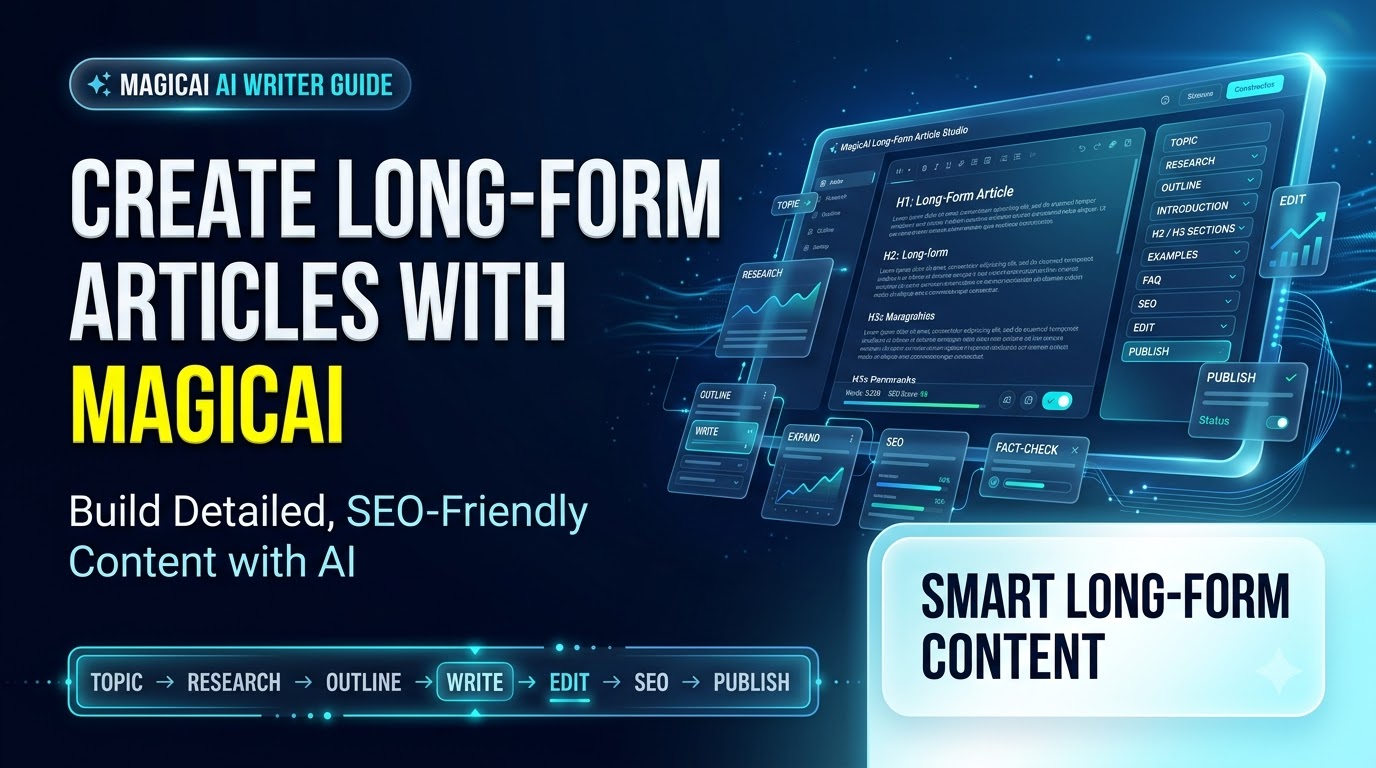
TOPIC → RESEARCH → SEARCH INTENT → OUTLINE → SECTION PROMPTS → MAGICAI → EDIT → FACT-CHECK → SEO → FINAL REVIEW
This gives you greater control over structure, accuracy, and content quality.
Why Use MagicAI for Long-Form Articles?
Faster Content Development
MagicAI can help produce first drafts and section-level content much faster than starting entirely from scratch.
Detailed Outlining
You can use MagicAI to organize complex subjects into logical sections before writing.
Consistent Structure
A detailed prompt can help maintain consistent formatting, tone, and organization throughout a long article.
Easier Section Expansion
Individual sections can be expanded with examples, explanations, comparisons, and practical instructions.
SEO Content Support
MagicAI can help organize keywords, headings, FAQs, and search-intent-focused sections.
Content Repurposing
Long-form research can later be adapted into:
- Short blog posts
- FAQs
- Social media content
- Email content
- Guides
- Checklists
- Video scripts
Step 1: Choose a Focused Topic
Start with a topic that is specific enough to support a complete article.
For example:
Too broad:
AI
Better:
AI Content Creation for Small Businesses
More focused:
How Small Businesses Can Use AI to Create Website Content
A focused topic makes it easier to determine what should and should not be included.
Step 2: Define the Search Intent
Before writing, determine what the reader wants to accomplish.
Common search intents include:
| Intent | Reader Goal | Example |
|---|---|---|
| Informational | Learn | What Is Long-Form Content? |
| Commercial | Evaluate | Best AI Writing Tools |
| Transactional | Take action | AI Content Generator |
| Navigational | Find a resource | MagicAI AI Writer |
For long-form articles, informational intent is particularly common, but commercial and practical intent can also be addressed when relevant.
Step 3: Define Your Target Audience
Tell MagicAI who will read the article.
For example:
Target audience: Beginners, bloggers, marketers, small businesses, and content teams.
Then instruct MagicAI to use an appropriate knowledge level.
Audience Prompt
Create long-form content for the following audience:

TARGET AUDIENCE:
[DESCRIBE AUDIENCE]

Assume the reader has [BEGINNER / INTERMEDIATE / ADVANCED] knowledge.

Use terminology appropriate for the audience and explain unfamiliar concepts clearly.
Step 4: Research the Topic Before Writing
AI-generated content should not be treated as a substitute for research.
Before creating the final article, collect reliable information about:
- Main topic
- Important subtopics
- Industry terminology
- Current facts
- Relevant examples
- Search intent
- Existing content
- Frequently asked questions
For time-sensitive or factual topics, verify information using reliable sources before publication.
Step 5: Create a Detailed Outline
A strong outline is the foundation of a good long-form article.
Ask MagicAI to create:
- H1 title
- H2 sections
- H3 subsections
- Key points
- Examples
- Tables
- FAQs
- Conclusion
Outline Prompt
Create a detailed outline for a comprehensive article about:

[TOPIC]

Target audience:
[AUDIENCE]

Primary keyword:
[PRIMARY KEYWORD]

Search intent:
[SEARCH INTENT]

Create:

- H1 title
- Introduction
- H2 sections
- H3 subsections where useful
- Practical examples
- Tables or comparison sections where appropriate
- FAQs
- Conclusion

Make sure every section serves a clear purpose and avoid overlapping topics.
Step 6: Build a Content Brief
Before writing the article, create a content brief.
Include:
- Primary keyword
- Secondary keywords
- Search intent
- Target audience
- Article objective
- Main questions
- Key sections
- Internal-link opportunities
- Desired tone
- Content requirements
This gives MagicAI a clear framework.
Step 7: Create the Article Section by Section
For long-form content, section-by-section generation often provides better control than requesting the entire article in one prompt.
A practical process is:
Introduction → H2 Section 1 → H2 Section 2 → H2 Section 3 → H2 Section 4 → FAQs → Conclusion
After generating each section, review it before continuing.
This helps prevent:
- Repetition
- Topic drift
- Contradictions
- Unnecessary filler
- Inconsistent tone
Step 8: Write a Strong Introduction
The introduction should quickly establish:
- What the topic is
- Why it matters
- What problem the reader has
- What the article will explain
Prompt
Write an introduction for a long-form article about [TOPIC].

The introduction should:

- Clearly introduce the topic.
- Address the reader's main problem or goal.
- Explain why the topic matters.
- Naturally introduce the primary keyword.
- Tell readers what they will learn.
- Avoid generic filler.
Step 9: Expand Each Section With Useful Information
Do not ask MagicAI to simply make sections longer.
Instead, specify what additional value should be included.
For example:
Expand this section about [SUBTOPIC].

Include:

- A clear explanation
- Practical steps
- One relevant example
- Important considerations
- Common mistakes where appropriate

Do not repeat information already covered in previous sections.
Do not add unsupported facts.
This creates meaningful depth instead of artificial length.
Step 10: Use Examples
Examples make long-form articles easier to understand.
For example, an article about AI content creation could include:
Concept: Content brief
Example: A sample content brief showing the topic, audience, keyword, intent, outline, and tone.
Ask MagicAI to provide practical examples where they genuinely improve understanding.
Step 11: Use Tables Where They Add Value
Tables can make complex information easier to compare.
For example:
| Content Stage | Purpose | Example |
|---|---|---|
| Research | Gather information | Topic research |
| Planning | Organize content | Article outline |
| Writing | Create draft | MagicAI generation |
| Editing | Improve quality | Human review |
| SEO | Optimize discovery | Keywords and metadata |
Avoid adding tables simply to make the article look longer.
Step 12: Add FAQs
FAQs can address questions that are related to the main topic but may not require separate sections.
Prompt:
Generate 8 useful FAQs for an article about [TOPIC].

Questions should:
- Be relevant to the target audience.
- Address practical concerns.
- Avoid repeating the main article sections.
- Have concise but useful answers.

Do not invent facts.
Step 13: Maintain Consistent Tone
Long articles can become inconsistent when different sections are generated separately.
Give MagicAI a clear style guide.
For example:
Maintain this writing style throughout the article:

- Professional
- Clear
- Educational
- Practical
- Conversational but not casual
- Concise where possible
- Free from unnecessary jargon

Keep terminology and formatting consistent across every section.
Step 14: Prevent Repetition
Long-form articles often repeat the same idea across multiple sections.
After generating the draft, ask MagicAI to identify repeated information.
Review this long-form article for repetitive ideas.

Identify:
- Repeated explanations
- Duplicate examples
- Overlapping sections
- Repeated conclusions

Suggest specific sections that can be combined, shortened, or rewritten.

Do not remove unique information.
Step 15: Add Original Insights
AI-generated content becomes more valuable when combined with genuine expertise and experience.
Consider adding:
- Your own observations
- Original examples
- Industry experience
- Case studies
- Customer questions
- Unique processes
- Expert opinions
- Lessons learned
MagicAI can help organize these insights, but original expertise should come from the people or organization publishing the content.
Step 16: Optimize Long-Form Content for SEO
SEO optimization should happen naturally throughout the article.
Focus on:
- Search intent
- Primary keyword
- Secondary keywords
- Descriptive headings
- Useful content
- Internal links
- Meta title
- Meta description
- URL
- FAQs
- Readability
Avoid forcing keywords into every paragraph.
SEO Prompt
Review this long-form article for SEO.

Primary keyword:
[PRIMARY KEYWORD]

Secondary keywords:
[SECONDARY KEYWORDS]

Search intent:
[SEARCH INTENT]

Improve:

- Heading structure
- Keyword relevance
- Search-intent alignment
- Internal-link opportunities
- Readability
- Content organization
- Meta title
- Meta description

Do not keyword-stuff.
Do not change the article's factual meaning.
Step 17: Improve Internal Linking
Long-form articles often provide excellent opportunities for internal links.
Look for sections where another article could provide additional information.
For example:
Article: How to Create Long-Form Articles with MagicAI
Potential related articles:
- How to Write SEO-Friendly Articles with MagicAI
- How to Generate Blog Ideas with MagicAI
- How to Create High-Quality Content with MagicAI
- How to Rewrite Content Using MagicAI AI Writer
- How to Create SEO Meta Titles and Descriptions with MagicAI
Internal links should be relevant and useful rather than added simply to increase link count.
Step 18: Create a Strong Conclusion
A long article should end by summarizing the most important ideas.
Conclusion Prompt
Write a concise conclusion for this long-form article.

The conclusion should:

- Summarize the main lessons.
- Reinforce the practical workflow.
- Avoid introducing major new topics.
- Give the reader a clear takeaway.
- Maintain the same tone as the article.
Step 19: Fact-Check the Draft
AI-generated content can contain inaccurate or outdated information.
Check:
- Statistics
- Dates
- Product specifications
- Names
- Technical claims
- Industry regulations
- Research references
- Current features
- Pricing
- Examples presented as facts
If information cannot be verified, remove it or rewrite it appropriately.
Step 20: Perform a Final Quality Review
Before publishing, review the complete article.
Long-Form Content Checklist
- Is the article answering the intended search query?
- Is the introduction useful?
- Does every section add value?
- Are headings logical?
- Is the information accurate?
- Is there unnecessary repetition?
- Are examples relevant?
- Are keywords natural?
- Are internal links useful?
- Is the tone consistent?
- Is the conclusion effective?
- Is the article easy to scan?
- Are factual claims verified?
- Does the article provide something useful beyond generic AI-generated information?
MagicAI Master Prompt for Long-Form Articles
Act as an expert SEO content strategist and professional long-form writer.

Create a comprehensive article about:

TOPIC:
[TOPIC]

PRIMARY KEYWORD:
[PRIMARY KEYWORD]

SECONDARY KEYWORDS:
[SECONDARY KEYWORDS]

TARGET AUDIENCE:
[TARGET AUDIENCE]

SEARCH INTENT:
[SEARCH INTENT]

ARTICLE GOAL:
[ARTICLE GOAL]

TONE:
[PROFESSIONAL / EDUCATIONAL / CONVERSATIONAL / OTHER]

Create a detailed, well-structured long-form article.

Requirements:

1. Create a compelling introduction.
2. Use a logical H2 and H3 structure.
3. Cover the topic comprehensively.
4. Explain complex concepts clearly.
5. Include practical examples where useful.
6. Use tables or bullet lists when they improve readability.
7. Avoid unnecessary repetition.
8. Keep every section focused on the main topic.
9. Use keywords naturally.
10. Align the article with search intent.
11. Include relevant FAQs.
12. End with a useful conclusion.
13. Do not invent statistics, research, quotes, or factual claims.
14. Clearly distinguish examples from factual information.
15. Maintain a consistent professional tone.
16. Prioritize usefulness and depth over arbitrary word count.

After creating the article, provide:
- Suggested meta title
- Suggested meta description
- Suggested URL
- Primary keyword
- Secondary keywords
- Suggested internal-link opportunities
A Practical Long-Form Article Workflow
A reliable process looks like this:
TOPIC → AUDIENCE → INTENT → RESEARCH → KEYWORDS → OUTLINE → CONTENT BRIEF → MAGICAI → SECTION WRITING → HUMAN EXPERTISE → FACT-CHECK → SEO → EDIT → FINAL REVIEW → PUBLISH
This workflow provides more control than asking MagicAI to generate an entire long article without preparation.
Common Mistakes When Creating Long-Form Articles With MagicAI
Chasing a Word Count
A 5,000-word article is not automatically better than a 2,000-word article.
Better: Write enough to comprehensively satisfy the topic.
Generating Everything in One Prompt
Large one-shot prompts can produce repetition and inconsistent sections.
Better: Create the outline first and generate major sections individually.
Adding Filler
Long introductions, repetitive explanations, and unnecessary examples reduce quality.
Better: Every section should have a clear purpose.
Ignoring Research
AI-generated information may be incomplete or outdated.
Better: Research and verify important claims.
Forgetting Original Expertise
Generic AI content can lack firsthand experience.
Better: Add original examples, insights, processes, and expert knowledge.
Overusing Keywords
Repeated keywords can make an article awkward.
Better: Prioritize natural language and search intent.
Skipping the Final Edit
A generated article still needs editorial review.
Better: Read the complete article as a human reader before publishing.
Benefits of Long-Form Content Created With MagicAI
MagicAI can support:
- Faster article planning
- Detailed content outlines
- Section-by-section drafting
- Topic expansion
- Example generation
- FAQ development
- Content restructuring
- SEO optimization
- Internal-link planning
- Content repurposing
- Readability improvements
- Content updates
The biggest advantage is not simply producing more words. It is making the planning and drafting process more manageable.
MagicAI Long-Form Content vs Manual Writing
| Factor | MagicAI-Assisted | Manual |
|---|---|---|
| Initial drafting speed | Fast | Slower |
| Outline generation | Fast | Manual |
| Idea expansion | Strong | Depends on writer |
| Research judgment | Requires human review | Human-controlled |
| Original expertise | Requires human input | Strong potential |
| Fact-checking | Required | Required |
| Brand voice | Prompt-dependent | Writer-controlled |
| Final editing | Necessary | Necessary |
The strongest workflow combines AI assistance with human expertise, research, and editorial judgment.
FAQs
Can MagicAI create long-form articles?
Yes. MagicAI can assist with long-form articles by generating outlines, sections, explanations, examples, FAQs, and drafts.
How long should a MagicAI article be?
There is no universal ideal word count. The article should be long enough to answer the searcher’s needs comprehensively without adding unnecessary filler.
Is it better to generate a long article all at once?
For complex articles, generating the outline first and then writing section by section often provides better control over quality and consistency.
Can MagicAI create SEO-friendly long-form content?
Yes. You can provide keywords, search intent, audience information, and SEO requirements to guide the writing process.
Can MagicAI research information for a long article?
MagicAI can help organize and develop information, but important facts, statistics, current information, and technical claims should be independently verified before publication.
How can I prevent repetitive AI content?
Use a detailed outline, instruct MagicAI to avoid overlapping sections, and perform a final review specifically for repeated ideas.
Should I add human-written content to a MagicAI article?
Yes. Original expertise, examples, experiences, opinions, and verified insights can make the article more useful and distinctive.
Can one long-form article be turned into multiple pieces of content?
Yes. A long-form article can provide material for FAQs, short articles, social posts, email content, checklists, videos, and other formats.
Final Verdict
MagicAI can make long-form article creation faster and more manageable, especially during brainstorming, outlining, drafting, rewriting, and optimization.
The key is not to ask AI to produce thousands of words and publish the result immediately. A stronger approach is to plan the topic, understand the audience and search intent, build a detailed outline, generate content section by section, add original expertise, verify facts, and perform a thorough editorial review.
A practical workflow is:
TOPIC → INTENT → RESEARCH → OUTLINE → MAGICAI → HUMAN EXPERTISE → FACT-CHECK → SEO → EDIT → PUBLISH
When used this way, MagicAI can support the creation of detailed long-form articles that are organized, useful, readable, and aligned with the needs of both readers and search engines.