
Introduction
Content creation has traditionally depended on human writers, editors, designers, marketers, and other creative professionals. From brainstorming an idea to researching a topic, writing a first draft, editing the content, optimizing it, and publishing it, the process can require considerable time and coordination.
AI-powered platforms such as MagicAI have introduced another approach.
Instead of relying entirely on manual production, businesses and content teams can use AI to accelerate repetitive stages of the workflow. MagicAI can assist with tasks such as writing, content generation, editing, marketing copy, SEO-oriented content, product descriptions, social media content, and content repurposing.
This creates an important question:
How is MagicAI different from traditional content creation?
The answer is not simply that AI is faster. The real difference is in how the content-production workflow is structured, where human effort is applied, how quickly content can be scaled, and how repetitive tasks are handled.
This guide compares MagicAI and traditional content creation across speed, cost, quality, creativity, scalability, workflow, SEO, personalization, and human involvement.
What Is Traditional Content Creation?
Traditional content creation is a primarily human-led process.
A typical workflow might look like:
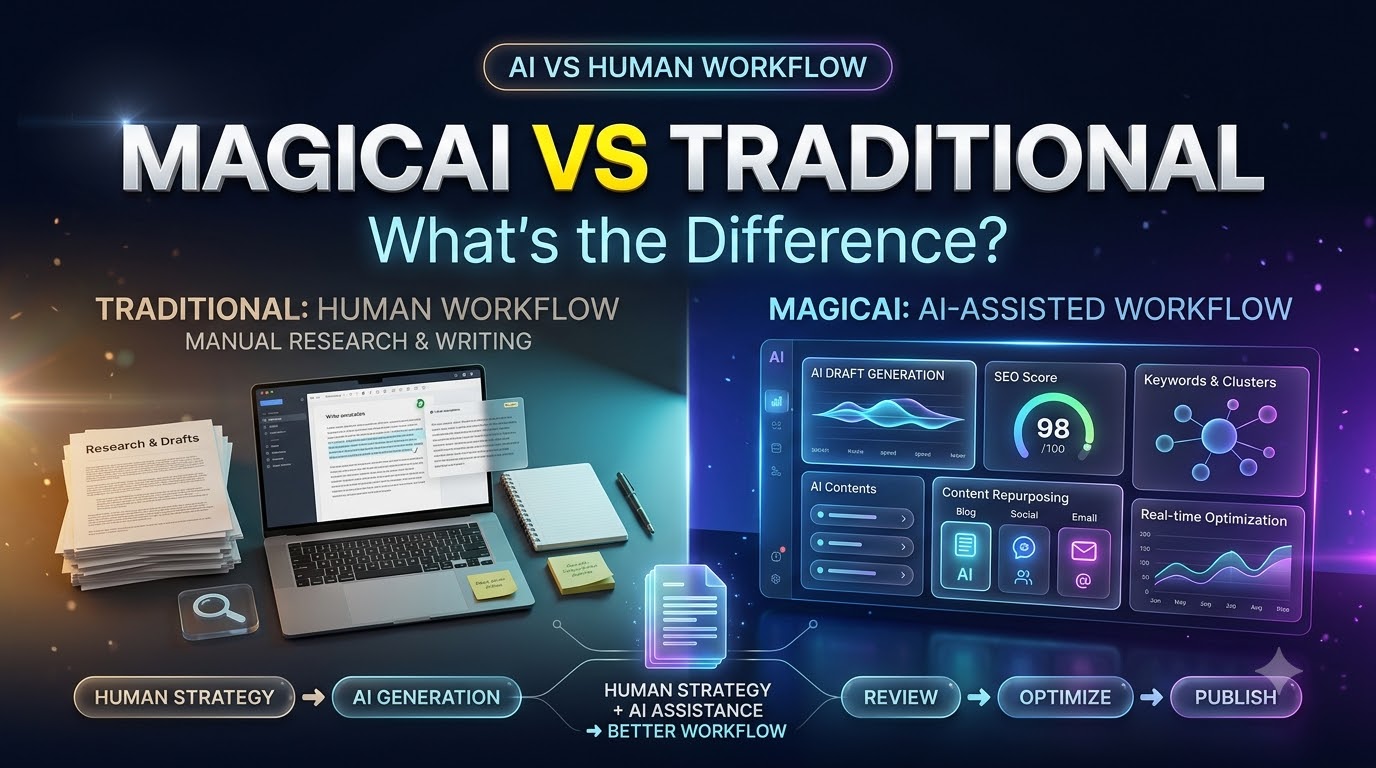
IDEA → RESEARCH → OUTLINE → WRITE → EDIT → SEO → DESIGN → PUBLISH
Depending on the project, several people may be involved.
For example:
- A marketing manager chooses the topic.
- An SEO specialist performs keyword research.
- A writer creates the draft.
- An editor reviews the content.
- A designer creates visuals.
- A publisher uploads the final content.
This approach offers strong human control, but it can also require significant time and coordination.
What Is MagicAI Content Creation?
MagicAI represents an AI-assisted approach to content production.
Instead of requiring every stage to be performed manually, AI can assist with repetitive tasks.
A simplified workflow looks like:
PROMPT → AI GENERATION → HUMAN REVIEW → OPTIMIZATION → PUBLISH
The AI can help produce an initial draft, generate variations, transform content into different formats, or assist with editing.
The human still controls the strategy, verifies information, adds expertise, and approves the final result.
MagicAI vs Traditional Content Creation at a Glance
| Factor | MagicAI-Assisted Creation | Traditional Creation |
|---|---|---|
| First Draft Speed | Very fast | Usually slower |
| Brainstorming | AI-assisted | Human-led |
| Research | AI can assist | Primarily manual/tools |
| Writing | AI-assisted | Human-led |
| Editing | AI + human | Primarily human |
| Scalability | High | Depends on team capacity |
| Repetitive Tasks | Highly suitable for AI | More manual |
| Creativity | AI-assisted + human direction | Strong human control |
| Brand Voice | Requires clear instructions/review | Direct human control |
| Accuracy | Requires verification | Human-controlled |
| Cost Structure | Can reduce repetitive production effort | Often tied to labor hours |
| Final Quality | Depends on prompting and review | Depends on writer/editor expertise |
| Human Involvement | Essential | Essential |
Neither method is automatically better for every situation. The right choice depends on the content type, goals, resources, and quality requirements.
1. Speed: MagicAI vs Traditional Writing
Speed is one of the most obvious differences.
Traditional content creation requires a writer to research, plan, draft, revise, and format content.
AI can generate a first draft much faster.
For example, instead of starting with a blank document, a writer can provide MagicAI with:
- Topic
- Target audience
- Content goal
- Tone
- Keywords
- Required sections
- Word-count range
The AI can then generate a starting point.
This does not mean the final article should be published immediately. The biggest time-saving opportunity comes from reducing the time required to produce the first usable draft.
Traditional Workflow
Research → Outline → Write → Rewrite → Edit
AI-Assisted Workflow
Prompt → Generate → Review → Improve
The second workflow can significantly reduce repetitive drafting work.
2. Research and Information Gathering
Traditional writers often spend considerable time gathering information before writing.
They may use:
- Search engines
- Industry publications
- Company documents
- Research reports
- Product documentation
- Expert interviews
AI can assist with information organization and topic exploration.
However, there is an important distinction:
AI-generated information should not automatically be treated as verified information.
For factual, technical, financial, medical, legal, or product-specific content, reliable sources and human verification remain important.
MagicAI can therefore be useful as a research and organization assistant, but businesses should maintain an appropriate verification process.
3. Cost Differences
Traditional content creation often has a labor-based cost structure.
Businesses may pay:
- Writers
- Editors
- SEO specialists
- Designers
- Agencies
- Freelancers
The total cost increases as content volume increases.
AI changes the workflow by reducing the amount of repetitive manual work required for certain tasks.
However, AI does not necessarily eliminate human costs.
Businesses may still need:
- Writers
- Editors
- Subject-matter experts
- SEO professionals
- Marketing strategists
- Designers
The better way to evaluate cost is therefore:
Cost per completed, quality-approved content asset
rather than simply comparing the cost of AI with the hourly cost of a writer.
4. Scalability
Traditional content production is limited by team capacity.
If a company wants to double its publishing volume, it may need additional writers or freelancers.
AI-assisted workflows can make it easier to increase production without increasing manual drafting effort at the same rate.
For example, an e-commerce company with 2,000 products could use structured product information and AI-assisted workflows to create initial descriptions at scale.
The process could become:
PRODUCT DATA → AI DRAFT → HUMAN REVIEW → SEO → PUBLISH
This makes AI particularly useful for repetitive content tasks.
5. Creativity
Creativity is one area where comparisons become more complicated.
Human creators bring:
- Personal experience
- Cultural understanding
- Original ideas
- Emotional intelligence
- Brand knowledge
- Strategic thinking
- Unique perspectives
AI can generate variations and combinations quickly, but it does not replace the value of genuine human insight.
MagicAI is therefore often most effective when humans provide the creative direction and AI helps execute or expand that direction.
Strong Combination
Human Strategy + AI Assistance + Human Refinement
This approach combines efficiency with originality.
6. Content Quality
Traditional content is directly controlled by the writer and editor.
AI-generated content depends heavily on:
- Prompt quality
- Input information
- Model capabilities
- Review process
- Editing
- Fact-checking
A weak prompt can produce generic content.
A detailed prompt combined with accurate source information can produce a much stronger starting point.
For example:
Weak Prompt
Write about digital marketing.
Better Prompt
Write a 1,500-word guide to digital marketing for small-business owners. Explain SEO, social media, email marketing, content marketing, and paid advertising. Include practical examples, common mistakes, and actionable recommendations. Use a professional but beginner-friendly tone.
The second prompt gives the AI much more direction.
7. Brand Voice and Consistency
Traditional writers can learn a company’s tone through brand guidelines and experience.
AI can also follow brand instructions, but the instructions need to be clearly defined.
A business can create a reusable style prompt containing:
- Tone
- Vocabulary
- Sentence style
- Audience
- Words to avoid
- Brand positioning
- Formatting preferences
For example:
Write in a professional, confident, and approachable B2B tone. Avoid exaggerated claims and unnecessary marketing language. Use short paragraphs and practical examples.
This can help standardize AI-generated content.
However, human review remains important for maintaining a consistent brand identity.
8. SEO Content Creation
Traditional SEO content production often involves separate stages:
KEYWORD RESEARCH → SEARCH INTENT → OUTLINE → WRITING → OPTIMIZATION → EDITING
MagicAI can assist with several writing-related stages.
For example, it can help generate:
- Article outlines
- Draft sections
- FAQs
- Meta description ideas
- SEO-friendly titles
- Supporting content
- Topic variations
But AI should not be treated as an automatic SEO strategy.
Good SEO still requires:
- Search-intent analysis
- Quality research
- Helpful information
- Internal linking
- Technical SEO
- Content originality
- User experience
AI can accelerate production, but strategy still matters.
9. Product Content
Product descriptions are an excellent example of where AI-assisted content creation can outperform purely manual production in terms of efficiency.
Traditional process:
PRODUCT INFORMATION → WRITER → DRAFT → EDITOR → SEO → PUBLISH
AI-assisted process:
PRODUCT INFORMATION → MAGICAI → REVIEW → SEO → PUBLISH
The AI can create the first draft while a human checks:
- Specifications
- Features
- Benefits
- Applications
- Technical details
- Claims
This can be particularly useful for businesses with large product catalogs.
10. Content Repurposing
Traditional repurposing can require significant manual rewriting.
For example, turning one blog article into:
- LinkedIn posts
- Email content
- Social captions
- FAQs
- Video scripts
may require several hours.
AI can accelerate this transformation.
Example Workflow
BLOG ARTICLE → MAGICAI → SOCIAL POSTS + EMAIL + FAQ + SUMMARY
The original content still needs to be accurate and useful, but AI can reduce the amount of manual rewriting.
11. Personalization
Traditional content personalization often requires separate versions to be manually written.
AI can make it easier to create variations for different audiences.
For example:
ONE CORE MESSAGE → BEGINNERS → PROFESSIONALS → BUSINESS OWNERS → TECHNICAL USERS
Each version can use different examples and levels of technical detail.
However, effective personalization requires accurate understanding of the audience. AI should be given clear audience information rather than being expected to infer everything automatically.
12. Editing and Rewriting
Traditional editing depends heavily on human editors.
AI can assist editors by quickly producing alternative versions.
For example:
Rewrite this paragraph to make it more concise without changing its meaning.
Or:
Improve the readability of this section while maintaining a professional B2B tone.
This can reduce the amount of repetitive editing work.
The final editorial decision should still remain with a human.
13. Content Production at Scale
Scalability is one of the strongest advantages of AI-assisted workflows.
Imagine an online store that needs:
- 500 product descriptions
- 100 category descriptions
- 50 blog articles
- 200 social posts
A traditional team could handle this, but the project may require significant time and coordination.
AI can help create initial drafts much more quickly.
The workflow becomes:
DATA → AI GENERATION → QUALITY CONTROL → PUBLICATION
The quality-control stage becomes especially important as volume increases.
14. Human Expertise vs AI Assistance
The comparison should not be framed as:
Humans OR AI
A better model is:
Humans + AI
Humans are better suited to:
- Strategy
- Expert judgment
- Original perspectives
- Relationship building
- Complex decisions
- Brand positioning
- Final accountability
AI is particularly useful for:
- Drafting
- Rewriting
- Brainstorming
- Summarizing
- Formatting
- Repurposing
- Generating variations
- Repetitive content tasks
The combination can produce a more efficient workflow.
15. Accuracy and Fact-Checking
Accuracy is an area where human review remains essential.
Traditional writing has the advantage that an experienced writer can deliberately research and verify information.
AI-generated content may sometimes produce incorrect or unsupported statements.
Businesses should therefore establish a verification process.
Fact-Checking Checklist
Before publication, verify:
- Statistics
- Dates
- Names
- Product specifications
- Technical claims
- Pricing
- Regulations
- Research findings
- Citations
- Company information
The more important the claim, the stronger the verification process should be.
16. Content Personalization and Context
Traditional writers may know a business deeply through experience.
AI needs that information to be provided as context.
For better results, give MagicAI:
- Brand information
- Customer profile
- Product details
- Existing content
- Writing examples
- Industry terminology
- Brand guidelines
The more relevant context the AI receives, the easier it becomes to create content aligned with the business.
17. Workflow Comparison
Traditional Workflow
IDEA
↓
RESEARCH
↓
OUTLINE
↓
WRITE
↓
EDIT
↓
SEO
↓
DESIGN
↓
PUBLISH
MagicAI-Assisted Workflow
IDEA
↓
PROMPT
↓
GENERATE
↓
EDIT
↓
VERIFY
↓
SEO
↓
DESIGN
↓
PUBLISH
The AI-assisted process does not remove the important quality-control stages. It primarily accelerates drafting and repetitive production.
MagicAI vs Traditional Content Creation: Detailed Comparison
| Category | MagicAI-Assisted | Traditional |
|---|---|---|
| Initial Draft | Fast | Slower |
| Repetitive Writing | Highly efficient | Time-consuming |
| Human Creativity | Requires direction | Directly controlled |
| Research | AI-assisted | Human-led |
| Editing | AI + human | Primarily human |
| Scalability | High | Team-dependent |
| Personalization | Prompt-dependent | Writer-dependent |
| Accuracy | Requires verification | Research-dependent |
| Brand Voice | Requires guidelines | Writer familiarity |
| Content Variations | Easy to generate | More time-consuming |
| Content Repurposing | Fast | Manual |
| Strategy | Human-led | Human-led |
| Final Approval | Human | Human |
When Traditional Content Creation May Be Better
AI is not the best option for every content task.
Traditional human-led creation may be preferable when the content requires:
- Deep original research
- Personal experience
- Expert interviews
- Sensitive communication
- Complex brand storytelling
- High-stakes professional judgment
- Unique creative direction
For example, an executive’s personal thought-leadership article may benefit from direct interviews and extensive human involvement.
When MagicAI May Be Better
MagicAI can be especially useful for:
- First drafts
- Product descriptions
- Blog outlines
- Social media variations
- Content repurposing
- FAQ drafts
- Marketing copy variations
- Rewriting
- Summarization
- High-volume repetitive content
The more repetitive and structured the task, the greater the potential efficiency benefit.
The Best Approach: Hybrid Content Creation
For many businesses, the strongest approach is a hybrid model.
Step 1: Human Defines the Goal
Determine what the content needs to accomplish.
Step 2: Human Provides Context
Supply accurate business information, audience details, and source material.
Step 3: MagicAI Generates
Create a first draft or multiple variations.
Step 4: Human Reviews
Check accuracy, originality, tone, and usefulness.
Step 5: AI Assists With Refinement
Improve readability, formatting, or specific sections.
Step 6: Human Finalizes
Add expertise, examples, opinions, and brand-specific information.
Step 7: Publish
Release only the final quality-approved version.
This creates the following workflow:
HUMAN STRATEGY → MAGICAI ASSISTANCE → HUMAN EXPERTISE → FINAL CONTENT
Example: Creating a Business Blog
Imagine a company wants to publish an article about automation.
Traditional Approach
A writer researches the subject, creates an outline, writes the article, edits it, and prepares it for SEO.
MagicAI-Assisted Approach
The SEO specialist creates the brief, MagicAI generates the outline and initial draft, the writer adds industry expertise, and the editor verifies the final article.
The second approach does not eliminate the writer. It changes how the writer spends their time.
Instead of spending most of the day producing the first draft, the writer can spend more time improving:
- Accuracy
- Originality
- Examples
- Expertise
- Storytelling
- Search intent
Example: E-Commerce Content
An online store launches 100 new products.
Traditional Workflow
A writer manually creates 100 descriptions.
AI-Assisted Workflow
The business provides structured product data, MagicAI generates initial descriptions, and an editor reviews the content.
This can reduce repetitive drafting work while keeping human quality control.
How Businesses Should Choose Between AI and Traditional Creation
Ask five questions:
1. Is the Task Repetitive?
If yes, AI may provide significant value.
2. Does the Task Require Deep Expertise?
If yes, human involvement should be strong.
3. Is Content Volume High?
If yes, AI can help improve scalability.
4. Is Accuracy Critical?
If yes, establish strong human verification.
5. Is Originality the Main Objective?
If yes, use AI as an assistant rather than the primary creative source.
Common Mistakes When Comparing MagicAI and Traditional Writing
Mistake 1: Assuming AI Automatically Produces Better Content
Speed does not equal quality.
Mistake 2: Assuming Traditional Writing Is Always Better
Manual production can also create generic or poorly researched content.
Mistake 3: Comparing Only Cost
The real comparison should include quality, time, scalability, editing, and business outcomes.
Mistake 4: Ignoring Human Review
AI-generated drafts require appropriate quality control.
Mistake 5: Using AI for Every Task
Some projects benefit more from direct human expertise.
Frequently Asked Questions
Is MagicAI better than traditional content creation?
Neither approach is universally better. MagicAI is particularly useful for speed, repetitive tasks, content variations, and scalability, while traditional human-led creation is valuable for expertise, originality, strategy, and complex creative work.
Is AI content faster to create than traditional content?
AI can significantly speed up the drafting and variation stages, especially for structured or repetitive content. Final production time still depends on research, editing, fact-checking, and approval.
Can MagicAI replace content writers?
It is better viewed as an assistant than a complete replacement. Writers remain valuable for strategy, expertise, originality, editing, and final quality control.
Is traditional content more accurate than AI content?
Not automatically. Human-written content can also contain mistakes. Both approaches require appropriate research and fact-checking.
Can MagicAI help with SEO content?
Yes. AI can assist with outlines, drafts, headings, FAQs, metadata ideas, and other writing tasks, but SEO strategy and final optimization still require human judgment.
Which approach is better for e-commerce?
AI-assisted workflows can be particularly effective for large product catalogs because product descriptions are often structured and repetitive. Human review should verify specifications and claims.
Which approach is better for creative storytelling?
Human-led creation is generally stronger when the content depends heavily on personal experience, emotional depth, unique perspectives, or highly specific storytelling.
Should businesses use MagicAI or human writers?
For many businesses, the strongest solution is a hybrid workflow that combines AI efficiency with human strategy, expertise, creativity, and quality control.
Final Verdict
The difference between MagicAI and traditional content creation is not simply about machines writing instead of people.
It is about changing the production workflow.
Traditional content creation depends heavily on manual research, drafting, editing, and repurposing. MagicAI can accelerate many of these repetitive stages, allowing businesses to create first drafts and content variations more efficiently.
However, AI does not eliminate the need for human expertise.
The most effective model is usually:
HUMAN STRATEGY → AI GENERATION → HUMAN REVIEW → AI REFINEMENT → HUMAN APPROVAL
MagicAI is particularly valuable when businesses need to produce content at scale, create multiple variations, repurpose existing material, or reduce repetitive drafting work.
Traditional human-led creation remains essential when originality, expertise, personal perspective, and strategic judgment are the highest priorities.
Ultimately, the strongest content strategy is not MagicAI vs humans.
It is MagicAI + humans.