
Introduction
E-commerce businesses need to create a large amount of content across multiple channels. Product pages need descriptions, websites need category content, search engines need useful articles, social media needs regular posts, customers need emails, and advertising campaigns need multiple creative variations.
For a growing online store, producing all of this content manually can become time-consuming.
MagicAI for e-commerce businesses can help streamline many of these tasks through AI-assisted writing, product descriptions, product name generation, blog content, advertising copy, social media content, email generation, newsletters, FAQs, meta descriptions, rewriting, AI image generation, document analysis, and custom content workflows. MagicAI’s current platform specifically lists Ecommerce among its custom-template categories and includes tools such as Product Description, Product Name Generator, Article Generator, Facebook Ads, Google Ads Description, Instagram Captions, Meta Description, FAQ Generator, Email Generator, Newsletter Generator, AI Image Generator, and AI ReWriter.
The best approach is to use MagicAI as a productivity and content-assistance system rather than treating AI output as automatically publish-ready.
This guide explains how e-commerce businesses can use MagicAI across product content, SEO, marketing, customer communication, and everyday operations.
What Is MagicAI for E-commerce?
MagicAI is an AI-powered content and productivity platform that can assist businesses with text, images, documents, rewriting, and other content-generation tasks.
For e-commerce businesses, its most relevant capabilities include:
- Product descriptions
- Product names
- Blog content
- SEO-oriented content
- Meta descriptions
- FAQs
- Social media posts
- Instagram captions
- Instagram hashtags
- Facebook advertising copy
- Google Ads descriptions
- Email content
- Newsletters
- AI-generated images
- Content rewriting
- Document summarization
- Custom prompts and templates
MagicAI also supports an ecommerce category within its custom templates, making e-commerce a specific use area of the platform.
A basic workflow looks like:
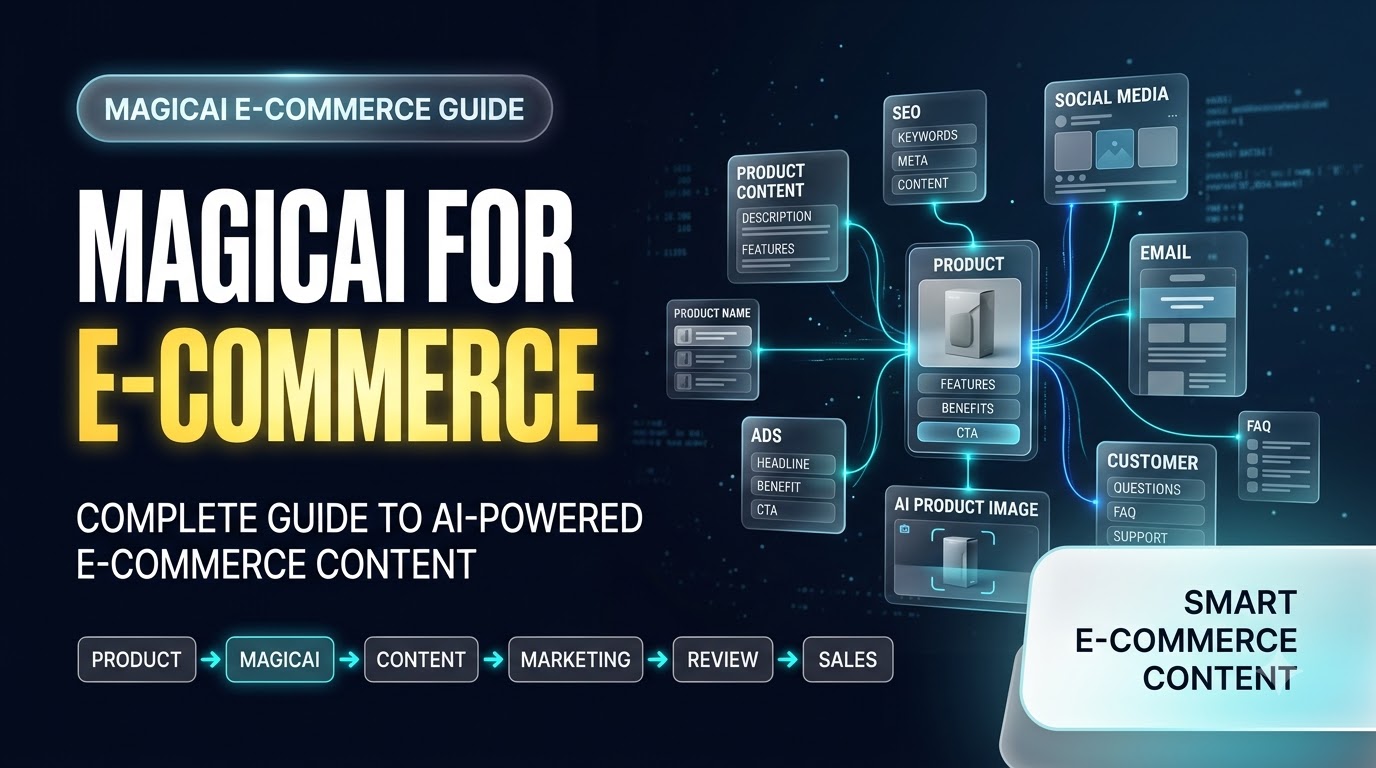
PRODUCT INFORMATION → MAGICAI → CONTENT → HUMAN REVIEW → PUBLISH
Why E-commerce Businesses Can Use MagicAI
1. Faster Product Content Creation
Online stores can have hundreds or thousands of products. Creating every description manually can consume considerable time.
MagicAI can generate an initial draft from product information, allowing the team to focus on accuracy and optimization.
2. More Marketing Variations
E-commerce campaigns often need multiple headlines, descriptions, captions, and CTAs.
AI can help create different versions quickly.
3. Consistent Content Structure
Reusable prompts can help maintain a similar structure across product pages and marketing assets.
4. Faster Content Repurposing
A product description can become social media content, email copy, advertising ideas, and FAQ material.
5. Support for Small E-commerce Teams
Small stores may not have separate teams for copywriting, SEO, email, and social media. AI assistance can help reduce repetitive production work.
15 Practical Ways to Use MagicAI for E-commerce
1. Create Product Descriptions
Product descriptions are one of the most obvious e-commerce applications.
MagicAI’s current Product Description template is specifically designed for creating product copy.
Provide:
- Product name
- Product category
- Features
- Specifications
- Materials
- Size
- Benefits
- Applications
- Target customer
- Brand voice
Example Prompt
Write an SEO-friendly product description for [PRODUCT]. Use the supplied product specifications, features, benefits, materials, dimensions, applications, and target audience. Explain what the product does and why it is useful. Do not invent specifications, certifications, performance claims, or customer results.
A human should verify the final description against the actual product.
2. Generate Product Names
An e-commerce store may need names for new products, bundles, collections, or variations.
MagicAI includes a Product Name Generator.
Example Prompt
Generate 20 professional product name ideas for [PRODUCT]. The names should be memorable, relevant to the target customer, easy to understand, and suitable for an e-commerce product page. Avoid misleading claims and trademark-like names.
The final name should be checked for brand and trademark considerations before use.
3. Improve Existing Product Descriptions
Older product pages may contain:
- Repetitive copy
- Weak benefits
- Poor formatting
- Unclear language
- Missing information
- Outdated descriptions
MagicAI’s AI ReWriter can help create a more professional and detailed version of existing content.
Example Prompt
Rewrite this product description to improve clarity, readability, structure, and customer relevance. Preserve every verified product fact. Do not add specifications or benefits that are not present in the original information.
4. Create E-commerce SEO Content
Search traffic can be an important acquisition channel for online stores.
MagicAI can support different parts of an SEO content workflow through article generation, blog tools, meta descriptions, FAQs, and related content templates.
A practical workflow is:
PRODUCT / TOPIC → KEYWORD → SEARCH INTENT → OUTLINE → MAGICAI → EDIT → SEO REVIEW → PUBLISH
Use it for:
- Category pages
- Product education
- Buying guides
- Comparison articles
- How-to articles
- Product-related blogs
- FAQs
AI-generated content should still be reviewed for usefulness, originality, accuracy, and search intent.
5. Write Meta Descriptions
E-commerce websites often have many product and category pages.
MagicAI provides a Meta Description template for generating SEO-oriented metadata.
Example Prompt
Write five concise meta description options for [PRODUCT/PAGE]. Include the primary keyword naturally, communicate the main customer benefit, and create a clear reason to visit the page. Avoid unsupported claims.
The final version should accurately represent the page.
6. Create Category Page Content
Category pages can help shoppers understand a product group while supporting organic search.
Example Prompt
Write an e-commerce category introduction for [CATEGORY]. Explain what products are included, who they are suitable for, key buying considerations, important product differences, and what shoppers should look for. Use a clear and helpful tone.
Keep category content useful rather than adding unnecessary keyword repetition.
7. Generate Social Media Content
E-commerce businesses often need regular social content to promote products and educate customers.
MagicAI currently provides Instagram captions, Instagram hashtags, business social posts, tweet-style posts, and Facebook headline tools.
Possible content types include:
- New product announcements
- Product benefits
- Customer education
- Seasonal campaigns
- Product demonstrations
- Buying tips
- Promotional posts
- FAQs
- Behind-the-scenes content
Example Prompt
Create 10 social media posts for [PRODUCT]. Include product education, benefits, use cases, customer problems, promotional ideas, and engagement-focused posts. Keep all product claims accurate.
8. Create E-commerce Email Campaigns
Email marketing can help stores communicate with subscribers and customers.
MagicAI includes Email Generator, Email Answer Generator, and Newsletter Generator templates.
Use it for:
- Welcome emails
- Product launches
- New arrivals
- Promotional campaigns
- Product education
- Seasonal campaigns
- Newsletters
- Customer follow-ups
Example Prompt
Create a three-email campaign for [PRODUCT]. Email one should introduce the product, email two should explain its main benefits and applications, and email three should provide a clear CTA. Maintain a professional and customer-focused tone.
9. Create Advertising Copy
E-commerce advertising frequently requires multiple creative variations.
MagicAI currently includes Facebook Ads, Facebook Headlines, and Google Ads Description templates.
Example Prompt
Generate 10 advertising headline variations and 10 descriptions for [PRODUCT]. Focus on verified customer benefits, use clear language, and create different messaging angles without making unsupported claims.
Multiple variations can then be reviewed and tested through the appropriate advertising platform.
10. Generate FAQs for Product Pages
Product FAQs can answer questions before a customer contacts support.
Useful topics include:
- Product usage
- Size
- Materials
- Compatibility
- Shipping information
- Care instructions
- Warranty information
- Returns
- Setup
- Applications
Example Prompt
Create 15 FAQs for [PRODUCT] using only the information provided. Cover product usage, specifications, compatibility, care, shipping, returns, warranty, and common customer questions. Clearly identify any question that requires additional business information.
Do not allow AI to invent warranty, shipping, or return policies.
11. Create Buying Guides
Buying guides can help customers make informed purchasing decisions.
Examples include:
- How to choose running shoes
- How to select office furniture
- How to choose a laptop
- How to select skincare products
- How to choose packaging equipment
Example Prompt
Create a comprehensive buying guide for [PRODUCT CATEGORY]. Explain the major buying factors, important specifications, common mistakes, product differences, ideal customer types, and questions shoppers should ask before purchasing.
12. Create Product Comparison Content
Comparison pages can help shoppers understand differences between products.
Example Prompt
Create a comparison framework for [PRODUCT A] and [PRODUCT B]. Compare their features, specifications, use cases, advantages, limitations, ideal customers, and key differences. Do not declare a winner unless the supplied information supports the conclusion.
Always verify technical specifications before publication.
13. Generate Product Marketing Images
MagicAI includes an AI Image Generator for creating images and graphics.
E-commerce teams can use AI image generation for:
- Campaign concepts
- Social media visuals
- Blog images
- Lifestyle concepts
- Promotional graphics
- Product presentation ideas
Example Image Prompt
Create a premium e-commerce product marketing visual for [PRODUCT]. Place the product in a clean modern environment with professional studio lighting, realistic materials, subtle shadows, premium composition, strong product focus, and clean negative space for marketing text. Do not change the product’s actual shape, color, logo, packaging, or important physical details.
For actual product representation, accuracy should always be checked against the real product.
14. Repurpose Product Content
One product page can become many marketing assets.
For example:
ONE PRODUCT DESCRIPTION
can become:
- 3 social media posts
- 1 email
- 5 FAQs
- 3 ad concepts
- 1 newsletter section
- 5 short content ideas
- 1 buying-guide section
Repurposing Prompt
Repurpose the following product description into three social posts, one promotional email, five FAQs, three advertising concepts, and five customer-education ideas. Preserve all verified product information and do not introduce new claims.
This can significantly reduce repetitive content work.
15. Summarize E-commerce Documents and Research
E-commerce businesses work with many documents, including:
- Supplier information
- Product catalogs
- Specifications
- Market research
- Customer feedback
- Internal documents
- Product spreadsheets
- Reports
MagicAI’s File Analyzer supports PDF, CSV, DOC, and DOCX files for extracting key insights or summarizing documents.
Example Prompt
Analyze this product research document and summarize the important product specifications, customer insights, buying considerations, unanswered questions, and information that should be verified before publication.
MagicAI for Different E-commerce Departments
| E-commerce Area | MagicAI Use Cases |
|---|---|
| Product Management | Product names, descriptions, specifications drafts |
| SEO | Blogs, metadata, FAQs, buying guides |
| Marketing | Campaigns, ads, social content |
| Email Marketing | Emails, newsletters, product announcements |
| Customer Support | FAQ drafts, response drafts |
| Content Team | Articles, guides, product education |
| Creative Team | AI image concepts and campaign visuals |
| Sales | Product messaging and comparison content |
| Operations | Document summaries |
| Management | Research summaries and content planning |
How to Build an E-commerce Content Workflow with MagicAI
A repeatable process can make AI much more useful.
Use:
PRODUCT INFORMATION → CUSTOMER → GOAL → PROMPT → MAGICAI → REVIEW → FACT-CHECK → SEO → APPROVAL → PUBLISH
For product pages:
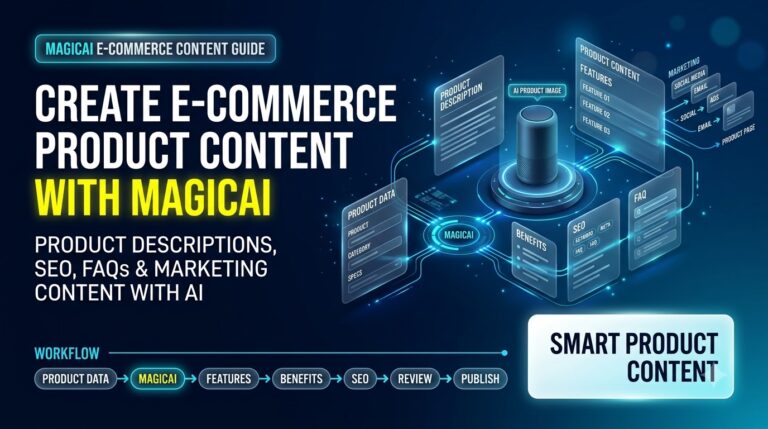
PRODUCT DATA → PRODUCT DESCRIPTION → FEATURES → BENEFITS → FAQ → SEO → REVIEW → PUBLISH
For marketing:
CAMPAIGN GOAL → AUDIENCE → PRODUCT → MESSAGE → MAGICAI → VARIATIONS → REVIEW → PUBLISH
For social media:
PRODUCT → CONTENT IDEA → MAGICAI → CAPTION → VISUAL → REVIEW → PUBLISH
How to Create a Reusable E-commerce MagicAI Template
Create a standard product-content input form.
Product Information Template
Product Name:
[PRODUCT]
Category:
[CATEGORY]
Target Customer:
[CUSTOMER]
Main Features:
[FEATURES]
Specifications:
[SPECS]
Benefits:
[BENEFITS]
Applications:
[APPLICATIONS]
Unique Selling Points:
[USPs]
Primary Keyword:
[KEYWORD]
Secondary Keywords:
[KEYWORDS]
Brand Voice:
[VOICE]
CTA:
[CTA]
This structure can be reused for every product.
MagicAI supports custom prompts and templates, allowing businesses to build repeatable content-generation workflows.
Master MagicAI Prompt for E-commerce
Act as an experienced e-commerce content specialist.
Store: [STORE NAME]
Product: [PRODUCT]
Category: [CATEGORY]
Target Customer: [AUDIENCE]
Product Features: [FEATURES]
Specifications: [SPECIFICATIONS]
Benefits: [BENEFITS]
Applications: [APPLICATIONS]
Primary Keyword: [KEYWORD]
Secondary Keywords: [KEYWORDS]
Brand Voice: [VOICE]
Content Type: [PRODUCT DESCRIPTION / CATEGORY PAGE / BLOG / EMAIL / SOCIAL POST / AD]
CTA: [CTA]
Create a professional, useful, customer-focused first draft using only the information provided.
Highlight the practical value of the product without exaggerating its capabilities.
Do not invent product specifications, certifications, prices, guarantees, customer reviews, statistics, or performance results.
Use keywords naturally and prioritize readability.
Clearly identify any information that is missing and should be supplied before publication.
10 Ready-to-Use MagicAI E-commerce Prompts
Prompt 1: Product Description
Write an SEO-friendly product description for [PRODUCT] using the supplied features, specifications, benefits, applications, and target customer.
Prompt 2: Product Names
Generate 20 professional product name ideas for [PRODUCT]. Make them relevant, memorable, easy to understand, and suitable for an e-commerce store.
Prompt 3: Category Content
Write helpful category-page content for [CATEGORY]. Explain the product types, key buying factors, customer needs, and important differences.
Prompt 4: Product FAQ
Generate 15 FAQs for [PRODUCT] using only the information supplied. Identify questions that require additional information.
Prompt 5: Social Media
Create 10 social media posts for [PRODUCT], including educational, product-focused, promotional, and engagement-oriented content.
Prompt 6: Email Campaign
Create a three-email product campaign for [PRODUCT]. Include subject lines, body copy, customer benefits, and CTA.
Prompt 7: Ad Copy
Generate 10 ad headlines and 10 descriptions for [PRODUCT]. Focus on verified benefits and different customer motivations.
Prompt 8: Buying Guide
Create a buying guide for [CATEGORY]. Explain important specifications, customer considerations, common mistakes, and questions shoppers should ask.
Prompt 9: Product Comparison
Compare [PRODUCT A] and [PRODUCT B] using the supplied specifications. Highlight differences, use cases, advantages, limitations, and ideal customers.
Prompt 10: Content Repurposing
Repurpose this product description into social posts, an email, FAQs, ad concepts, and customer-education content without changing or inventing product facts.
How to Use MagicAI for E-commerce SEO
E-commerce SEO should connect search intent with useful shopping information.
A practical workflow is:
KEYWORD → SEARCH INTENT → PRODUCT/CATEGORY → CONTENT PLAN → MAGICAI → SEO → HUMAN REVIEW → PUBLISH
Product Page SEO
Review:
- Product title
- Product description
- Primary keyword
- Secondary keywords
- Meta title
- Meta description
- Headings
- Product FAQs
- Internal links
- Image ALT text
- Structured product information
Category Page SEO
Focus on:
- Category relevance
- Search intent
- Product selection
- Helpful buying information
- Related categories
- Internal links
- FAQs
Blog SEO
Create content around:
- Buying guides
- Product comparisons
- How-to topics
- Product education
- Common customer questions
- Industry topics
- Problem-solving content
AI can accelerate drafting, but keyword selection, search intent, product accuracy, and final quality should be validated by the e-commerce team.
How to Maintain a Consistent E-commerce Brand Voice
A large store can have many products and many contributors.
Create a brand-voice instruction such as:
Use a confident, helpful, and professional tone. Focus on customer benefits without exaggerated language. Use short, readable sentences. Avoid unnecessary jargon. Do not make unsupported performance claims. Keep the language informative and trustworthy.
Add this instruction to your reusable prompts.
How to Improve E-commerce Content Quality
Use Real Product Data
The more accurate the input, the more useful the output.
Separate Features From Benefits
A feature describes what the product has.
A benefit explains why that feature matters to the customer.
Avoid Generic Claims
Instead of:
The best product on the market.
Use specific, verifiable information.
Add Customer Context
Explain who the product is for and how it can be used.
Review AI Images Carefully
Generated visuals should not misrepresent the real product.
Keep Product Information Consistent
Specifications should match the actual catalog and product data.
Common Mistakes E-commerce Businesses Should Avoid
1. Publishing Product Content Without Verification
Always compare AI-generated information with the actual product data.
2. Inventing Product Specifications
AI should never create dimensions, materials, warranties, certifications, performance figures, or technical specifications.
3. Using Generic Product Descriptions
Product pages should explain specific customer value.
4. Overusing Keywords
SEO content should remain natural and useful.
5. Making Unsupported Claims
Avoid statements about guaranteed results, rankings, health outcomes, savings, or performance unless properly supported.
6. Creating Misleading AI Product Images
AI visuals should accurately represent the real product when used for commercial purposes.
7. Using One Prompt for Every Product
Different product categories require different information and structures.
8. Ignoring Customer Questions
Use real support queries, reviews, and sales conversations to improve product content.
E-commerce Content Quality Checklist
Before publishing AI-assisted content, check:
- Product name is correct
- Product specifications are verified
- Features are accurate
- Benefits are realistic
- Product applications are correct
- Pricing information is accurate
- Warranty information is accurate
- Shipping information is accurate
- Return information is accurate
- Keywords are naturally used
- Meta title is relevant
- Meta description is accurate
- FAQs are verified
- Images represent the actual product
- Brand voice is consistent
- Human review is complete
MagicAI vs Manual E-commerce Content Creation
| Task | Manual Workflow | MagicAI-Assisted Workflow |
|---|---|---|
| Product description | Write from scratch | Generate first draft |
| Product names | Brainstorm manually | Generate naming ideas |
| Social posts | Create individually | Generate variations |
| Email campaigns | Write manually | AI-assisted drafts |
| Ad copy | Create variations manually | Generate multiple concepts |
| FAQs | Collect and write | AI-assisted question generation |
| Blog ideas | Manual brainstorming | AI-assisted ideation |
| Blog draft | Manual writing | AI-assisted first draft |
| Repurposing | Manual rewriting | Generate multiple formats |
| Document summary | Read and summarize | AI-assisted summary |
The strongest workflow combines AI-assisted production with human quality control.
How to Measure the Value of MagicAI in E-commerce
Track practical improvements rather than simply counting generated words.
Measure:
- Product description production time
- Number of products processed
- Email creation time
- Social media production time
- Ad variation production time
- Content editing time
- Blog production time
- Content repurposing time
- Customer-response drafting time
For example:
| Activity | Before AI | With MagicAI | Main Metric |
|---|---|---|---|
| Product descriptions | Manual | AI-assisted | Time per product |
| Social posts | Manual | AI-assisted | Posts per hour |
| Email campaigns | Manual | AI-assisted | Drafting time |
| FAQs | Manual | AI-assisted | Questions processed |
| Blog drafts | Manual | AI-assisted | Drafting time |
| Repurposing | Manual | AI-assisted | Assets per source |
The objective is to reduce repetitive work while maintaining or improving content quality.
Frequently Asked Questions
Can MagicAI help e-commerce businesses?
Yes. MagicAI provides e-commerce-related templates and capabilities for product descriptions, product names, articles, advertising, social media, email, FAQs, metadata, AI images, rewriting, and other content workflows.
Can MagicAI create product descriptions?
Yes. Product Description is one of MagicAI’s listed custom templates.
Can MagicAI generate product names?
Yes. MagicAI currently lists a Product Name Generator among its custom templates.
Can MagicAI create e-commerce advertising copy?
Yes. Its current templates include Facebook Ads, Facebook Headlines, and Google Ads Description.
Can MagicAI create social media content for online stores?
Yes. MagicAI lists Instagram captions, Instagram hashtags, business social media posts, tweet-style posts, and Facebook headline tools.
Can MagicAI create email marketing content?
Yes. MagicAI provides Email Generator, Email Answer Generator, and Newsletter Generator templates.
Can MagicAI generate e-commerce images?
Yes. MagicAI currently includes an AI Image Generator for creating images and graphics.
Can MagicAI improve existing product descriptions?
Yes. Its AI ReWriter can help rewrite existing content into a more professional and detailed format.
Should e-commerce businesses publish AI-generated product content without checking it?
No. Product descriptions, specifications, pricing, shipping information, warranties, claims, and other important information should be checked against the actual business data.
Can small online stores use MagicAI?
Yes. Its combination of writing, marketing, image, summarization, custom-template, and export capabilities can support stores with small teams.
Final Verdict
MagicAI for e-commerce businesses can help online stores streamline a wide range of repetitive content and marketing tasks.
From product descriptions and product names to SEO articles, category content, emails, social media, advertisements, FAQs, buying guides, product comparisons, AI visuals, and content repurposing, MagicAI can become part of a structured e-commerce content workflow.
The most effective system is:
PRODUCT DATA → CUSTOMER → GOAL → MAGICAI → HUMAN REVIEW → SEO → APPROVAL → PUBLISH → MEASURE
The important point is that AI should accelerate e-commerce operations without replacing product expertise or quality control.
Businesses should provide accurate product information, use structured prompts, create reusable templates, maintain a consistent brand voice, and verify every important claim before publication.
When used this way, MagicAI can help e-commerce teams spend less time on repetitive content production and more time on merchandising, customer experience, marketing strategy, and business growth.
Use MagicAI to scale the content workflow—not to compromise product accuracy.