
Introduction
A strong product description does more than explain what a product is. It helps customers understand its benefits, answers buying questions, communicates value, and encourages them to take action.
Writing descriptions manually for a large ecommerce store can be time-consuming, especially when hundreds or thousands of products need unique content. MagicAI can help streamline this process by generating structured product descriptions from product information, keywords, specifications, features, and target-audience details.
However, simply asking an AI tool to “write a product description” may produce generic content. The best results come from giving MagicAI clear instructions, accurate product information, a defined audience, and a specific content structure.
This guide explains how to write high-quality, SEO-friendly product descriptions with MagicAI and how to improve AI-generated copy before publishing it.
What Is a Product Description?
A product description is written content that explains a product and helps potential customers decide whether it is suitable for them.
A good product description can include:
- Product overview
- Main features
- Customer benefits
- Technical specifications
- Materials
- Size or dimensions
- Applications
- Use cases
- Compatibility
- Important product details
- Buying considerations
- Call to action
The exact structure depends on the type of product and the audience.
For example, a technical machine may require detailed specifications and applications, while a fashion product may focus more on material, fit, appearance, comfort, and styling.
Can MagicAI Write Product Descriptions?
Yes. MagicAI can be used to create product-description drafts from structured product information.
You can provide details such as:
- Product name
- Product category
- Features
- Specifications
- Materials
- Dimensions
- Benefits
- Target audience
- Applications
- Keywords
- Brand tone
- Selling points
MagicAI can then organize these details into readable product copy.
The quality of the result depends heavily on the quality of the information and instructions provided in the prompt.
Why Use MagicAI for Product Descriptions?
Faster Content Creation
Creating descriptions individually can take considerable time. MagicAI can help produce initial drafts quickly, allowing content teams to spend more time reviewing and optimizing the information.
Consistent Structure
A predefined prompt can instruct MagicAI to use the same structure across a product catalog.
For example:
Product Introduction → Key Features → Benefits → Specifications → Applications → Buying Information → CTA
This can make a large ecommerce catalog more consistent.
SEO Support
MagicAI can help incorporate relevant keywords naturally into product descriptions.
Instead of repeatedly inserting the same keyword, you can instruct it to use primary and secondary keywords naturally throughout the content.
Multiple Product Categories
A reusable prompt can be adapted for different categories, including:
- Electronics
- Clothing
- Home appliances
- Industrial equipment
- Food products
- Beauty products
- Software
- Tools
- Machinery
- Accessories
Easy Content Expansion
If an existing description is too short, MagicAI can help expand it with additional benefits, applications, FAQs, or specification explanations.
What Makes a High-Quality Product Description?
A strong product description should be:
- Accurate
- Specific
- Easy to understand
- Customer-focused
- Benefit-oriented
- SEO-friendly
- Original
- Scannable
- Relevant to search intent
- Consistent with the actual product
Avoid writing descriptions that simply repeat specifications.
Instead, explain why important features matter to the customer.
For example:
Feature: Stainless steel construction.
Weak description:
“Made from stainless steel.”
Better description:
“Stainless steel construction provides a durable, easy-to-clean surface that is suitable for demanding everyday use.”
The second version connects the feature with a practical benefit.
Step 1: Collect Complete Product Information
Before asking MagicAI to write a description, collect as much verified information as possible.
Useful information includes:
| Product Information | Example |
|---|---|
| Product Name | Automatic Coffee Grinder |
| Category | Kitchen Appliance |
| Material | Stainless Steel |
| Capacity | 500 g |
| Power | 1,000 W |
| Main Feature | Adjustable grinding |
| Application | Commercial and home use |
| Target Audience | Cafes, restaurants, home users |
| Benefits | Fast and consistent grinding |
| Primary Keyword | automatic coffee grinder |
| Secondary Keywords | commercial coffee grinder, electric coffee grinder |
The more useful information MagicAI receives, the less likely it is to produce vague copy.
Step 2: Define the Target Customer
A product description should be written for a specific audience.
For example, the same product may require different messaging for:
- Individual consumers
- Business owners
- Industrial buyers
- Retailers
- Professionals
- Wholesalers
Tell MagicAI who the intended customer is.
This helps determine the language, benefits, technical depth, and purchasing considerations.
Step 3: Identify the Product’s Main Benefits
Features explain what a product has.
Benefits explain why those features matter.
For example:
Feature: Large storage capacity.
Benefit: Users can store more material without frequent refilling.
Ask MagicAI to convert important features into practical customer benefits without inventing unsupported claims.
Step 4: Build an SEO Keyword Strategy
Choose one primary keyword and several relevant secondary keywords.
For example:
Primary Keyword: automatic coffee grinder
Secondary Keywords:
- commercial coffee grinder
- electric coffee grinder
- coffee grinding machine
- high-capacity coffee grinder
- professional coffee grinder
Use keywords naturally.
Do not instruct MagicAI to repeat a keyword a specific number of times simply to increase keyword density. Search-friendly content should prioritize relevance and readability.
Step 5: Create a Product Description Structure
A useful structure for many ecommerce products is:
Product Overview
Introduce the product and explain its primary purpose.
Key Features
List the most important features.
Product Benefits
Explain how the features help the customer.
Technical Specifications
Present measurable information clearly.
Applications
Explain where and how the product can be used.
Who Is It For?
Identify the most relevant customers or industries.
Why Choose This Product?
Summarize the strongest differentiating factors.
Call to Action
Encourage the reader to take the next appropriate step.
Step 6: Give MagicAI a Detailed Prompt
A detailed prompt generally produces more useful results than a short instruction.
Product Description Prompt
Write a professional, SEO-friendly product description for the following product.

Product Name: [PRODUCT NAME]
Category: [CATEGORY]
Target Audience: [TARGET AUDIENCE]
Primary Keyword: [PRIMARY KEYWORD]
Secondary Keywords: [SECONDARY KEYWORDS]

Product Features:
- [FEATURE 1]
- [FEATURE 2]
- [FEATURE 3]

Product Benefits:
- [BENEFIT 1]
- [BENEFIT 2]
- [BENEFIT 3]

Technical Specifications:
- Material: [MATERIAL]
- Size: [SIZE]
- Capacity: [CAPACITY]
- Power: [POWER]
- Other Specifications: [DETAILS]

Applications:
- [APPLICATION 1]
- [APPLICATION 2]

Write the description in clear, professional English.

Use the primary keyword naturally and incorporate relevant secondary keywords where appropriate.

Focus on customer benefits instead of simply repeating specifications.

Do not invent technical specifications, certifications, performance claims, warranties, or features that were not provided.

Use headings, short paragraphs, and bullet points where useful.

Make the content informative, persuasive, readable, and suitable for an ecommerce website.
Step 7: Ask MagicAI to Focus on Benefits
One of the most useful improvements is to make the description benefit-oriented.
Use a prompt such as:
Rewrite this product description by connecting each major feature with a practical customer benefit. Keep all factual information unchanged and do not add unsupported claims.This helps turn technical information into more useful buying information.
Step 8: Create Different Product Description Lengths
Different pages may require different amounts of content.
You can ask MagicAI for:
Short Description
Useful for product cards, category pages, and quick listings.
Standard Description
Useful for most ecommerce product pages.
Detailed Description
Useful for technical products, high-value products, machinery, or products requiring extensive specifications.
For example:
Create three versions of this product description:
1. A 50-word short description.
2. A 150-word standard description.
3. A 400-word detailed description.

Keep all versions factually consistent.
Step 9: Generate SEO-Friendly Product Titles
MagicAI can also help improve product titles.
Example prompt:
Generate 10 SEO-friendly product title options for this product.

Keep the titles clear and natural.
Include the main product keyword where appropriate.
Avoid keyword stuffing.
Do not add specifications that were not provided.
Keep each title suitable for an ecommerce product page.
Choose the title based on clarity and search relevance rather than simply selecting the longest option.
Step 10: Write Product Meta Descriptions
A product page also needs a useful meta description.
Example prompt:
Write 5 concise SEO meta description options for this product page.

Use the primary keyword naturally.
Communicate the main customer benefit.
Make each option compelling without using exaggerated claims.
Keep the information factually accurate.
Step 11: Create Product FAQs with MagicAI
FAQs can help address common customer questions.
Useful questions may include:
- What is this product used for?
- Who is this product suitable for?
- What material is it made from?
- What are its dimensions?
- What is its capacity?
- How does it work?
- Where can it be used?
- Is it suitable for commercial use?
Only include answers supported by verified product information.
Step 12: Improve Existing Product Descriptions
MagicAI does not have to create every description from scratch.
You can provide an existing description and ask it to improve:
- Clarity
- Grammar
- Structure
- Readability
- SEO
- Benefits
- Conversion language
- Technical presentation
Example prompt:
Improve the following product description for an ecommerce website.

Preserve all factual information.
Do not invent features or specifications.
Improve readability and structure.
Make the benefits clearer.
Use the primary keyword naturally.
Remove repetitive language.
Make the content professional and customer-focused.
Step 13: Make AI-Generated Content Sound Natural
AI-generated descriptions can sometimes contain repetitive phrases such as:
- “Whether you are…”
- “In today’s fast-paced world…”
- “Perfect for…”
- “Designed to meet all your needs…”
- “Take your business to the next level…”
These phrases can make product content feel generic.
Ask MagicAI to use specific, direct language instead.
Rewrite this product description using natural, specific language. Remove generic marketing phrases and unnecessary repetition. Keep the tone professional and informative.Step 14: Avoid Unsupported Claims
This is one of the most important rules when using AI for product content.
Do not allow MagicAI to invent:
- Certifications
- Warranty periods
- Performance percentages
- Materials
- Dimensions
- Production capacities
- Safety features
- Compatibility
- Energy ratings
- Customer reviews
- Awards
- Medical claims
- Technical specifications
If the information is not known, the description should not pretend that it is known.
Step 15: Add Internal SEO Opportunities
Product descriptions can support a broader website SEO strategy.
Relevant internal links may point to:
- Product categories
- Related products
- Buying guides
- Industry pages
- Product comparison pages
- How-to articles
- Frequently asked questions
For example:
Product → Product Category → Buying Guide → Related Product
This creates a useful internal linking structure.
Step 16: Create Category-Specific Prompts
A single prompt does not have to work for every product.
Fashion Product Prompt
Ask MagicAI to emphasize:
- Fabric
- Fit
- Style
- Comfort
- Occasion
- Care instructions
- Available variations
Electronics Product Prompt
Emphasize:
- Specifications
- Compatibility
- Connectivity
- Performance
- Included accessories
- Power requirements
Industrial Machine Prompt
Emphasize:
- Machine type
- Applications
- Production capacity
- Operating system
- Materials
- Technical specifications
- Suitable products
- Maintenance considerations
Food Product Prompt
Emphasize:
- Ingredients
- Product format
- Taste or usage information where verified
- Packaging
- Storage
- Serving or preparation information where applicable
Step 17: Use a Product Description Workflow
A reliable MagicAI workflow can look like this:
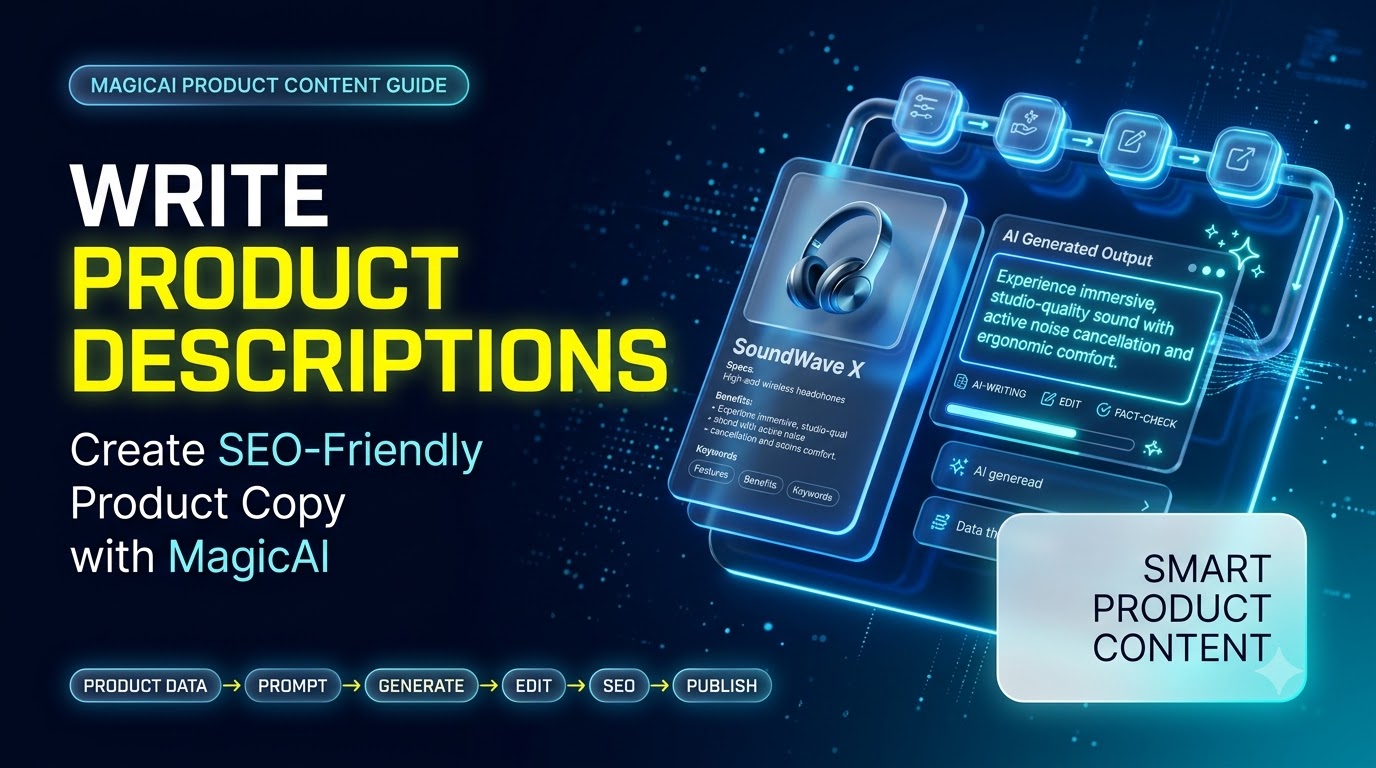
PRODUCT DATA → CUSTOMER → KEYWORDS → PROMPT → MAGICAI DRAFT → FACT CHECK → HUMAN EDITING → SEO OPTIMIZATION → FINAL REVIEW → PUBLISH
Each stage serves a different purpose.
MagicAI handles much of the drafting and restructuring, while human review ensures that the final content is accurate and appropriate.
Example: MagicAI Product Description Workflow
Suppose the product is an Automatic Coffee Grinder.
Product Data
- Stainless steel construction
- 500 g capacity
- Adjustable grinding settings
- Electric operation
- Suitable for commercial and home use
MagicAI Instruction
Write a detailed ecommerce product description for an Automatic Coffee Grinder.

Target audience: cafes, restaurants, coffee shops, and home users.

Explain the purpose of the grinder, highlight its adjustable grinding settings, describe the practical benefits of its 500 g capacity, and present the specifications clearly.

Primary keyword: automatic coffee grinder.

Secondary keywords: commercial coffee grinder, electric coffee grinder, coffee grinding machine.

Do not invent technical specifications or performance claims.
MagicAI can then turn the supplied information into a structured draft.
Common Mistakes When Using MagicAI
Using Extremely Short Prompts
“Write a product description” provides too little direction.
Better: Provide product information, audience, keywords, tone, structure, and restrictions.
Giving Incomplete Product Data
If important specifications are missing, the generated description may become vague.
Solution: Collect verified product information first.
Asking AI to Invent Details
This can create inaccurate product pages.
Solution: Explicitly instruct MagicAI not to invent specifications or claims.
Keyword Stuffing
Repeatedly inserting keywords can make the content unnatural.
Solution: Prioritize relevance and readability.
Publishing Without Review
AI-generated content should be checked before publication.
Solution: Verify product facts, claims, measurements, pricing, compatibility, and other important details.
Using the Same Description for Multiple Products
Duplicate or overly similar product descriptions can reduce content quality.
Solution: Provide product-specific information and selling points.
How to Make Product Descriptions More Persuasive
A persuasive description should answer three questions:
What Is the Product?
Clearly identify the product and its purpose.
Why Does It Matter?
Explain the practical benefits.
Why Should the Customer Consider It?
Highlight relevant features, use cases, quality factors, or differentiators supported by the available information.
A useful formula is:
FEATURE → FUNCTION → BENEFIT → USE CASE
For example:
Adjustable grinding settings → allows different grind levels → provides greater preparation flexibility → useful for different coffee preparation needs.
MagicAI Product Description Master Prompt
The following reusable prompt can be adapted for almost any product category:
Act as an experienced ecommerce copywriter and SEO content specialist.

Create a unique, accurate, customer-focused product description for the product information below.

PRODUCT NAME:
[NAME]

CATEGORY:
[CATEGORY]

TARGET CUSTOMER:
[AUDIENCE]

PRIMARY KEYWORD:
[KEYWORD]

SECONDARY KEYWORDS:
[KEYWORDS]

PRODUCT OVERVIEW:
[OVERVIEW]

FEATURES:
[FEATURES]

BENEFITS:
[BENEFITS]

TECHNICAL SPECIFICATIONS:
[SPECIFICATIONS]

APPLICATIONS:
[APPLICATIONS]

MAIN SELLING POINTS:
[SELLING POINTS]

Create the following:

1. Product Overview
2. Key Features
3. Product Benefits
4. Applications and Use Cases
5. Technical Specifications
6. Why Choose This Product
7. Short Product Description
8. SEO Meta Title
9. SEO Meta Description
10. Suggested Product Tags

Requirements:
- Write natural, professional English.
- Use the primary keyword naturally.
- Include relevant secondary keywords without keyword stuffing.
- Focus on customer benefits.
- Use clear headings and bullet points.
- Keep all factual information accurate.
- Do not invent specifications, certifications, reviews, warranties, or performance claims.
- Avoid generic AI phrases and unnecessary repetition.
- Make the content suitable for an ecommerce website.
- Keep the description unique and product-specific.
Product Description Quality Checklist
Before publishing a MagicAI-generated description, check:
- Product name is correct.
- Product category is correct.
- Main features are accurate.
- Technical specifications are verified.
- Benefits are realistic.
- Applications are relevant.
- Primary keyword is used naturally.
- Secondary keywords are relevant.
- No keyword stuffing is present.
- No unsupported claims are included.
- Content is easy to scan.
- Product-specific information is included.
- Grammar and spelling are correct.
- Meta title is optimized.
- Meta description is useful.
- Internal links are relevant.
- Final content has been reviewed by a human.
AI vs Human Product Description Writing
| Area | MagicAI | Human Review |
|---|---|---|
| First Draft | Excellent | Useful |
| Content Structure | Excellent | Review |
| Keyword Integration | Useful | Final optimization |
| Product Accuracy | Depends on input | Essential |
| Brand Voice | Can follow instructions | Final approval |
| Technical Claims | Should not be assumed | Verification required |
| Editing | Excellent | Final quality control |
| Large Catalogs | Highly useful | Essential oversight |
The strongest workflow combines AI-assisted drafting with human expertise.
Benefits of Using MagicAI for Ecommerce Content
Using MagicAI as part of a product-content workflow can help businesses:
- Create product drafts faster
- Standardize product-page structure
- Generate multiple content variations
- Improve readability
- Organize technical information
- Support SEO content production
- Expand short descriptions
- Generate FAQs
- Create meta descriptions
- Refresh older product pages
- Scale content production
The key is to use AI as a content-production assistant rather than treating generated copy as automatically final.
FAQs
Can MagicAI write ecommerce product descriptions?
Yes. MagicAI can help create product-description drafts when you provide accurate product information, audience details, keywords, features, benefits, and clear instructions.
Can MagicAI create SEO-friendly product descriptions?
Yes. It can help incorporate relevant keywords and organize content for search visibility. Human review is still important to ensure the content is useful, natural, and accurate.
How long should a product description be?
There is no universal ideal length. The description should be long enough to answer important customer questions without adding unnecessary information.
Can MagicAI rewrite existing product descriptions?
Yes. You can provide an existing description and ask MagicAI to improve its clarity, structure, readability, SEO, and benefit-focused messaging while preserving factual information.
Should I publish MagicAI product descriptions without editing?
It is better to review them first. Verify product specifications, claims, measurements, compatibility, and other important information before publication.
Can MagicAI write descriptions for large product catalogs?
Yes. A standardized prompt can help create descriptions at scale while maintaining a consistent structure. Product-specific data should still be supplied for each item.
Can MagicAI create product FAQs?
Yes. It can generate potential FAQ questions and answers based on the information provided. Answers should be checked to ensure they are factually supported.
Final Verdict
MagicAI can make product-description creation significantly more efficient when it is given clear product information and detailed instructions. It can help businesses create structured drafts, improve readability, incorporate SEO keywords, generate FAQs, and scale ecommerce content across large catalogs.
The best results come from combining accurate product data, specific prompts, customer-focused writing, SEO optimization, and human review.
A practical approach is:
PRODUCT DATA → CUSTOMER NEEDS → KEYWORDS → MAGICAI → EDIT → FACT-CHECK → SEO → PUBLISH
Used this way, MagicAI becomes a powerful assistant for creating product descriptions that are informative, useful, search-friendly, and conversion-focused.