
Introduction
Creating SEO content requires more than adding keywords to an article. High-quality search-focused content needs a clear topic, relevant keywords, strong structure, useful information, appropriate metadata, internal links, FAQs, and a final editorial review.
MagicAI can support many of these tasks through its collection of AI writing and SEO-focused tools. Its current toolset includes an Article Generator, AI Article Wizard, Keyword Generator, Keyword Extractor, SEO tool, Meta Description generator, FAQ generator, and Rewrite with Keywords functionality.
The key is to use these tools as part of a complete optimization workflow rather than expecting one-click SEO perfection.
This guide explains how to use MagicAI to plan, create, optimize, edit, and publish better SEO content.
What Is MagicAI SEO Content?
MagicAI SEO content refers to website content created or improved with MagicAI while following SEO principles.
This can include:
- Blog articles
- Website pages
- Landing pages
- Product descriptions
- FAQs
- Meta descriptions
- Marketing content
- Service pages
- Educational articles
- Long-form guides
MagicAI provides dedicated tools for article generation, blog content, keywords, SEO optimization, FAQs, website copywriting, and keyword-based rewriting.
The purpose is not simply to generate more words. The objective is to create content that is:
- Relevant
- Helpful
- Well structured
- Search-intent focused
- Easy to read
- Naturally optimized
- Accurate
- Useful to the target audience
How MagicAI Supports SEO Content Optimization
MagicAI provides several tools that can be combined into one workflow.
| MagicAI Tool | SEO Content Use |
|---|---|
| Article Generator | Create initial article drafts |
| AI Article Wizard | Build custom articles |
| Keyword Generator | Discover relevant keyword ideas |
| Keyword Extractor | Identify important terms from content |
| SEO Tool | Optimize website content |
| Meta Description | Create search-result descriptions |
| FAQ | Generate relevant questions and answers |
| Rewrite with Keywords | Improve content around targeted terms |
| Blog Outline | Structure an article before writing |
| Blog Ideas | Generate potential content topics |
| AI ReWriter | Improve existing content |
MagicAI’s available feature set explicitly includes these types of content and SEO tools.
Why SEO Optimization Matters
Search engines need to understand what a page is about, while users need to understand and benefit from the content.
A properly optimized article can make it easier for both to understand the page.
Good optimization focuses on:
- Search intent
- Topic relevance
- Keyword usage
- Content depth
- Clear headings
- Readability
- Metadata
- Internal linking
- Useful answers
- Content accuracy
SEO should therefore be treated as a complete content strategy rather than a keyword-insertion exercise.
Step 1: Define Your SEO Content Goal
Start by deciding what the content needs to accomplish.
Your goal could be:
- Increase organic traffic
- Explain a product
- Educate potential customers
- Generate leads
- Build topical authority
- Answer a specific question
- Support another website page
- Promote a service
- Improve an existing article
Example
Instead of simply telling MagicAI:
Write an article about SEO.
Give it a specific goal:
Create an informational article explaining how small businesses can optimize website content for search engines.
A clear objective gives the AI a better direction.
Step 2: Identify Your Target Audience
The same topic may require completely different content depending on the audience.
Consider:
- Age and experience level
- Industry
- Search intent
- Technical knowledge
- Main problems
- Desired outcome
Example
For beginners:
Explain SEO content using simple language and practical examples.
For SEO professionals:
Discuss content optimization using advanced terminology, semantic relevance, topical coverage, internal linking, and content auditing.
MagicAI can then be instructed to adjust the tone and complexity accordingly.
Step 3: Choose the Primary Keyword
Your primary keyword should represent the main topic of the page.
For this guide:
Primary Keyword: MagicAI SEO content
The keyword should naturally appear in important locations such as:
- Page title
- Introduction
- Relevant headings
- Body content
- Meta title
- Meta description
- URL
- Image ALT text
However, natural usage is more important than forcing the exact phrase repeatedly.
Step 4: Generate Supporting Keywords With MagicAI
MagicAI provides a Keyword Generator for creating relevant keyword ideas and a Keyword Extractor for identifying important terms from existing content.
For example, supporting terms for MagicAI SEO content could include:
- MagicAI SEO tools
- MagicAI SEO writing
- MagicAI article generator
- MagicAI keyword generator
- MagicAI content optimization
- SEO content with MagicAI
- AI SEO content
- SEO-friendly content with MagicAI
- MagicAI AI Writer
Use supporting terms to expand topical coverage instead of repeating the primary keyword.
Step 5: Understand Search Intent
Before generating an article, determine what the user actually wants.
There are four common search-intent categories.
Informational Intent
The user wants to learn.
Example:
How does MagicAI SEO content work?
Commercial Investigation
The user is comparing solutions.
Example:
Best AI tools for SEO content
Transactional Intent
The user is ready to take action.
Example:
Buy an AI SEO writing tool
Navigational Intent
The user wants a specific website or platform.
Example:
MagicAI login
For an optimization guide, the primary intent should generally be informational.
Step 6: Build a Strong Content Outline
A strong outline prevents the article from becoming repetitive or unfocused.
For example:
- Introduction
- What Is MagicAI SEO Content?
- How MagicAI Supports SEO
- Choosing Keywords
- Understanding Search Intent
- Creating an SEO Outline
- Generating Content
- Optimizing Headings
- Improving Keyword Usage
- Optimizing Metadata
- Adding Internal Links
- Creating FAQs
- Editing AI Content
- Fact-Checking
- Common SEO Mistakes
- SEO Checklist
- FAQs
- Final Verdict
MagicAI provides Blog Ideas, Blog Intro, Blog Outline, and Blog Article tools that can support different stages of this planning process.
Step 7: Generate the First Draft With MagicAI
Once the strategy is ready, use MagicAI to generate a first draft.
MagicAI SEO Content Prompt
Create a comprehensive SEO-friendly article about [TOPIC].

Primary keyword:
[PRIMARY KEYWORD]

Secondary keywords:
[SECONDARY KEYWORDS]

Target audience:
[TARGET AUDIENCE]

Search intent:
[SEARCH INTENT]

Content objective:
[OBJECTIVE]

Create a logical H1, H2, and H3 structure.

Cover the topic thoroughly without unnecessary repetition.

Use the primary keyword naturally and incorporate related keywords where relevant.

Include:
- A useful introduction
- Clear explanations
- Step-by-step guidance
- Practical examples
- Bullet points
- Relevant tables where useful
- FAQs
- A concise conclusion

Prioritize usefulness, accuracy, readability, natural language, and search intent.

Avoid keyword stuffing, generic filler, unsupported claims, and repetitive AI-generated wording.
A detailed prompt gives MagicAI more context than a short instruction.
Step 8: Optimize the Article Structure
After generating the article, review the structure.
A good SEO article should have a clear hierarchy.
H1
Use one primary page title.
H2
Use H2 headings for major sections.
H3
Use H3 headings to divide major sections into smaller topics.
For example:
H2: How to Optimize MagicAI SEO Content
H3: Improve Keyword Placement
H3: Strengthen Search Intent
H3: Add Internal Links
H3: Improve Readability
This makes the article easier to scan.
Step 9: Improve Keyword Placement
Keywords should appear naturally throughout the article.
Important locations can include:
- H1
- Opening paragraph
- Relevant H2/H3 headings
- Main content
- Meta title
- Meta description
- URL
- Image ALT text
Avoid placing the same keyword in every heading.
Poor Approach
MagicAI SEO Content
MagicAI SEO Content Benefits
MagicAI SEO Content Features
MagicAI SEO Content Tools
MagicAI SEO Content Guide
Better Approach
What Is MagicAI SEO Content?
How MagicAI Supports Content Optimization
How to Choose Keywords
How to Improve AI-Generated Articles
Common SEO Mistakes to Avoid
The second structure is more natural and informative.
Step 10: Optimize Content for Search Intent
Keyword optimization alone is not enough.
Ask:
Does this section answer the question behind the search?
For example, if someone searches:
How to optimize AI content for SEO
they probably want:
- A process
- Practical steps
- Examples
- Optimization techniques
- Common mistakes
- A checklist
They do not necessarily want a long description of what AI is.
Use MagicAI to generate the initial content, but manually check whether every section contributes to the searcher’s goal.
Step 11: Improve Topical Coverage
A strong article should cover related concepts.
For MagicAI SEO content, relevant topics include:
- Keyword research
- Search intent
- Content structure
- Article generation
- Meta descriptions
- Keyword placement
- Internal linking
- FAQs
- Readability
- Content editing
- Fact-checking
- Content freshness
- User experience
This helps create a more complete resource.
Step 12: Optimize the Meta Title
Your meta title should clearly communicate the page topic.
Example
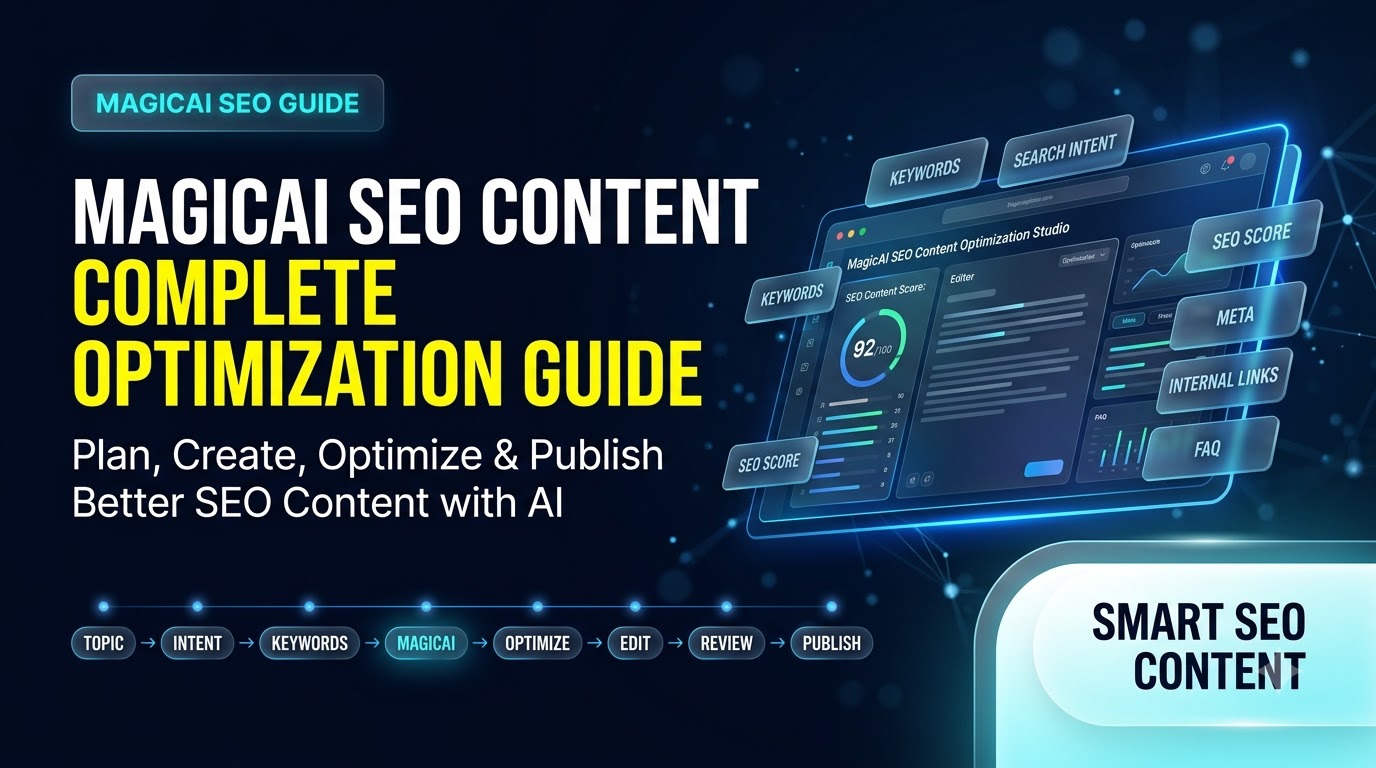
MagicAI SEO Content: Complete Optimization Guide
The title contains the primary topic while also communicating the purpose of the page.
Keep titles natural and focused rather than filling them with multiple keywords.
Step 13: Create a Better Meta Description
MagicAI includes a Meta Description generator for website pages.
A useful description should:
- Summarize the page
- Mention the topic naturally
- Give users a reason to click
- Match the actual page content
Example
Learn how to create and optimize SEO content with MagicAI using keywords, search intent, content structure, metadata, internal links, FAQs, and AI-assisted editing.
Avoid writing a description that promises information the page does not actually provide.
Step 14: Use MagicAI for Content Rewriting
Sometimes an existing article has useful information but poor structure or weak keyword targeting.
MagicAI’s rewriting tools can help improve such content. The platform includes an AI ReWriter and a Rewrite with Keywords tool.
Rewrite Prompt
Rewrite the following article to improve clarity, structure, readability, and SEO relevance.

Primary keyword:
[PRIMARY KEYWORD]

Supporting keywords:
[KEYWORDS]

Keep the original factual meaning.

Improve:
- Heading structure
- Paragraph flow
- Readability
- Keyword placement
- Topic coverage
- User usefulness

Remove:
- Repetition
- Generic filler
- Awkward AI wording
- Keyword stuffing
- Unsupported claims

Do not change factual information unless clearly instructed.
Always compare the rewritten version with the original.
Step 15: Optimize Existing Content With Keywords
MagicAI’s Rewrite with Keywords functionality can be used to incorporate targeted keywords into existing website content.
However, the goal should be natural integration.
For example, instead of forcing:
MagicAI SEO content MagicAI SEO tools MagicAI SEO writing MagicAI SEO content optimization…
rewrite the sentence naturally:
MagicAI provides several tools that can support keyword research, article creation, rewriting, and SEO-focused content optimization.
Step 16: Create Useful FAQs
FAQs can help cover important questions that were not fully addressed in the main article.
MagicAI includes an FAQ tool for generating frequently asked questions and answers.
Potential FAQs for this topic include:
- What is MagicAI SEO content?
- Can MagicAI create SEO articles?
- Does MagicAI have keyword tools?
- Can MagicAI rewrite SEO content?
- How should AI-generated content be edited?
- Can MagicAI generate meta descriptions?
- Should AI-generated content be fact-checked?
The questions should be genuinely relevant to the page.
Step 17: Add Internal Links
Internal links connect related pages within your website.
For a MagicAI content website, you could link to related articles about:
- MagicAI AI Writer
- MagicAI features
- SEO-friendly articles
- Blog writing
- Website content
- Landing page copy
- Marketing copy
- Email content
Example
If the article discusses AI article generation, link naturally to:
MagicAI AI Writer: Complete Guide to AI Content Generation
Do not add internal links simply to increase the number of links. Each link should provide additional value.
Step 18: Improve Readability
AI-generated content can sometimes contain repetitive wording or overly similar sentence structures.
Review the article for:
- Long paragraphs
- Repeated phrases
- Unnecessary introductions
- Excessive adjectives
- Generic statements
- Complex sentences
- Unclear explanations
Use short paragraphs and clear subheadings.
Better Structure
Problem → Explanation → Example → Solution
This makes technical SEO topics easier to understand.
Step 19: Add Original Examples
Examples make SEO content more useful.
For example, when explaining keyword placement, show the difference between unnatural and natural usage.
Unnatural:
MagicAI SEO content is useful because MagicAI SEO content helps create SEO content with MagicAI.
Natural:
MagicAI can assist with drafting and optimizing content, while the writer controls keyword strategy, accuracy, structure, and final editing.
Practical examples demonstrate how the technique works.
Step 20: Fact-Check AI-Generated Content
Never assume every AI-generated statement is accurate.
Review:
- Statistics
- Dates
- Product features
- Pricing
- Technical specifications
- Research claims
- Names
- Quotes
- External links
MagicAI can accelerate content production, but human review remains important before publication.
Step 21: Add Internal SEO Elements
Before publishing, check the complete page.
On-Page SEO Checklist
- Primary keyword
- Secondary keywords
- SEO title
- Meta description
- SEO-friendly URL
- H1
- H2/H3 structure
- Internal links
- Relevant external references
- Image ALT text
- FAQs
- CTA
- Readability
The page should be optimized as a complete resource rather than as a collection of isolated SEO elements.
Step 22: Optimize Images
Images should support the content.
For an article about MagicAI SEO content, a useful featured image could visually represent:
- AI content generation
- Keyword research
- Search optimization
- Article structure
- SEO analytics
- Content editing
Use descriptive image filenames and ALT text.
Example Filename
magicai-seo-content-complete-optimization-guide.jpg
Example ALT Text
MagicAI SEO content optimization workflow with keywords, article generation, SEO tools, and content editing
Step 23: Use a Complete MagicAI SEO Workflow
The most effective process combines multiple stages.
Recommended Workflow
TOPIC
↓
SEARCH INTENT
↓
PRIMARY KEYWORD
↓
SECONDARY KEYWORDS
↓
CONTENT OUTLINE
↓
MAGICAI DRAFT
↓
STRUCTURE
↓
KEYWORD OPTIMIZATION
↓
METADATA
↓
INTERNAL LINKS
↓
FAQ
↓
HUMAN EDITING
↓
FACT-CHECK
↓
FINAL SEO REVIEW
↓
PUBLISH
This approach uses MagicAI for speed while keeping strategic and editorial decisions under human control.
Master MagicAI SEO Optimization Prompt
Act as an experienced SEO content strategist and editor.

Optimize the following article for the primary keyword:

[PRIMARY KEYWORD]

Secondary keywords:
[SECONDARY KEYWORDS]

Target audience:
[TARGET AUDIENCE]

Search intent:
[SEARCH INTENT]

Improve the content for:

1. Search intent
2. Keyword relevance
3. Content structure
4. H1/H2/H3 hierarchy
5. Readability
6. Topic coverage
7. Natural keyword placement
8. Internal-link opportunities
9. FAQ opportunities
10. Meta title
11. Meta description
12. Image ALT text
13. User experience

Keep the content natural and human-focused.

Do not keyword stuff.

Do not add unsupported claims.

Do not create repetitive sections.

Do not change factual information without a clear reason.

Preserve useful information while improving clarity, structure, depth, and SEO relevance.

Return:
- Improved title
- Meta title
- Meta description
- Suggested URL
- Primary keyword
- Secondary keywords
- Improved article structure
- Optimized article
- FAQ suggestions
- Internal-link suggestions
- Image ALT text
- Final SEO checklist
Common MagicAI SEO Content Mistakes
Keyword Stuffing
Repeating keywords excessively can make an article difficult to read.
Weak Search Intent
A page can target the right keyword while failing to answer the user’s actual question.
Publishing AI Drafts Without Review
A first draft should be treated as a starting point.
Generic Content
AI-generated content can become generic when the prompt contains little information.
Over-Optimization
Adding keywords to every heading, paragraph, and sentence can reduce readability.
Ignoring Internal Links
Related pages should be connected where those links are genuinely useful.
Missing Metadata
Titles and descriptions help communicate the purpose of the page.
No Original Examples
Generic explanations are less useful than specific examples and practical steps.
Skipping Fact-Checking
AI-generated claims should be reviewed before publication.
Writing Only for Search Engines
The reader should remain the primary focus.
MagicAI SEO Content Optimization Checklist
Use this checklist before publishing:
- Topic clearly defined
- Search intent identified
- Primary keyword selected
- Supporting keywords researched
- Content outline created
- Article generated with a detailed prompt
- H1 is clear
- H2/H3 structure is logical
- Keywords appear naturally
- Related concepts are covered
- Meta title optimized
- Meta description written
- URL is concise
- Internal links added
- FAQs included where useful
- Images optimized
- ALT text added
- Content fact-checked
- AI repetition removed
- Brand voice reviewed
- CTA added where appropriate
- Final human review completed
Benefits of MagicAI SEO Content Optimization
| Benefit | Result |
|---|---|
| Faster drafting | Reduces time spent creating first drafts |
| Keyword assistance | Helps identify and work with relevant terms |
| Better structure | Supports organized article creation |
| Easier rewriting | Helps improve existing content |
| Metadata support | Simplifies meta description creation |
| FAQ generation | Helps identify and answer related questions |
| Content scalability | Makes larger content workflows easier |
| Consistency | Helps maintain repeatable content processes |
| Productivity | Reduces repetitive writing work |
| Content improvement | Provides an additional optimization layer |
MagicAI’s current feature set includes dedicated tools for keywords, SEO, articles, blogs, FAQs, metadata, and rewriting, making it suitable for a multi-stage content workflow.
MagicAI SEO Content vs Traditional Content Workflow
| Factor | Traditional Workflow | MagicAI-Assisted Workflow |
|---|---|---|
| Topic ideas | Manual | AI-assisted |
| Keyword ideas | Manual tools/research | AI-assisted + research |
| Outline | Manual | AI-assisted |
| First draft | Manual | AI-assisted |
| Rewriting | Manual | AI-assisted |
| FAQs | Manual | AI-assisted |
| Metadata | Manual | AI-assisted |
| Fact-checking | Required | Required |
| Strategy | Human-led | Human-led |
| Final editing | Required | Required |
The main advantage is efficiency. MagicAI can handle parts of the repetitive production process while the writer remains responsible for strategy, accuracy, originality, and final quality.
FAQs About MagicAI SEO Content
What is MagicAI SEO content?
MagicAI SEO content is content created or optimized with MagicAI while applying SEO principles such as search intent, keyword relevance, content structure, metadata, internal linking, and readability.
Can MagicAI generate SEO articles?
Yes. MagicAI provides Article Generator and AI Article Wizard functionality for creating articles and blog content.
Does MagicAI have keyword tools?
Yes. MagicAI provides both Keyword Generator and Keyword Extractor tools.
Can MagicAI optimize existing content?
Yes. Its toolset includes SEO functionality, AI ReWriter, and Rewrite with Keywords capabilities.
Can MagicAI generate meta descriptions?
Yes. MagicAI provides a Meta Description tool for website pages.
Can MagicAI create FAQs?
Yes. MagicAI includes an FAQ generator for creating frequently asked questions and answers.
Should MagicAI-generated content be edited?
Yes. Human editing should be used to verify accuracy, remove repetition, improve originality, match brand voice, and ensure the content genuinely satisfies the target search intent.
Final Verdict
MagicAI can be a useful part of an SEO content workflow because it brings together tools for article generation, keywords, SEO optimization, metadata, FAQs, blog content, and rewriting.
The strongest approach is not to rely on AI alone. Instead, use MagicAI to accelerate research planning, drafting, restructuring, and optimization while keeping human control over strategy, accuracy, originality, and final editing.
The complete process can be summarized as:
TOPIC → INTENT → KEYWORDS → OUTLINE → MAGICAI → OPTIMIZE → EDIT → FACT-CHECK → INTERNAL LINKS → FAQ → REVIEW → PUBLISH
When used this way, MagicAI becomes more than a content generator. It becomes a practical component of a repeatable SEO content production and optimization workflow.