
Introduction
Creating SEO-friendly content requires more than simply writing an article and adding keywords. A successful SEO article needs a clear search intent, useful information, logical structure, relevant keywords, optimized headings, strong readability, internal links, and a useful experience for the reader.
MagicAI can help simplify many parts of this process. Its current toolset includes an AI Article Wizard, article generation, keyword-related tools, SEO tools, meta description generation, FAQ generation, and rewriting features.
However, AI should be treated as a content assistant rather than a replacement for human judgment. The best results come from combining a good SEO strategy with carefully written prompts, AI-assisted drafting, editing, and fact-checking.
This guide explains how to use MagicAI for SEO content writing from the initial topic and keyword research through final optimization and publishing.
What Is SEO Content Writing?
SEO content writing is the process of creating useful online content that is designed to satisfy search intent and make a website easier to discover through search engines.
Good SEO content normally combines:
- A clear primary topic
- Relevant keywords
- Search intent
- Helpful information
- Logical headings
- Readable paragraphs
- Supporting keywords
- Internal links
- Appropriate metadata
- Useful FAQs
- Strong calls to action when relevant
- Human editing and fact-checking
The objective should not be to insert a keyword as many times as possible. Instead, the content should naturally answer the user’s question and cover the subject thoroughly.
Can MagicAI Help With SEO Content Writing?
Yes. MagicAI provides multiple content-generation tools that can support an SEO workflow. Its platform includes article generation, an AI Article Wizard, blog ideas, blog introductions, blog outlines, SEO tools, keyword generation, meta descriptions, FAQs, calls to action, and keyword-based rewriting.
MagicAI’s Article Wizard is specifically designed to help generate articles, while its SEO-related tools can help with optimization tasks.
A practical workflow is:
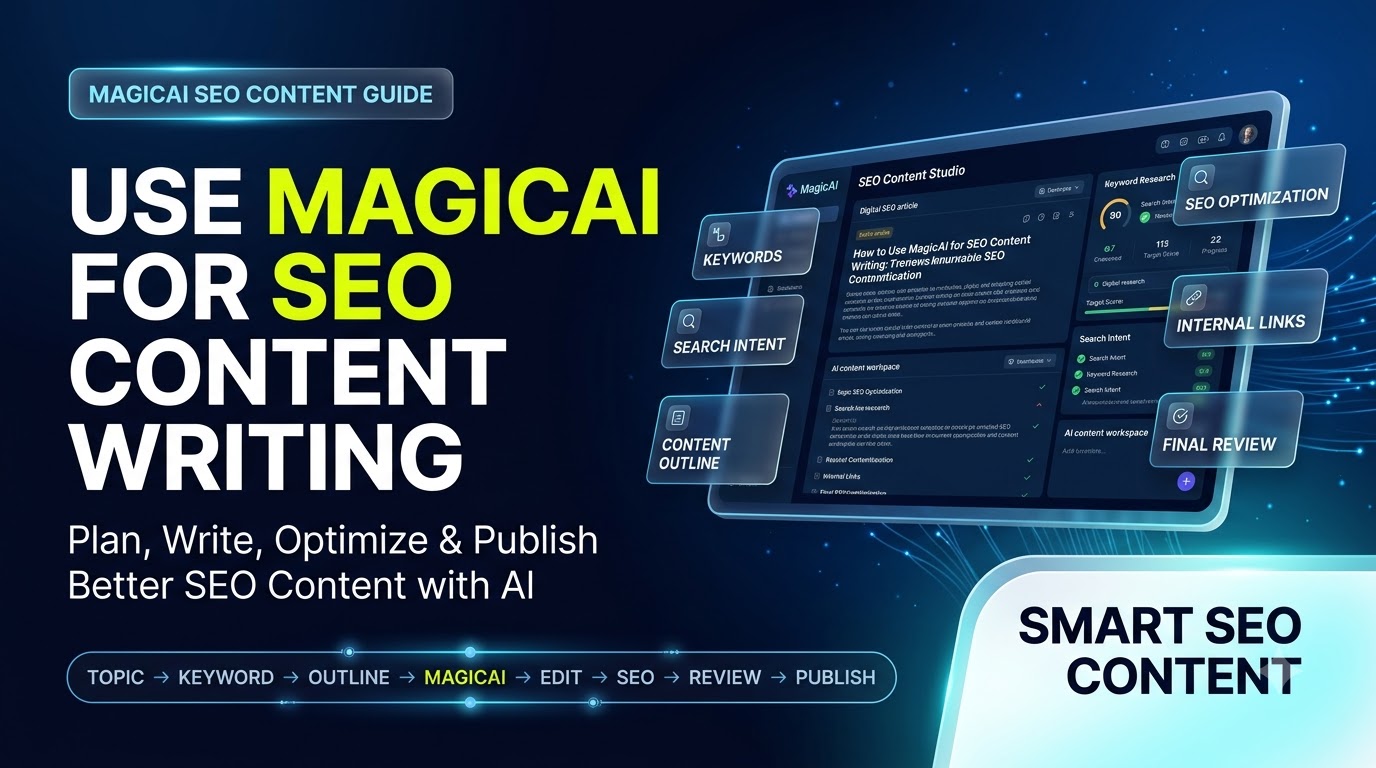
TOPIC → SEARCH INTENT → KEYWORD → QUESTIONS → OUTLINE → MAGICAI → EDIT → FACT-CHECK → SEO → INTERNAL LINKS → FAQ → REVIEW → PUBLISH
Why Use MagicAI for SEO Content Writing?
Using MagicAI can make several parts of content production faster and more organized.
1. Faster Content Ideation
Coming up with useful article topics can be difficult when publishing content regularly.
MagicAI can help generate:
- Blog ideas
- Article titles
- Content angles
- Introductions
- Outlines
- Questions
- Supporting topics
This gives writers a starting point instead of requiring them to create everything from scratch.
2. Faster First Drafts
Writing the first draft is often one of the most time-consuming parts of content creation.
MagicAI can generate an initial version that can then be reviewed and improved by the writer.
3. Better Content Structure
A well-structured article is easier to read and easier to edit.
MagicAI can help organize content into:
- H1
- H2 headings
- H3 subheadings
- Short paragraphs
- Lists
- FAQs
- Conclusions
4. SEO Support
MagicAI includes tools related to SEO, keyword generation, keyword extraction, meta descriptions, and keyword-based rewriting.
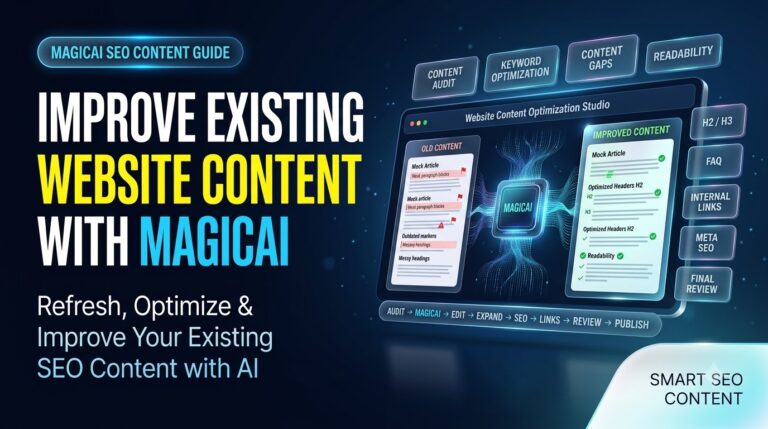
These tools can be useful when optimizing existing website content.
5. Content Repurposing
An existing article can be transformed into other formats, such as:
- Short summaries
- Social media content
- FAQs
- Website copy
- Email content
- Product descriptions
This can help businesses get more value from existing content.
Step 1: Choose a Clear SEO Topic
Before opening MagicAI, define exactly what the article should cover.
For example, instead of using a broad topic such as:
SEO
choose something more specific:
How to Create SEO-Friendly Blog Content
A specific topic makes it easier to identify the target audience, search intent, keywords, and article structure.
Ask These Questions
Before generating content, determine:
- What is the main topic?
- Who is the target reader?
- What problem does the article solve?
- What information does the reader expect?
- What action should the reader take after reading?
Step 2: Identify the Primary Keyword
The primary keyword represents the main search query you want the article to address.
For this article, the primary keyword is:
how to use MagicAI for SEO content writing
The keyword should naturally appear in important areas such as:
- Article title
- Introduction
- One or more headings where appropriate
- Body content
- Meta title
- Meta description
- URL
- Image ALT text
Do not force the keyword into every paragraph.
Step 3: Build a Secondary Keyword List
Secondary keywords help expand the topic naturally.
For a MagicAI SEO article, relevant secondary keywords could include:
- MagicAI SEO content writing
- MagicAI AI Writer
- MagicAI SEO content
- AI SEO writing
- SEO content with MagicAI
- MagicAI article writing
- AI content optimization
- SEO-friendly content with MagicAI
MagicAI also provides keyword-focused tools that can help generate or extract relevant terms.
The goal is to cover related concepts rather than repeatedly using the same keyword.
Step 4: Understand Search Intent
Search intent is the reason behind a user’s search.
Common types include:
Informational Intent
The user wants to learn something.
Example:
What is SEO content writing?
Commercial Intent
The user is researching available solutions.
Example:
Best AI tools for SEO content writing
Transactional Intent
The user is ready to take an action.
Example:
Buy SEO content software
Navigational Intent
The user is trying to find a specific website or platform.
Example:
MagicAI login
For an educational article, MagicAI should be prompted to focus primarily on informational intent.
Step 5: Find Questions People May Ask
Questions can make an article more useful and help identify content gaps.
Potential questions include:
- What is SEO content writing?
- Can MagicAI write SEO articles?
- How do I create SEO content with MagicAI?
- How should I use keywords in AI-generated content?
- Can MagicAI create blog outlines?
- How should AI-generated SEO content be edited?
- How can I optimize a MagicAI article?
- Should AI-generated content be fact-checked?
MagicAI’s ecosystem includes FAQ-generation functionality, which can help develop question-and-answer sections.
Step 6: Create an SEO-Friendly Content Outline
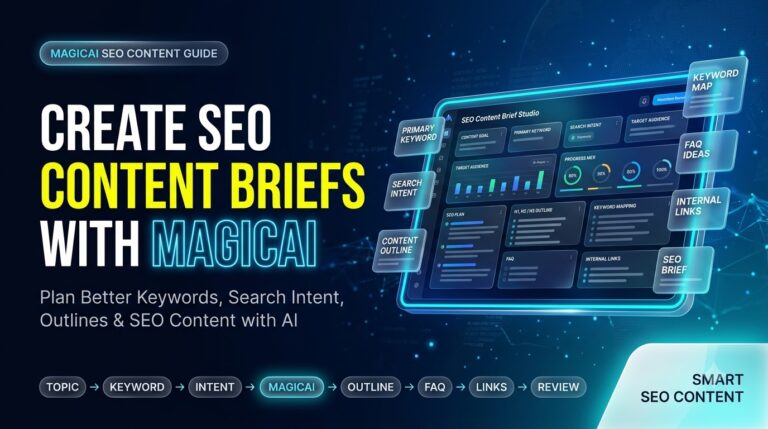
Before generating the full article, create the structure.
A useful outline could be:
- Introduction
- What Is SEO Content Writing?
- Can MagicAI Help With SEO Content?
- Why Use MagicAI?
- Choosing a Topic
- Finding Keywords
- Understanding Search Intent
- Creating an Outline
- Generating the First Draft
- Optimizing Headings
- Improving Keyword Usage
- Adding Internal Links
- Creating FAQs
- Editing and Fact-Checking
- Common Mistakes
- Final Checklist
- FAQs
- Final Verdict
MagicAI offers blog outline and article-generation functionality that can help with this stage.
Step 7: Use MagicAI to Generate the First Draft
Once the topic, audience, keyword, and outline are ready, provide MagicAI with detailed instructions.
Instead of writing:
Write an SEO article about AI.
use a more specific prompt.
MagicAI SEO Content Prompt
Write a comprehensive SEO-friendly article about [TOPIC].

Primary keyword: [PRIMARY KEYWORD]

Secondary keywords:
[KEYWORD 1]
[KEYWORD 2]
[KEYWORD 3]
[KEYWORD 4]

Target audience: [AUDIENCE]

Search intent: Informational

Create a clear H1, H2 and H3 structure. Explain the topic naturally and thoroughly. Use short paragraphs, bullet points, practical examples, and FAQs where appropriate.

Use the primary keyword naturally without keyword stuffing.

Include:
- Introduction
- Main topic explanation
- Step-by-step process
- Practical examples
- Benefits
- Common mistakes
- FAQs
- Conclusion

Write naturally for humans first. Avoid repetitive sentences, unnecessary filler, exaggerated claims, and awkward keyword placement.
The more useful information you provide, the easier it is for MagicAI to produce a focused first draft.
Step 8: Improve the Article Introduction
The introduction should quickly explain:
- What the article is about
- Why the topic matters
- What the reader will learn
Avoid long introductions that delay the answer.
A Good SEO Introduction Should:
- Mention the main topic naturally
- Establish the reader’s problem
- Explain the benefit of reading
- Lead smoothly into the first section
Step 9: Optimize Headings
Headings make long articles easier to scan.
A strong structure may look like:
H1: How to Use MagicAI for SEO Content Writing
H2: What Is SEO Content Writing?
H2: How MagicAI Helps With SEO Content
H3: Keyword Research
H3: Content Outlining
H3: Article Generation
H3: Content Optimization
H2: Common SEO Content Mistakes
H2: FAQs
Use descriptive headings rather than repeating the same keyword in every heading.
Step 10: Use Keywords Naturally
Keyword optimization should support the topic rather than dominate the writing.
For example, instead of repeatedly writing:
MagicAI SEO content writing is useful because MagicAI SEO content writing helps with SEO content writing…
write naturally:
MagicAI can assist with article planning, drafting, rewriting, and other content tasks while allowing the writer to refine the final result.
Use Keywords In Context
Place important terms where they genuinely make sense:
- Title
- Introduction
- Relevant headings
- Main content
- Metadata
- URL
- Image ALT text
Avoid keyword stuffing.
Step 11: Add Related Topics and Semantic Terms
Strong SEO content should cover the broader subject.
For an article about SEO content writing, related concepts may include:
- Search intent
- Keyword research
- Content structure
- Meta descriptions
- Internal linking
- Readability
- Content optimization
- FAQs
- User experience
- Content freshness
- Fact-checking
This creates a more comprehensive article instead of a page focused on a single repeated phrase.
Step 12: Optimize Meta Title and Meta Description
MagicAI includes a Meta Description generator and other SEO-focused tools that can assist with metadata creation.
Example Meta Title
How to Use MagicAI for SEO Content Writing | Complete Guide
Example Meta Description
Learn how to use MagicAI for SEO content writing with keyword research, content planning, AI article generation, optimization, internal linking, and editing.
The metadata should accurately describe the page and encourage relevant searchers to click.
Step 13: Add Internal Links
Internal linking connects related pages on your website.
For example, an article about MagicAI SEO content writing could link to related pages about:
- MagicAI AI Writer
- MagicAI features
- MagicAI blog writing
- MagicAI product descriptions
- MagicAI landing page copy
- MagicAI marketing copy
A useful internal linking strategy helps readers discover related information and creates a clearer website structure.
Step 14: Create an FAQ Section
FAQs are useful when they answer real questions related to the topic.
Example questions:
Can MagicAI create SEO content?
MagicAI provides article, SEO, keyword, meta description, FAQ, and rewriting tools that can support an SEO content workflow.
Can I use MagicAI for blog articles?
Yes. MagicAI includes blog and article-generation tools, including an AI Article Wizard.
Should I edit AI-generated SEO content?
Yes. Review the generated content for accuracy, originality, tone, clarity, factual claims, keyword usage, and usefulness before publishing.
Should I use the same keyword repeatedly?
No. Use the primary keyword naturally and cover related concepts without unnecessary repetition.
Step 15: Fact-Check the AI-Generated Content
AI-generated content should be reviewed before publication.
Check:
- Statistics
- Dates
- Names
- Product specifications
- Technical claims
- Pricing
- Research references
- Quotes
- Links
- Industry claims
MagicAI’s available ecosystem also includes web-search functionality and content-related tools, but the final responsibility for published information remains with the content creator.
Step 16: Improve Readability
Even a well-optimized article can perform poorly if it is difficult to read.
Use:
- Short paragraphs
- Clear headings
- Simple language
- Bullet points
- Tables when useful
- Examples
- Descriptive subheadings
- Direct explanations
Avoid unnecessary jargon unless the target audience understands it.
Step 17: Add Useful Examples
Examples make AI-generated content more practical.
For example, instead of simply explaining keyword placement, show:
Weak approach:
MagicAI SEO content writing helps with SEO content writing because it creates SEO content.
Better approach:
MagicAI can help writers create an initial SEO-focused article structure, after which the writer can refine the content for accuracy, search intent, brand voice, and reader value.
Practical examples make instructions easier to understand.
Step 18: Rewrite Weak Sections With MagicAI
If a generated paragraph is repetitive or unclear, use MagicAI’s rewriting functionality.
MagicAI provides an AI ReWriter designed to make content more professional and detailed. It also provides rewriting tools that can work with targeted keywords.
Example Rewrite Prompt
Rewrite the following paragraph to make it clearer, more professional, concise, and useful for an SEO-focused audience.

Keep the original meaning.

Use the primary keyword naturally where appropriate.

Avoid keyword stuffing, repetitive wording, exaggerated claims, and unnecessary filler.
Always compare the rewritten version with the original to make sure the meaning has not changed.
Step 19: Maintain Brand Voice
SEO content should still sound like the website publishing it.
Define:
- Tone
- Vocabulary
- Sentence style
- Target audience
- Brand personality
- Level of technical detail
For example:
Professional B2B website: Clear, technical, authoritative
Consumer website: Simple, friendly, practical
Educational website: Explanatory, structured, informative
MagicAI can generate the draft, but the final content should match the brand’s established communication style.
Step 20: Create a Strong CTA
If the article supports a business objective, finish with an appropriate call to action.
Examples:
- Explore our AI writing tools.
- Start creating your next article.
- Read our complete MagicAI guide.
- Contact our team for more information.
- Explore related SEO resources.
The CTA should be relevant to the article instead of feeling forced.
A Complete MagicAI SEO Content Workflow
A practical process can be organized into the following steps:
1. Choose Topic
↓
2. Define Search Intent
↓
3. Select Primary Keyword
↓
4. Find Secondary Keywords
↓
5. Identify Search Questions
↓
6. Build Content Outline
↓
7. Generate Draft With MagicAI
↓
8. Improve Structure
↓
9. Optimize Keywords
↓
10. Add Internal Links
↓
11. Create FAQs
↓
12. Edit for Readability
↓
13. Fact-Check
↓
14. Optimize Metadata
↓
15. Final SEO Review
↓
16. Publish
This approach keeps AI generation as one part of a broader editorial workflow.
Master Prompt for MagicAI SEO Content Writing
Use the following prompt when you want a more controlled result:
Act as an experienced SEO content writer.

Create a comprehensive, human-focused article about [TOPIC].

Primary keyword:
[PRIMARY KEYWORD]

Secondary keywords:
[SECONDARY KEYWORDS]

Target audience:
[TARGET AUDIENCE]

Search intent:
[SEARCH INTENT]

Article objective:
[OBJECTIVE]

Create a logical SEO-friendly structure with one H1 and relevant H2/H3 headings.

The article should:
- Clearly answer the main search query
- Explain the topic in depth
- Use keywords naturally
- Cover related concepts
- Include practical examples
- Use short and readable paragraphs
- Include bullet points where useful
- Include FAQs
- Include a useful conclusion
- Suggest relevant internal-link opportunities
- Include an SEO-friendly meta title
- Include an SEO-friendly meta description
- Avoid keyword stuffing
- Avoid repetitive statements
- Avoid unsupported claims
- Avoid generic filler
- Prioritize reader usefulness and clarity

Write the first draft for human review and editing before publication.
Common Mistakes When Using MagicAI for SEO
1. Publishing the First Draft Without Editing
AI-generated content should be reviewed before publishing.
2. Keyword Stuffing
Repeating the same keyword excessively can make content unnatural.
3. Ignoring Search Intent
An article can contain the correct keyword but still fail to satisfy what the searcher actually wants.
4. Using Generic Content
If the article could apply to every website, it may not provide enough unique value.
5. Skipping Fact-Checking
AI-generated claims should be verified, particularly when the content includes statistics, specifications, dates, or current information.
6. Writing Only for Search Engines
The primary audience is the reader. SEO should support useful content rather than replace it.
7. Forgetting Internal Links
Relevant internal links can help users navigate between related resources.
8. Ignoring Brand Voice
A technically optimized article can still feel wrong if it does not match the site’s communication style.
Benefits of Using MagicAI for SEO Content
| Benefit | How It Helps |
|---|---|
| Faster drafting | Creates a starting point quickly |
| Content ideas | Helps overcome topic and ideation problems |
| Article structure | Supports outlines and organized content |
| SEO assistance | Provides SEO and keyword-related tools |
| Metadata | Helps generate meta descriptions |
| Rewriting | Improves or restructures existing text |
| FAQs | Helps create question-and-answer content |
| Repurposing | Turns information into different content formats |
| Productivity | Reduces repetitive writing work |
| Scalability | Makes larger content workflows easier to manage |
MagicAI’s current toolset includes article generation, blog tools, SEO tools, keyword tools, FAQ generation, meta descriptions, rewriting, and other content-focused functions.
MagicAI vs Manual SEO Content Writing
| Factor | Manual Writing | MagicAI-Assisted Writing |
|---|---|---|
| Topic ideation | Manual research | AI-assisted |
| First draft | Takes more time | Faster |
| Outline creation | Manual | AI-assisted |
| Keyword integration | Manual | AI-assisted |
| Rewriting | Manual | Faster with AI |
| FAQs | Manual | AI-assisted |
| Human judgment | High | Still essential |
| Fact-checking | Required | Required |
| Final editing | Required | Required |
The strongest approach is usually not AI versus humans. It is a workflow where AI handles repetitive drafting tasks while humans control strategy, accuracy, originality, and final quality.
Final SEO Checklist
Before publishing a MagicAI-generated article, check:
- Primary keyword is clearly defined
- Search intent is satisfied
- Title accurately describes the content
- Meta title is optimized
- Meta description is useful
- URL is concise
- H1 is clear
- H2 and H3 headings are logical
- Keywords are used naturally
- Related topics are covered
- Content provides practical value
- Internal links are included
- FAQs answer relevant questions
- Facts have been checked
- Brand voice is consistent
- Paragraphs are readable
- Repetitive AI wording has been removed
- CTA is relevant
- Final human review is complete
FAQs About Using MagicAI for SEO Content Writing
Is MagicAI good for SEO content writing?
MagicAI can be useful for SEO content workflows because it offers article generation, SEO tools, keyword-related tools, meta descriptions, FAQs, and rewriting capabilities.
Can MagicAI generate a complete SEO article?
Yes. MagicAI includes an AI Article Wizard and article-generation functionality that can help create complete article drafts.
Can MagicAI generate keywords?
MagicAI provides keyword-generation and keyword-extraction tools within its available website-content toolset.
Can MagicAI create meta descriptions?
Yes. MagicAI includes a Meta Description generator for creating SEO-focused page descriptions.
Should I publish MagicAI content without editing?
No. AI-generated content should be reviewed, fact-checked, edited, and adapted to the intended audience and brand voice before publication.
Can MagicAI help rewrite existing SEO content?
Yes. MagicAI provides an AI ReWriter and keyword-focused rewriting functionality.
How should I prompt MagicAI for better SEO content?
Give it the topic, primary keyword, secondary keywords, target audience, search intent, desired structure, tone, content requirements, and any information that must be included.
Final Verdict
MagicAI can make SEO content production faster by assisting with topic ideation, article outlines, drafting, rewriting, keywords, metadata, FAQs, and other content tasks. Its current platform includes dedicated tools for article creation and SEO-related content workflows.
The best results come from using MagicAI as part of a complete SEO workflow rather than treating it as an automatic publishing system.
A strong process is:
TOPIC → SEARCH INTENT → KEYWORD → OUTLINE → MAGICAI → EDIT → FACT-CHECK → SEO → INTERNAL LINKS → FAQ → REVIEW → PUBLISH
When AI speed is combined with human expertise, editorial judgment, accurate information, and genuine reader value, MagicAI can become a practical part of a scalable SEO content strategy.