
Introduction
Creating new website content is only one part of a successful SEO strategy. Existing pages can also become outdated, poorly optimized, difficult to read, or misaligned with what users are searching for.
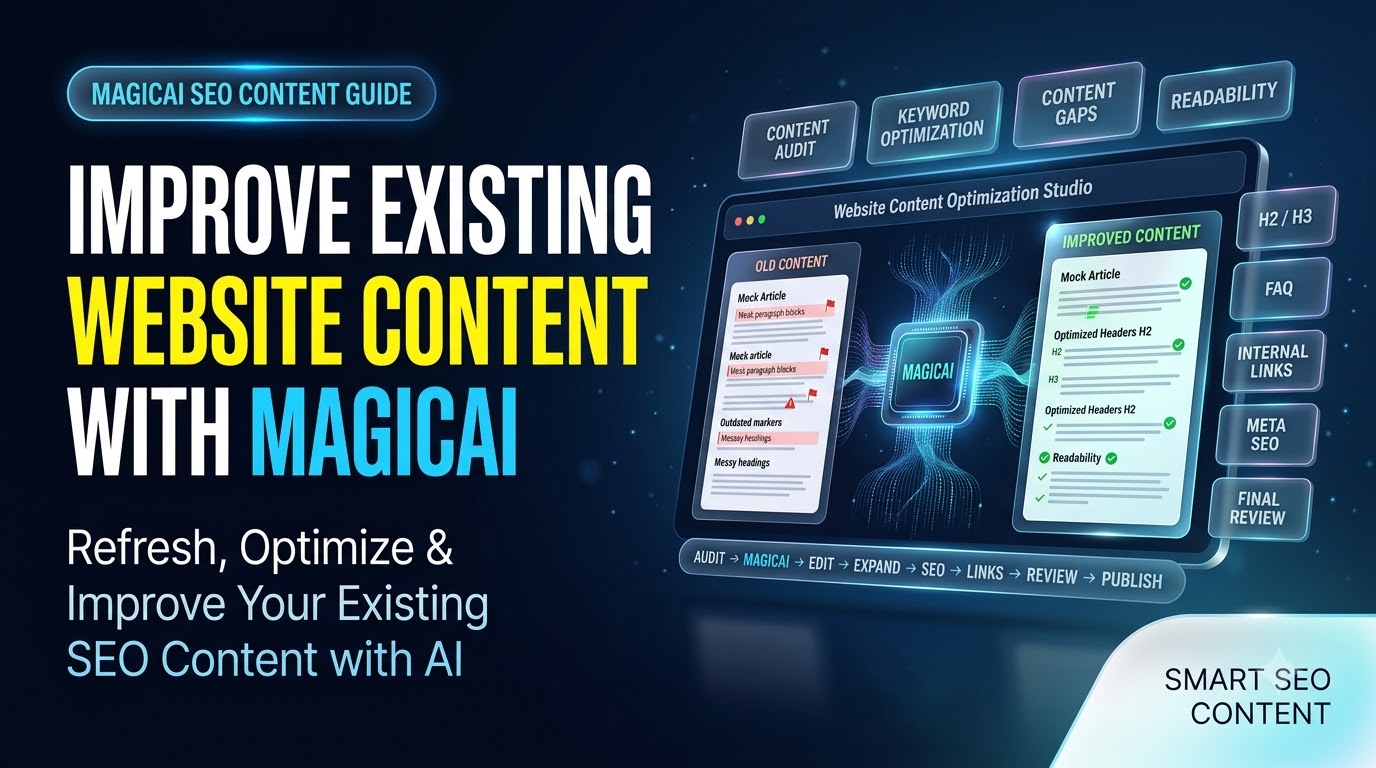
Instead of rewriting every page from scratch, you can use MagicAI to help analyze, rewrite, expand, simplify, and optimize existing website content.
A good content-improvement process should preserve useful information while making the page more relevant, readable, accurate, and useful for visitors.
This guide explains how to improve existing website content with MagicAI, including keyword optimization, headings, introductions, readability, FAQs, internal links, metadata, content gaps, and human review.
What Does Improving Existing Website Content Mean?
Improving existing website content means updating a page so that it better satisfies both users and its intended search purpose.
Content improvement can include:
- Updating outdated information
- Improving weak introductions
- Reorganizing headings
- Expanding missing sections
- Removing unnecessary information
- Improving readability
- Adding relevant keywords
- Improving search intent alignment
- Adding useful examples
- Strengthening internal links
- Updating FAQs
- Improving meta titles and descriptions
- Adding stronger calls to action
- Correcting grammar and awkward sentences
The objective is not simply to make an article longer.
The objective is to make the existing page more useful, accurate, focused, and relevant.
Why Use MagicAI to Improve Existing Content?
MagicAI can be useful during content-refresh workflows because existing text can be edited, rewritten, summarized, expanded, or reorganized instead of always being recreated from the beginning.
A structured AI-assisted workflow can help you:
- Identify weak sections
- Rewrite unclear paragraphs
- Improve introductions
- Generate alternative headings
- Expand useful topics
- Simplify complicated sentences
- Improve keyword usage
- Create FAQ ideas
- Generate meta descriptions
- Improve calls to action
- Repurpose existing information
- Standardize content quality
The key is to give MagicAI the existing content and clear instructions rather than simply asking it to rewrite everything.
When Should You Improve Existing Website Content?
Not every page needs a complete rewrite.
Consider refreshing content when:
- Information is outdated
- Search intent has changed
- The page has weak organic visibility
- Important subtopics are missing
- The introduction is unclear
- Headings are poorly organized
- The content is difficult to read
- Keywords are used unnaturally
- Internal links are missing
- FAQs are outdated
- The page no longer reflects the product or service
- The content contains unnecessary repetition
A page that already contains useful information may benefit more from targeted improvements than a complete rewrite.
Step 1: Analyze the Existing Content
Before asking MagicAI to make changes, understand what is already working.
Give MagicAI the existing content and use a prompt such as:
Analyze the following website content. Identify its strengths, weaknesses, outdated sections, missing information, readability problems, SEO opportunities, repetitive sections, and areas that should be improved. Do not rewrite the content yet.
This creates an improvement plan before editing begins.
Step 2: Define the Primary Keyword
Identify the main keyword the page should target.
For example:
Primary Keyword: SEO content optimization
Then ask MagicAI to evaluate whether the existing content naturally supports that topic.
Example prompt:
Analyze this page for the primary keyword “SEO content optimization.” Identify where the topic is covered well, where it is missing, and where the keyword or related concepts could be incorporated naturally.
Avoid forcing the primary keyword into every section.
Step 3: Check Search Intent
Search intent is one of the most important elements to review.
Ask MagicAI:
Analyze the likely search intent behind the keyword “[PRIMARY KEYWORD].” Compare it with the existing content and identify sections that do not satisfy the user’s likely expectations.
The goal is to ensure the page answers the questions and needs behind the search query.
Step 4: Improve the Page Title
An existing page may have a title that is too generic, unclear, or poorly aligned with the topic.
Ask MagicAI for alternatives:
Generate 10 SEO-friendly title options for this existing page. Keep them accurate, useful, natural, and aligned with the primary keyword and search intent.
Then select the title that best represents the actual content.
Step 5: Improve the Introduction
The introduction should quickly explain:
- What the page is about
- Who it is for
- Why the information matters
- What the reader will learn
Prompt MagicAI:
Rewrite the introduction to make it clearer, more useful, and more engaging. Keep the original meaning and important facts. Use the primary keyword naturally and avoid exaggerated claims.
Do not allow the AI to introduce unsupported information just to make the introduction sound more impressive.
Step 6: Improve H1, H2, and H3 Headings
Poor headings can make a useful article difficult to navigate.
Ask MagicAI:
Review the existing H1, H2, and H3 headings. Identify repetitive, vague, or poorly ordered headings and suggest a clearer SEO-friendly heading structure.
A logical structure could look like:
H1 → Introduction → Main Concept → Benefits → Process → Examples → Mistakes → FAQs → Conclusion
The exact structure should depend on the topic.
Step 7: Identify Missing Topics
One of the most useful content-refresh tasks is identifying gaps.
Prompt MagicAI:
Review the existing article and identify important subtopics that are missing. Focus only on topics that are directly relevant to the primary keyword and search intent. Explain where each missing topic should be added.
This can help turn an incomplete article into a more comprehensive resource.
Step 8: Improve Keyword Usage
Keywords should support the topic naturally.
Ask MagicAI to review:
- Primary keyword usage
- Secondary keywords
- Related terminology
- Keyword placement
- Heading relevance
- Contextual usage
Example prompt:
Review this content for keyword usage. Identify opportunities to naturally incorporate relevant primary, secondary, long-tail, and related terms without keyword stuffing or changing the original meaning.
Step 9: Improve Readability
Existing website content may contain long sentences, unnecessary jargon, or complicated paragraphs.
Ask MagicAI:
Improve the readability of this content while preserving its meaning and important information. Use shorter sentences, clearer wording, useful headings, and concise paragraphs. Do not remove important technical details.
This is particularly useful for:
- Technical content
- Product pages
- Business websites
- Service pages
- Long-form articles
- Documentation
Step 10: Rewrite Weak Sections
Do not automatically rewrite the entire page.
Instead, identify weak sections and improve them individually.
Example:
Rewrite this section to make it clearer, more informative, and easier to scan. Preserve all important factual information and avoid adding unsupported claims.
This gives you more control over the final content.
Step 11: Expand Useful Sections
Some pages are not bad—they are simply incomplete.
Ask MagicAI:
Expand this section with additional useful information that directly supports the topic. Avoid repetition, filler, generic statements, and unsupported claims.
Expansion should add value rather than simply increase word count.
Step 12: Remove Repetitive Content
Older website content may repeat the same idea multiple times.
Prompt:
Identify repetitive information in this content. List the repeated sections and recommend which version should be retained or combined. Do not remove unique information.
After reviewing the recommendations, you can ask MagicAI to consolidate the repeated sections.
Step 13: Improve Internal Linking Opportunities
Existing pages can often be strengthened with relevant internal links.
Ask MagicAI:
Identify natural internal-link opportunities in this article. For each opportunity, provide the section, recommended anchor-text idea, and relevant destination topic.
Potential destination pages may include:
- Related blog posts
- Product pages
- Service pages
- Category pages
- SEO guides
- Supporting educational resources
Always verify that the suggested destination pages actually exist.
Step 14: Improve FAQ Sections
Older content may have weak or outdated FAQs.
Ask MagicAI:
Review this article and generate relevant FAQ questions that address important user concerns not already answered clearly in the main content. Avoid duplicate or unrelated questions.
Then answer only the questions that genuinely belong on the page.
Step 15: Improve Meta Title and Meta Description
MagicAI can help generate alternative metadata for the refreshed page.
Example prompt:
Create five SEO-friendly meta title options and five meta description options for this page. Keep them accurate, concise, relevant to the primary keyword, and aligned with the actual content.
Do not make the metadata promise information that the page does not provide.
Step 16: Improve Calls to Action
A page may provide useful information but still have a weak next step.
Ask MagicAI:
Review the page and suggest three relevant CTA options based on the reader’s likely intent. Keep them helpful and natural rather than overly promotional.
For example, the CTA could encourage users to:
- Read a related guide
- Explore a product
- Request more information
- Contact the business
- Start a service
- View another resource
Step 17: Update Outdated Information
AI should not be allowed to invent replacement facts.
Instead, identify outdated information first.
Prompt:
Identify statements in this content that may be outdated or require verification. Do not invent updated information. List the statements that should be manually checked.
Then verify those details using reliable current sources before publishing.
Step 18: Preserve Valuable Existing Information
A common mistake is asking AI to completely rewrite an existing page.
That can accidentally remove:
- Important specifications
- Useful examples
- Original expertise
- Product details
- Business-specific information
- Relevant statistics
- Valuable explanations
A better prompt is:
Improve this content while preserving useful information, important details, original examples, and factual statements. Only remove content when it is clearly repetitive, irrelevant, or outdated.
Step 19: Improve Content Structure
A strong website page should be easy to scan.
Ask MagicAI to identify opportunities for:
- Bullet lists
- Tables
- Short paragraphs
- Step-by-step instructions
- Examples
- Definitions
- Highlighted key points
- FAQs
Not every page needs all of these formats. Use them when they genuinely improve comprehension.
Step 20: Compare the Original and Improved Versions
Do not immediately replace the original page.
Ask MagicAI to summarize the changes:
Compare the original and revised versions. List the major improvements made to the structure, clarity, SEO relevance, readability, topic coverage, and user experience.
This makes it easier to identify unwanted changes before publishing.
MagicAI Prompt for Improving an Existing Article
Use this reusable prompt:
Act as an experienced SEO content editor. Review the following existing website content and improve it without unnecessarily rewriting useful information.
Primary keyword: “[PRIMARY KEYWORD]”
Secondary keywords: “[SECONDARY KEYWORDS]”
Target audience: “[TARGET AUDIENCE]”
Search intent: “[SEARCH INTENT]”
Content goal: “[CONTENT GOAL]”
First analyze the content for:
- Search intent alignment
- Content gaps
- Keyword usage
- Heading structure
- Readability
- Repetition
- Outdated information
- Internal-link opportunities
- FAQ opportunities
- CTA opportunities
Then recommend specific improvements.
After the recommendations, rewrite only the sections that need improvement.
Preserve accurate facts, useful examples, important product or business information, and the original meaning. Do not invent facts, keyword-stuff, add filler, or remove valuable information simply to make the content longer.
MagicAI Prompt for Refreshing an Old SEO Article
Refresh the following existing SEO article for its current audience. Preserve valuable information while improving structure, readability, search intent alignment, keyword relevance, topical coverage, FAQs, internal-link opportunities, and calls to action.
Identify potentially outdated claims separately so they can be verified before publication.
Do not invent statistics, facts, product information, or current trends.
Keep the writing natural, useful, authoritative, and focused on the reader.
MagicAI Prompt for Improving a Product Page
Improve this existing product page for SEO and conversions. Preserve all verified technical specifications and product information. Improve the product introduction, benefits, features, keyword usage, headings, applications, FAQs, internal-link opportunities, meta title, meta description, and CTA. Do not invent specifications or make unsupported performance claims.
How to Improve Existing Service Pages
Service pages often require a different approach from blog articles.
Ask MagicAI to review:
- Service description
- Customer problems
- Benefits
- Process
- Service areas
- FAQs
- Trust signals
- CTA
- Internal links
- SEO metadata
Example prompt:
Improve this service page for search intent and conversions. Make the service benefits clearer, explain the process, answer important customer questions, and strengthen the CTA without making unsupported claims.
How to Improve Existing Product Descriptions
For ecommerce or product pages, focus on useful buyer information.
Ask MagicAI to improve:
- Product introduction
- Features
- Benefits
- Specifications
- Applications
- Suitable users
- Product use cases
- FAQs
- SEO title
- Meta description
- CTA
Always preserve verified technical specifications.
How to Improve Existing Blog Posts
For blog content, focus on:
- Search intent
- Topic coverage
- Content depth
- Heading structure
- Keyword relevance
- Examples
- FAQs
- Internal links
- Readability
- Freshness
Ask MagicAI to identify which sections should be updated rather than automatically rewriting everything.
Content Improvement Workflow with MagicAI
Use this workflow:
EXISTING CONTENT → CONTENT AUDIT → PRIMARY KEYWORD → SEARCH INTENT → CONTENT GAPS → HEADING REVIEW → KEYWORD REVIEW → MAGICAI IMPROVEMENTS → REWRITE WEAK SECTIONS → ADD MISSING INFORMATION → INTERNAL LINKS → FAQ → META DATA → CTA → FACT-CHECK → HUMAN REVIEW → PUBLISH
This process gives you control over every major content change.
Common Mistakes to Avoid
1. Rewriting Everything Automatically
A complete rewrite may remove useful information.
Improve the sections that actually need improvement.
2. Adding Keywords Everywhere
Keyword stuffing can make content unnatural.
Prioritize relevance and context.
3. Increasing Word Count Without Adding Value
A longer page is not automatically a better page.
Every new section should serve a purpose.
4. Allowing AI to Invent Facts
AI-generated information should be reviewed carefully, especially for technical, financial, medical, legal, product, or business-specific content.
5. Removing Original Expertise
Existing pages may contain unique knowledge that should be preserved.
6. Ignoring Search Intent
Adding keywords while leaving the actual user need unanswered will not solve the fundamental content problem.
7. Forgetting Internal Links
Refreshing the text without reviewing the site’s internal-link structure is a missed opportunity.
8. Publishing Without Human Review
AI should assist the editing process, not replace final editorial judgment.
Benefits of Improving Existing Website Content with MagicAI
A structured MagicAI content-refresh workflow can help you:
- Save editing time
- Identify content weaknesses
- Improve readability
- Generate new section ideas
- Improve keyword organization
- Refresh introductions
- Improve headings
- Find FAQ opportunities
- Plan internal links
- Create stronger CTAs
- Standardize content updates
- Maintain a repeatable SEO workflow
The biggest advantage is the ability to improve existing content systematically instead of treating every page as a completely new writing project.
AI-Assisted Content Refresh vs Manual Editing
| Factor | Manual Editing | MagicAI-Assisted Editing |
|---|---|---|
| Content analysis | Manual | AI-assisted |
| Rewrite ideas | Manual | Faster generation |
| Heading suggestions | Manual | AI-assisted |
| Readability improvements | Manual | Faster |
| Content-gap ideas | Research-intensive | AI-assisted |
| Keyword suggestions | Manual | AI-assisted |
| FAQ ideas | Manual | Rapid generation |
| Human judgment | Essential | Essential |
| Fact verification | Required | Required |
| Final publishing decision | Human | Human |
MagicAI can accelerate repetitive editing tasks, but the final quality still depends on human review and subject knowledge.
Existing Content Improvement Checklist
Before publishing an updated page, check:
- Existing content has been reviewed
- Primary keyword is clearly defined
- Search intent is understood
- Target audience is clear
- Title is relevant
- H1 is appropriate
- H2/H3 structure is logical
- Content gaps have been reviewed
- Important information is preserved
- Repetitive sections are removed
- Keywords are used naturally
- Readability has been improved
- Internal links are relevant
- FAQs are useful
- Meta title is optimized
- Meta description is accurate
- CTA matches user intent
- Potentially outdated claims are verified
- AI-generated changes have been reviewed
- Final content is accurate and useful
Frequently Asked Questions
Can MagicAI improve existing website content?
Yes. MagicAI can be used to help rewrite, expand, summarize, restructure, and refine existing content. The best results come from giving it the existing content along with specific improvement instructions.
Should I rewrite my entire website with MagicAI?
No. Prioritize pages that have clear improvement opportunities. Refresh valuable existing content instead of automatically replacing everything.
Can MagicAI improve SEO in existing content?
It can help identify keyword, structure, readability, and content-coverage opportunities. SEO recommendations should still be reviewed against the page’s actual search intent and business goals.
Can MagicAI identify content gaps?
Yes. You can ask it to review an existing page and suggest relevant topics, questions, and sections that may be missing.
Can MagicAI rewrite old content without changing its meaning?
Yes. A carefully written prompt can instruct MagicAI to preserve the original meaning, important facts, examples, and business information while improving clarity and structure.
Should AI-generated updates be fact-checked?
Yes. Especially when content includes statistics, specifications, dates, prices, policies, technical information, or other details that may change.
Can MagicAI improve product pages?
Yes. It can help improve product introductions, benefits, features, FAQs, SEO metadata, readability, and calls to action while preserving verified product specifications.
Does refreshing old content guarantee better rankings?
No. Content improvement can make a page more useful and better aligned with its intended search query, but search performance depends on many factors, including competition, relevance, technical SEO, authority, user experience, and overall site quality.
Final Verdict
Improving existing website content with MagicAI is often more efficient than starting every page from scratch.
The strongest approach is to audit first, improve second, and publish only after human review.
Use MagicAI to identify weak sections, improve headings, refine keyword usage, expand missing topics, simplify difficult writing, generate FAQ ideas, strengthen internal links, and create better metadata.
However, do not let AI automatically change everything. Preserve valuable information, verify potentially outdated claims, and make sure every revision serves the reader and the page’s search intent.
A practical process is:
AUDIT → PLAN → MAGICAI → EDIT → EXPAND → OPTIMIZE → FACT-CHECK → REVIEW → PUBLISH
Used consistently, this workflow can turn an existing website into a stronger, clearer, more useful, and better-organized content resource.