
Introduction
Startups usually operate with limited time, limited resources, and small teams. Founders and early employees often have to handle marketing, customer communication, content creation, research, product promotion, documentation, and other business tasks simultaneously.
AI can help startups reduce the time spent on repetitive work.
MagicAI for startups can support a wide range of these activities through AI-assisted writing, custom templates, content generation, image creation, rewriting, summarization, document analysis, social media tools, email generation, SEO-oriented content tools, and other capabilities. MagicAI’s current platform includes an AI writing assistant, AI Image Generator, custom prompts and templates, Article Generator, Product Description, social media templates, advertising tools, email tools, FAQ generation, File Analyzer, AI ReWriter, AI Web Chat, and export options.
The most effective approach is not to automate everything. Startups can use MagicAI to accelerate repetitive tasks while keeping product decisions, strategy, customer understanding, fact-checking, and final approval under human control.
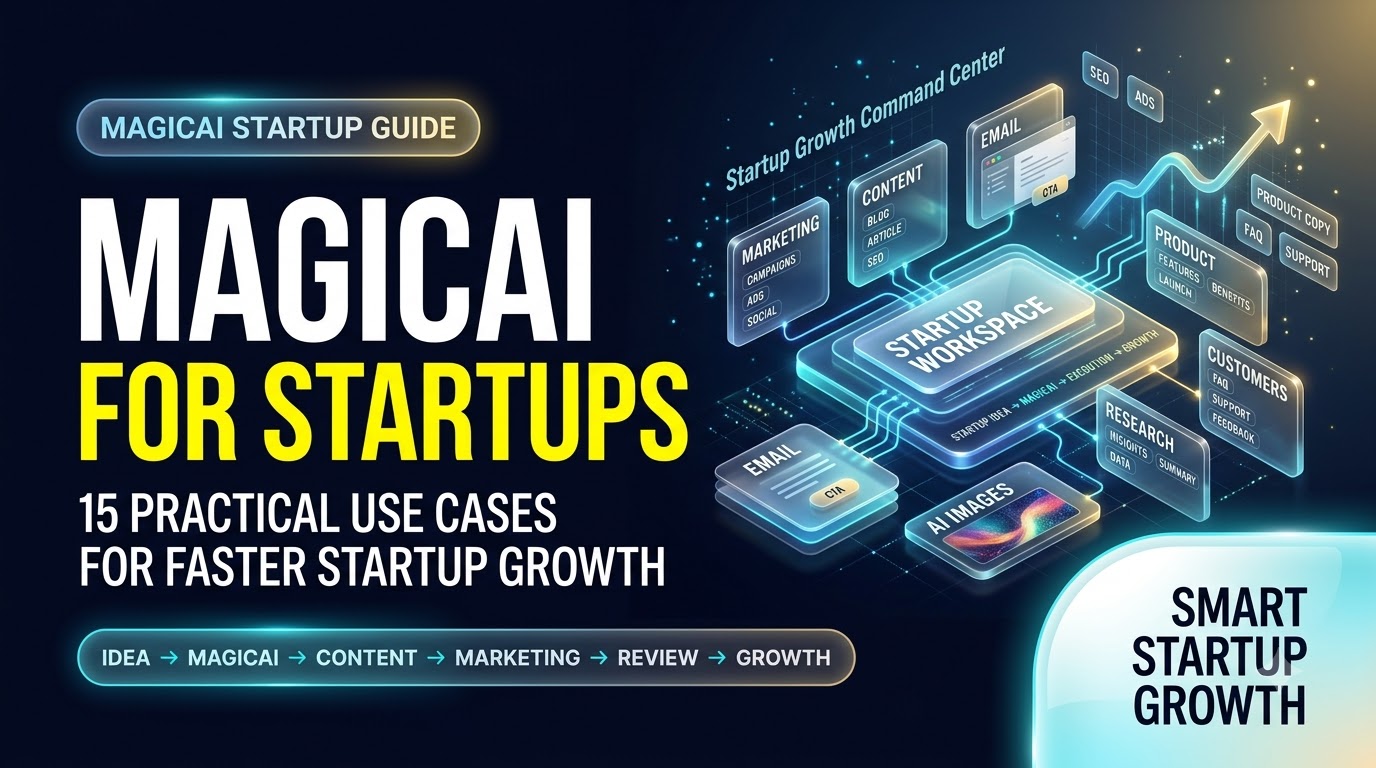
This guide covers 15 practical MagicAI use cases for startups, along with workflows and ready-to-use prompts.
What Is MagicAI for Startups?
MagicAI is an AI-powered platform that can help startups create and organize different types of content and business materials.
The platform allows users to provide an idea or basic information, generate an output, review and edit it, and then export or publish the result. It also supports custom prompts and templates, making it possible to create repeatable workflows.
For startups, this can be useful for:
- Content marketing
- SEO
- Social media
- Email campaigns
- Product descriptions
- Website copy
- Advertising
- Customer communication
- Research summaries
- Startup documentation
- Content repurposing
- AI-generated visuals
- Brainstorming
- Internal productivity
A simple startup workflow is:
IDEA → INFORMATION → MAGICAI → HUMAN REVIEW → PUBLISH / USE
Why Startups Can Benefit From MagicAI
Startups often need to move quickly without immediately building large specialized teams.
A founder may simultaneously act as:
- Product manager
- Marketer
- Salesperson
- Content creator
- Customer-support representative
- Business strategist
MagicAI can help reduce the workload involved in repetitive writing and content-production tasks.
Potential benefits include:
- Faster content creation
- Faster brainstorming
- More marketing variations
- Quicker customer communication
- Easier SEO content production
- Faster social media planning
- Easier document summarization
- Reusable content workflows
- Faster campaign development
- Better use of limited team resources
The objective should be more productive work, not simply more AI-generated content.
15 Practical MagicAI Use Cases for Startups
1. Generate Startup Content Ideas
Startups need a steady flow of content to build awareness and educate potential customers.
MagicAI includes tools such as Blog Post Ideas and Post Title Generator that can support content ideation.
Use it to generate ideas for:
- Blog posts
- Social media
- Newsletters
- Educational content
- Product announcements
- Customer stories
- Industry insights
- Lead-generation content
Example Prompt
Generate 30 content ideas for a startup offering [PRODUCT/SERVICE] to [TARGET AUDIENCE]. Divide the ideas into educational, problem-solving, product-focused, industry-insight, customer-focused, and promotional topics. Include the purpose of each idea.
This gives the startup a larger pool of ideas to evaluate.
2. Create Website Content
A startup website needs clear messaging.
MagicAI can help create first drafts for:
- Homepage sections
- Service pages
- Product pages
- About pages
- FAQs
- Landing pages
- Feature descriptions
- Calls to action
Example Prompt
Create homepage copy for a startup that provides [PRODUCT/SERVICE] to [AUDIENCE]. Include a clear headline, supporting statement, customer problem, solution, three key benefits, feature summary, trust section, FAQ, and CTA. Use only the information provided.
The startup team should then refine the copy to reflect its actual positioning.
3. Write Product Descriptions
Startups launching physical or digital products need clear product messaging.
MagicAI includes Product Description and Product Name Generator templates.
A startup can provide:
- Product name
- Features
- Benefits
- Target audience
- Specifications
- Applications
- Differentiators
- Brand voice
Example Prompt
Write a professional product description for [PRODUCT]. Explain the customer problem, how the product solves it, key features, practical benefits, ideal customer, and CTA. Use only the supplied product information and do not invent specifications or claims.
4. Build an SEO Content Strategy
Organic search can be valuable for startups looking to build long-term visibility.
MagicAI can support several stages of SEO content production through article generation, blog ideas, meta descriptions, FAQs, blog sections, and related content templates.
A practical workflow is:
TOPIC → KEYWORD → SEARCH INTENT → OUTLINE → MAGICAI → EDIT → SEO REVIEW → PUBLISH
Example Prompt
Create an SEO content plan for a startup selling [PRODUCT/SERVICE]. Identify primary topics, supporting topics, customer questions, search intent, suggested content formats, and internal-link opportunities.
AI should support the process, while keyword research and SEO decisions should be validated independently.
5. Create Blog Articles
Content marketing can help startups educate potential customers and build topical authority.
MagicAI currently provides Article Generator, Blog Section, Blog Post Ideas, Blog Intros, Blog Conclusion, and AI Article Wizard tools.
Instead of generating an entire article without direction, use a staged workflow:
RESEARCH → OUTLINE → INTRO → SECTIONS → CONCLUSION → FACT-CHECK → EDIT
Example Prompt
Write an introduction for a detailed article about [TOPIC] targeting [AUDIENCE]. Explain the problem, why it matters, what the article will cover, and what the reader can expect to learn. Keep the tone professional and natural.
6. Create Social Media Content
Startups need to communicate consistently across social platforms.
MagicAI currently includes templates for Instagram captions, Instagram hashtags, business social posts, tweet-style posts, and Facebook headlines.
Possible startup content categories include:
- Product education
- Founder insights
- Customer problems
- Industry news
- Product updates
- Behind-the-scenes content
- Educational tips
- Launch announcements
Example Prompt
Create 10 LinkedIn posts for a startup offering [PRODUCT/SERVICE] to [AUDIENCE]. Include educational, problem-solving, founder-led, product-focused, and industry-insight posts. Keep the tone professional, clear, and authentic.
7. Create Startup Marketing Campaigns
A startup may need to promote a product launch, feature, event, offer, or new service.
MagicAI can help brainstorm campaign messaging and produce initial marketing assets.
Campaign Workflow
GOAL → AUDIENCE → OFFER → MESSAGE → MAGICAI → VARIATIONS → REVIEW → PUBLISH
Example Prompt
Create a marketing campaign concept for the launch of [PRODUCT/FEATURE]. Define the target audience, campaign objective, core message, content themes, social media ideas, email angle, advertising concepts, CTA, and suggested campaign timeline.
This creates a starting framework that the startup team can refine.
8. Generate Advertising Copy
Paid advertising often requires multiple variations for testing.
MagicAI includes Facebook Ads, Facebook Headlines, and Google Ads Description templates.
Startups can use AI to develop:
- Headlines
- Ad descriptions
- Benefits
- CTA variations
- Campaign angles
- Promotional copy
Example Prompt
Create 10 advertising headline variations and 10 descriptions for [PRODUCT]. Target [AUDIENCE]. Focus on the primary customer benefit and use only verified product information. Avoid unsupported statistics, guarantees, and exaggerated claims.
Human review is important before advertising copy is published.
9. Write Email Campaigns
Email can help startups communicate with leads, customers, and subscribers.
MagicAI currently provides Email Generator, Email Answer Generator, and Newsletter Generator templates.
Use it for:
- Welcome emails
- Product launches
- Feature announcements
- Newsletters
- Lead nurturing
- Customer education
- Follow-ups
Example Prompt
Create a four-email sequence for a startup launching [PRODUCT]. Email 1 should introduce the problem, Email 2 should educate the audience, Email 3 should explain the product solution, and Email 4 should encourage the reader to take the next step. Use a professional and approachable tone.
10. Create Startup Newsletters
Newsletters allow startups to build a direct communication channel with their audience.
A simple newsletter structure is:
SUBJECT → INTRODUCTION → INSIGHT → PRODUCT UPDATE → USEFUL RESOURCE → CTA
MagicAI’s current templates include Newsletter Generator and other email-related tools.
Example Prompt
Create a monthly newsletter for [STARTUP]. Include one useful industry insight, one educational tip, one product update, one customer-focused takeaway, and one CTA. Keep the content informative rather than overly promotional.
11. Create FAQs and Customer Education
Early-stage startups frequently receive similar customer questions.
MagicAI includes an FAQ Generator that can help create initial question-and-answer content.
FAQs can cover:
- Product functionality
- Pricing questions
- Setup
- Use cases
- Compatibility
- Support
- Implementation
- Common objections
Example Prompt
Generate 20 FAQs for [PRODUCT/SERVICE]. Cover common customer questions, implementation, features, limitations, support, and next steps. Use only the information supplied and identify questions that require additional business information.
This content can support websites, onboarding, sales conversations, and customer education.
12. Summarize Research and Documents
Startup teams often receive large amounts of information from:
- Market research
- Customer interviews
- Product documents
- Competitor research
- Industry reports
- Internal documents
MagicAI currently provides summarization features and a File Analyzer that supports PDF, CSV, DOC, and DOCX files.
Example Prompt
Analyze this startup research document and summarize the key findings, customer problems, market observations, important facts, unanswered questions, and recommended areas for further research. Clearly separate information from recommendations.
The original documents should still be checked before important business decisions are made.
13. Improve Existing Content
Startups often create website or marketing content quickly and improve it later.
MagicAI’s AI ReWriter can help rewrite content to make it more professional and detailed.
Use it to improve:
- Website copy
- Blog articles
- Product pages
- Email campaigns
- Social posts
- Marketing messages
- FAQs
Example Prompt
Improve this startup website copy for clarity, readability, and customer focus. Preserve all factual information, remove unnecessary repetition, strengthen the value proposition, and do not introduce unsupported claims.
14. Create AI Marketing Visuals
Visual content can be expensive or time-consuming for a small startup.
MagicAI includes an AI Image Generator and Chat Image functionality for generating images from user input.
Potential uses include:
- Blog featured images
- Social media graphics
- Campaign concepts
- Product concepts
- Website visuals
- Marketing creatives
Example Image Prompt
Create a premium SaaS startup marketing visual showing a modern AI-powered business workspace with product analytics, customer insights, content creation, and marketing workflow cards. Use dark navy, electric blue, cyan, white, premium glassmorphism, cinematic lighting, realistic depth, and clean negative space.
The startup should review generated visuals for brand consistency and accuracy.
15. Repurpose Startup Content
One of the most practical uses of AI is turning one asset into multiple formats.
For example:
ONE BLOG ARTICLE
can become:
- 3 LinkedIn posts
- 5 social media captions
- 1 newsletter
- 5 FAQs
- 3 ad concepts
- 1 customer email
- 5 short-form content ideas
Example Prompt
Repurpose the following startup article into three LinkedIn posts, five social media captions, one newsletter, five FAQs, three advertising concepts, and five short-form content ideas. Preserve all factual information and maintain a consistent brand voice.
This allows small teams to get more value from content they have already created.
MagicAI for Different Startup Departments
| Startup Area | Practical MagicAI Uses |
|---|---|
| Marketing | Campaigns, blogs, ads, social media |
| SEO | Articles, metadata, FAQs, content ideas |
| Sales | Emails, product messaging, proposals |
| Customer Success | FAQs, responses, educational content |
| Product | Feature descriptions, announcements, documentation drafts |
| Founder/CEO | Thought leadership and communication |
| Operations | Summaries, documents, internal content |
| Ecommerce | Product names and descriptions |
| Design/Creative | AI visual concepts |
| Research | Document and webpage analysis |
MagicAI Startup Workflow
A startup can build a repeatable workflow around its most common tasks.
BUSINESS GOAL → AUDIENCE → INFORMATION → PROMPT → MAGICAI → HUMAN REVIEW → FACT-CHECK → PUBLISH → MEASURE
For content marketing:
TOPIC → KEYWORD → OUTLINE → MAGICAI → EDIT → SEO → PUBLISH
For campaigns:
GOAL → AUDIENCE → MESSAGE → MAGICAI → VARIATIONS → REVIEW → DISTRIBUTE
For customer communication:
QUESTION → CONTEXT → MAGICAI → PERSONALIZE → REVIEW → SEND
How Startups Can Create Reusable MagicAI Templates
The biggest productivity opportunity is to avoid starting from scratch.
Create reusable templates for:
- Blog posts
- Social media
- Emails
- Product descriptions
- FAQs
- Ad copy
- Newsletters
- Customer responses
- Content briefs
- Marketing campaigns
MagicAI supports custom prompts and templates, making repeatable workflows possible.
Example Startup Template
Startup: [NAME]
Product: [PRODUCT]
Target Audience: [AUDIENCE]
Customer Problem: [PROBLEM]
Key Benefit: [BENEFIT]
Channel: [CHANNEL]
Campaign Goal: [GOAL]
Brand Voice: [VOICE]
CTA: [CTA]Create [DELIVERABLE] using only the information provided. Make the content clear, customer-focused, and consistent with the brand voice. Do not invent statistics, testimonials, pricing, certifications, guarantees, or product claims.
Master MagicAI Prompt for Startups
Act as an experienced startup marketing and content assistant.
Startup: [STARTUP NAME]
Industry: [INDUSTRY]
Product/Service: [PRODUCT/SERVICE]
Target Audience: [AUDIENCE]
Business Goal: [GOAL]
Customer Problem: [PROBLEM]
Key Benefits: [BENEFITS]
Marketing Channel: [CHANNEL]
Primary Keyword: [KEYWORD]
Brand Voice: [VOICE]
CTA: [CTA]
Required Deliverable: [FORMAT]Create a professional first draft based only on the information supplied. Make the content useful, clear, specific, and audience-focused. Do not invent statistics, testimonials, customer results, pricing, certifications, guarantees, or product claims. Structure the output so it can be reviewed and edited by a startup team before publication.
15 Ready-to-Use MagicAI Prompts for Startups
Prompt 1: Startup Content Ideas
Generate 25 content ideas for [STARTUP] targeting [AUDIENCE]. Group them into educational, problem-solving, product-focused, industry-insight, and promotional topics.
Prompt 2: Homepage Copy
Create homepage copy for [STARTUP]. Include a headline, value proposition, customer problem, solution, benefits, features, FAQ, and CTA.
Prompt 3: Product Launch
Create a launch campaign for [PRODUCT]. Include the campaign message, social posts, email angle, advertising ideas, landing-page headline, and CTA.
Prompt 4: Blog Strategy
Create a 60-day SEO content plan for [STARTUP] targeting [AUDIENCE]. Include topics, search intent, content format, primary keyword, and suggested CTA.
Prompt 5: Social Media
Create 15 social media posts for [STARTUP]. Mix educational, product, founder, customer-problem, industry-insight, and engagement content.
Prompt 6: Email Sequence
Create a five-email sequence for [PRODUCT]. Include subject lines, email purpose, body copy, CTA, and audience stage.
Prompt 7: Ad Copy
Generate 10 ad headlines and 10 descriptions for [PRODUCT]. Focus on customer benefits and use only verified information.
Prompt 8: FAQ
Generate 20 FAQs for [PRODUCT/SERVICE]. Cover features, setup, use cases, limitations, support, and common customer objections.
Prompt 9: Product Description
Write a professional product description for [PRODUCT] using only the supplied features, specifications, benefits, and applications.
Prompt 10: Customer Response
Write a helpful response to this customer question: [QUESTION]. Use the supplied company information and avoid making claims that cannot be verified.
Prompt 11: Research Summary
Summarize this research document into key findings, customer problems, market observations, important facts, unanswered questions, and areas requiring further investigation.
Prompt 12: Content Repurposing
Turn this article into LinkedIn posts, social captions, email content, FAQs, and ad concepts while preserving all original facts.
Prompt 13: Founder Content
Generate 10 thought-leadership post ideas for the founder of [STARTUP]. Focus on lessons, industry observations, customer problems, product-building insights, and practical advice.
Prompt 14: Marketing Calendar
Create a 30-day marketing calendar for [STARTUP]. Include date, platform, topic, content format, objective, CTA, and target audience.
Prompt 15: Content Review
Review this startup marketing content for clarity, factual accuracy, brand voice, customer relevance, repetition, unsupported claims, and missing information. Provide prioritized recommendations.
How Startups Can Measure Productivity
AI adoption should be measured by actual improvements.
Track:
- Time spent creating content
- Time spent writing emails
- Research time
- Number of content assets produced
- Editing time
- Campaign preparation time
- Customer-response time
- Time spent on repetitive tasks
A simple comparison can be:
| Task | Before MagicAI | With MagicAI | What to Measure |
|---|---|---|---|
| Blog first draft | Manual | AI-assisted | Time saved |
| Email writing | Manual | AI-assisted | Time saved |
| Social content | Manual | Template-assisted | Production time |
| Research summary | Manual | AI-assisted | Review time |
| Content repurposing | Manual | AI-assisted | Assets per hour |
| Ad variations | Manual | AI-assisted | Creative production time |
The purpose is not to maximize AI output. It is to give the startup team more time for product development, customer conversations, strategy, and growth.
Common Mistakes Startups Should Avoid
1. Using Generic Prompts
Give MagicAI enough information about the startup, customer, product, and goal.
2. Publishing AI Content Without Review
AI-generated drafts should be edited and fact-checked.
3. Inventing Startup Claims
Do not allow AI to create fake:
- Customer numbers
- Revenue figures
- Testimonials
- Reviews
- Certifications
- Product capabilities
- Performance claims
4. Losing the Startup’s Voice
AI content should sound like the actual company.
5. Automating Customer Communication Completely
Customer communication often requires context and empathy.
6. Creating Content Without a Goal
Every content asset should have a clear purpose.
7. Using AI Instead of Customer Research
AI can organize and assist with information, but real customer conversations remain important.
Best Practices for Using MagicAI at a Startup
Start Small
Choose one or two repetitive workflows first.
Create Templates
Turn successful prompts into reusable systems.
Provide Real Context
Include accurate product and customer information.
Review Important Content
Keep humans involved in claims, strategy, and customer-facing communication.
Protect Confidential Information
Only provide information that is appropriate to process through the tool.
Measure Time Saved
Compare actual workflow times before and after AI adoption.
Keep Strategy Human-Led
AI can accelerate execution, but startup strategy should remain connected to customers and business objectives.
MagicAI vs Manual Startup Workflow
| Activity | Manual Approach | MagicAI-Assisted Approach |
|---|---|---|
| Brainstorming | Team ideation | AI-assisted ideation |
| Blog drafting | Start from blank page | Generate initial draft |
| Social media | Write each post individually | Generate structured variations |
| Write manually | AI-assisted draft | |
| Product copy | Manual drafting | AI-assisted first version |
| FAQs | Manual research and writing | AI-assisted question generation |
| Research summary | Read and summarize manually | AI-assisted summary |
| Content repurposing | Manual adaptation | Generate multiple formats |
| Visual concepts | Separate creative process | AI image generation available |
| Final approval | Human | Human |
The strongest model is a combination of both.
Final Verdict
MagicAI for startups can help small teams move faster by reducing repetitive writing, brainstorming, research, communication, and content-production work.
Its current capabilities include AI writing, custom prompts and templates, articles, product descriptions, social media content, advertising, email generation, newsletters, FAQs, AI images, document analysis, webpage analysis, rewriting, multilingual generation, and export options.
The most useful approach is to build repeatable workflows around the tasks your startup performs most frequently.
A practical system looks like:
BUSINESS GOAL → CUSTOMER → INFORMATION → MAGICAI → HUMAN REVIEW → PUBLISH → MEASURE
MagicAI should not replace customer research, product expertise, strategic thinking, or human judgment. Instead, it can help founders and small teams spend less time on repetitive production and more time on the work that actually moves the startup forward.
The core principle is simple:
USE AI TO ACCELERATE EXECUTION, NOT TO REPLACE STARTUP THINKING.