
Introduction
Programmatic SEO is a strategy for creating many useful, highly targeted pages from a structured dataset, template, or repeatable search pattern.
Instead of manually writing every page from scratch, marketers identify a scalable content structure and populate it with unique information.
For example, a website about travel could create location-based pages such as:
- Best Restaurants in Delhi
- Best Restaurants in Mumbai
- Best Restaurants in Jaipur
- Best Restaurants in Bengaluru
The underlying page structure may remain similar, while the location-specific information changes.
MagicAI can support this process by helping generate content templates, introductions, sections, FAQs, metadata, rewriting, and other SEO-focused content elements. Its current platform includes an Article Generator, Blog Post Ideas, Meta Description, FAQ Generator, AI Article Wizard Generator, AI ReWriter, custom templates, and custom generation capabilities. It also supports editing and exporting generated content.
However, programmatic SEO should not mean producing thousands of nearly identical AI pages.
The goal is to create useful, differentiated pages at scale.
What Is Programmatic SEO?
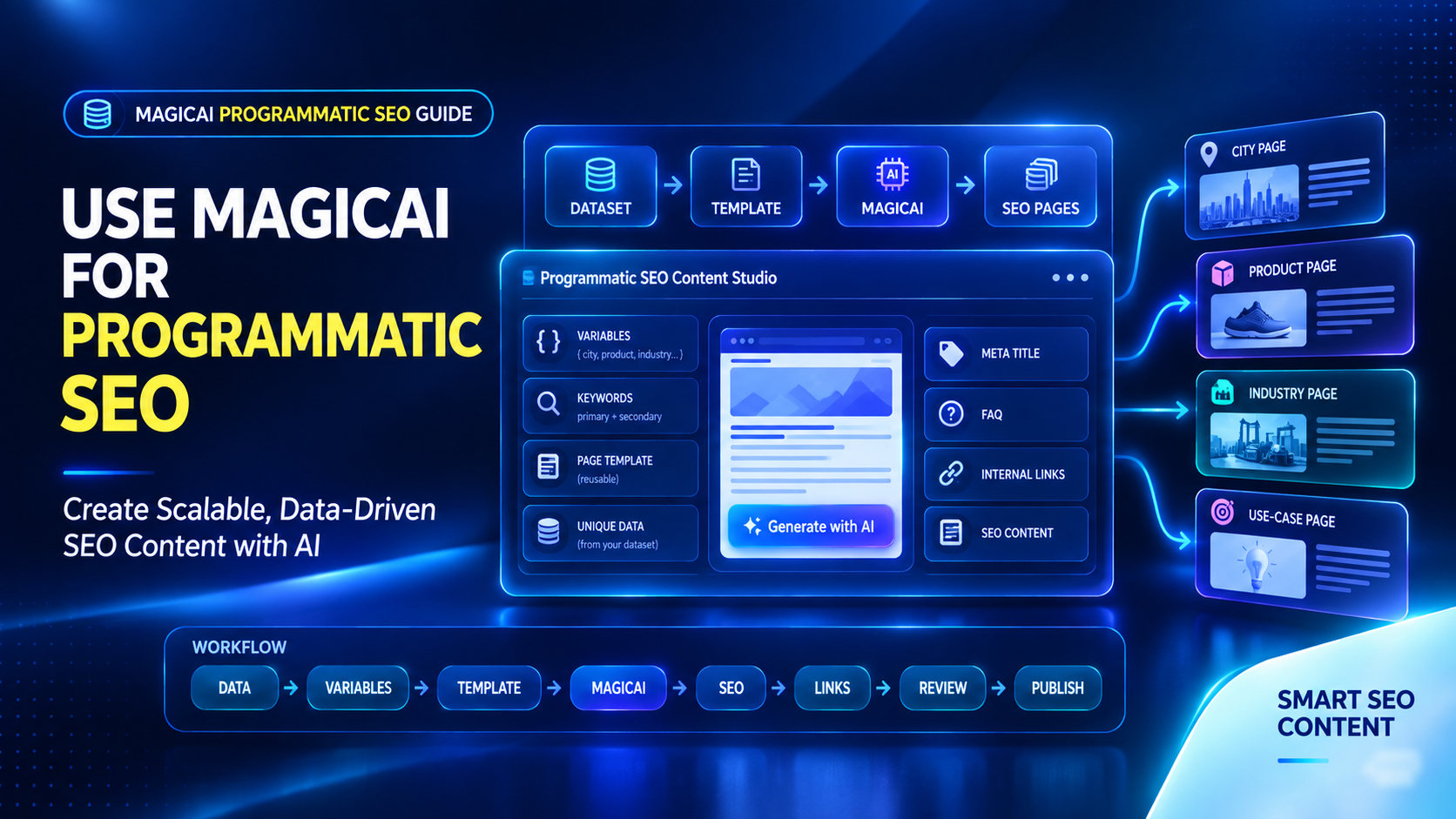
Programmatic SEO is an approach where a website uses structured data, templates, variables, and repeatable page patterns to create many targeted landing pages.
A simple model is:
DATASET + TEMPLATE + VARIABLES + SEARCH INTENT = PROGRAMMATIC SEO PAGES
For example:
Template:Best [SERVICE] in [CITY]
Variables:
- SERVICE = Digital Marketing Agency
- CITY = Delhi
Result:
Best Digital Marketing Agency in Delhi
Another variation:
- SERVICE = SEO Agency
- CITY = Mumbai
Result:
Best SEO Agency in Mumbai
The structure is scalable, but each page should provide genuinely useful information specific to its target query.
How Can MagicAI Help With Programmatic SEO?
MagicAI can help with the content layer of a programmatic SEO workflow.
Useful capabilities include:
- Content generation
- Custom templates
- Article generation
- Blog ideas
- Meta descriptions
- FAQ generation
- Content rewriting
- Custom prompts
- Content editing
- Exporting generated content
The platform also allows users to provide basic information or keywords and then view, edit, and export generated results.
For programmatic SEO, the most useful concept is the custom template.
Instead of asking MagicAI to create every page from scratch, you can establish a repeatable content framework and define which information should change from page to page.
Programmatic SEO vs Traditional SEO Content
| Factor | Traditional SEO | Programmatic SEO |
|---|---|---|
| Page creation | Mostly manual | Template-driven |
| Number of pages | Usually smaller | Potentially large |
| Content structure | Page-specific | Repeatable framework |
| Data usage | Limited | Central to workflow |
| Variables | Few | Many |
| Production speed | Slower | Faster |
| Quality control | Easier | More important |
| Duplicate-content risk | Lower | Higher |
| Human review | Important | Critical |
Programmatic SEO is therefore best suited to situations where there is a legitimate, repeatable search pattern.
When Should You Use Programmatic SEO?
Programmatic SEO can work well when you have:
- A large dataset
- Repeated search patterns
- Multiple locations
- Multiple products
- Multiple categories
- Different use cases
- Different industries
- Different service combinations
- Structured comparison data
- Large inventories
- Location-specific information
Examples include:
Location Pages
[SERVICE] in [CITY]
Product Pages
[PRODUCT] Specifications
Comparison Pages
[PRODUCT A] vs [PRODUCT B]
Integration Pages
[TOOL A] + [TOOL B] Integration
Industry Pages
[SERVICE] for [INDUSTRY]
Use-Case Pages
[PRODUCT] for [USE CASE]
The important factor is not simply the ability to generate many pages. There must be a meaningful reason for those pages to exist.
Step 1: Identify a Scalable Search Pattern
Start by finding a repeatable query pattern.
For example:
Main Topic: SEO Tools
Potential pattern:
Best SEO Tools for [AUDIENCE]
Variables:
- Bloggers
- Agencies
- Ecommerce Stores
- Small Businesses
- SaaS Companies
Another pattern:
SEO Tools for [USE CASE]
Variables:
- Keyword Research
- Technical SEO
- Content Optimization
- Rank Tracking
- Site Audits
The more useful the underlying search pattern, the stronger your programmatic SEO strategy can become.
Step 2: Define Your Variables
Variables are the elements that change from page to page.
For example:
[PRODUCT]
[CATEGORY]
[LOCATION]
[INDUSTRY]
[USE_CASE]
[FEATURE]
[TARGET_AUDIENCE]
Suppose you are creating software pages.
Your dataset could contain:
| Product | Industry | Use Case | Audience |
|---|---|---|---|
| CRM Software | Real Estate | Lead Management | Agencies |
| CRM Software | Healthcare | Patient Communication | Clinics |
| CRM Software | Education | Student Management | Institutions |
MagicAI can then be instructed to generate content around these variables.
Step 3: Build Your Dataset
A programmatic SEO system is only as useful as the data behind it.
Your dataset should contain meaningful information.
For example:
| City | Service | Description | Benefits | Price Range | Key Features |
|---|---|---|---|---|---|
| Delhi | SEO Services | Local SEO solutions | Visibility, leads | Variable | SEO audits |
| Mumbai | SEO Services | Search optimization | Traffic, leads | Variable | Content strategy |
| Jaipur | SEO Services | Local search strategy | Visibility | Variable | Local SEO |
Avoid using the same generic description for every page.
The unique data is what makes programmatic pages useful.
Step 4: Create a Reusable MagicAI Template
Create a structured prompt that explains the page format.
Example MagicAI Prompt
Create an SEO-focused landing page for:

Service: [SERVICE]
Location: [CITY]
Target Audience: [AUDIENCE]
Primary Keyword: [PRIMARY KEYWORD]

Use the following unique information:
[UNIQUE DATA]

Structure:

1. SEO-friendly H1
2. Helpful introduction
3. Overview of [SERVICE] in [CITY]
4. Key benefits
5. Important features
6. Who the service is suitable for
7. Local or industry-specific considerations
8. Practical use cases
9. Frequently asked questions
10. Clear conclusion and CTA

Requirements:
- Write naturally.
- Use the primary keyword naturally.
- Include related terms where relevant.
- Do not repeat sentences between pages.
- Do not invent statistics, prices, businesses, certifications, or factual claims.
- Use the supplied data as the source of truth.
- Make the page genuinely useful for someone searching for this service.
This template can become the foundation of your programmatic content workflow.
Step 5: Create a Consistent Page Structure
A scalable page system needs consistency.
A typical structure could be:
H1: [SERVICE] in [CITY]
Introduction
H2: [SERVICE] in [CITY]
Location-specific overview
H2: Benefits of [SERVICE]
Benefits relevant to the location or audience
H2: [SERVICE] Options
Unique information from the dataset
H2: Who Needs [SERVICE]?
Audience-specific information
H2: Frequently Asked Questions
Unique or relevant FAQs
H2: Get Started
CTA
The structure stays consistent while the useful information changes.
Step 6: Generate Unique Introductions
One common programmatic SEO problem is repetitive introductions.
For example:
Looking for the best SEO services in Delhi? Our SEO services in Delhi help businesses improve their online visibility.
Changing only the city name does not create meaningful uniqueness.
Instead, provide MagicAI with location-specific information.
Better Prompt
Write a unique introduction for a page about [SERVICE] in [CITY].

Use these specific details:
[LOCAL INFORMATION]

Explain:
- What users are looking for
- Why the service matters in this location
- Which type of audience may benefit
- What makes this page useful

Do not use generic location filler.
Do not repeat common phrases.
Do not invent local statistics.
This encourages meaningful differentiation.
Step 7: Use Structured Data as Content Inputs
Your dataset should provide the facts MagicAI needs.
Useful fields can include:
- Product name
- Product category
- Features
- Specifications
- Location
- Industry
- Use case
- Benefits
- Pricing information
- Availability
- Service details
- FAQs
- Supporting resources
The more useful the structured data, the less MagicAI needs to guess.
Step 8: Generate SEO Titles
MagicAI can also help create page titles based on variables.
Example Prompt
Generate 10 SEO title options for:

Service: [SERVICE]
Location: [CITY]
Primary Keyword: [KEYWORD]

Keep the titles clear, specific, natural, and useful.
Avoid clickbait and unnecessary keyword repetition.
Choose a consistent title framework while allowing enough variation where appropriate.
Step 9: Generate Meta Descriptions
MagicAI provides a Meta Description template, making it useful for creating page-level metadata.
Prompt
Write an SEO-friendly meta description for:

Page Topic: [TOPIC]
Primary Keyword: [KEYWORD]
Location/Product/Industry: [VARIABLE]

Make it specific to the page.
Clearly communicate the page's value.
Avoid keyword stuffing.
Do not make unsupported claims.
Each description should accurately represent its corresponding page.
Step 10: Create Programmatic FAQs
FAQs can help answer real questions related to the page.
MagicAI includes an FAQ Generator that can assist with generating question-and-answer content.
However, do not create identical FAQ blocks across hundreds of pages.
Instead, use page-specific inputs.
Example
For:
SEO Services in Delhi
Potential questions could focus on:
- Local SEO requirements
- Service suitability
- Typical project considerations
- SEO process
- Reporting
For:
SEO Services for Ecommerce
Questions should instead focus on:
- Product-page optimization
- Category-page SEO
- Ecommerce keyword research
- Technical ecommerce SEO
The FAQ should match the actual search intent.
Step 11: Add Internal Links Programmatically
Programmatic SEO can produce a large number of pages, so internal linking becomes especially important.
For example:
SEO Services in Delhi
could link to:
- SEO Services
- Local SEO Guide
- Technical SEO
- Ecommerce SEO
- SEO Pricing
You can create rules such as:
Every city page → main service page
Every service page → relevant industry pages
Every industry page → relevant service pages
Every related guide → appropriate landing pages
This creates a connected site architecture.
Step 12: Create Location-Specific Pages Carefully
Location-based programmatic SEO is one of the most common use cases.
But simply replacing the city name is not enough.
Weak Approach
SEO Services in Delhi
SEO Services in Mumbai
SEO Services in Jaipur
All three pages contain nearly identical content.
Better Approach
Use unique information for every location:
- Local customer needs
- Relevant service types
- Local considerations
- Location-specific examples
- Unique FAQs
- Actual service availability
- Genuine local information
If you do not have meaningful location-specific information, creating a separate page may not provide enough value.
Step 13: Generate Product Pages From Structured Data
Ecommerce websites can use a similar system.
Dataset:
| Product | Category | Material | Feature | Application |
|---|---|---|---|---|
| Product A | Packaging Machine | Stainless Steel | Automatic Filling | Powder |
| Product B | Packaging Machine | Stainless Steel | Automatic Sealing | Granules |
MagicAI can use these variables to create structured product content.
Prompt
Create an SEO-friendly product description using only the supplied product data.

Product: [PRODUCT]
Category: [CATEGORY]
Features: [FEATURES]
Specifications: [SPECS]
Applications: [APPLICATIONS]
Target Customer: [CUSTOMER]

Include:
- Product overview
- Key benefits
- Technical specifications
- Applications
- Suitable products
- FAQs
- SEO-friendly excerpt

Do not invent technical specifications.
Do not add unsupported performance claims.
This is especially useful when a website has a large catalog.
Step 14: Add Industry-Specific Content
Another useful programmatic pattern is:
[SERVICE] for [INDUSTRY]
Examples:
- SEO for Healthcare
- SEO for SaaS
- SEO for Ecommerce
- SEO for Education
- SEO for Real Estate
But each industry page should explain actual industry-specific problems, workflows, terminology, and use cases.
Generic content with an industry name inserted is not enough.
Step 15: Create Comparison Pages
Programmatic comparison pages can follow structures such as:
[PRODUCT A] vs [PRODUCT B]
Useful comparison fields include:
- Features
- Pricing
- Use cases
- Advantages
- Limitations
- Integrations
- Target users
- Ease of use
Only generate comparisons where you have reliable data for both products.
Step 16: Use MagicAI for Content Refreshes
Programmatic SEO is not only about creating new pages.
MagicAI can also help rewrite or improve existing content. Its current platform includes an AI ReWriter for making content more professional and detailed.
You can use it to:
- Improve introductions
- Rewrite repetitive sections
- Refresh outdated wording
- Improve readability
- Expand useful sections
- Create updated FAQs
- Improve metadata
Always verify facts before publishing refreshed content.
Step 17: Add Human Quality Control
This is one of the most important steps.
Before publishing programmatic pages, review:
- Accuracy
- Originality
- Search intent
- Usefulness
- Data quality
- Keyword targeting
- Internal links
- Metadata
- Grammar
- Brand consistency
- Unsupported claims
- Duplicate content
- Page indexing strategy
A scalable process should have quality gates, not simply an automatic publish button.
Step 18: Check for Duplicate and Thin Pages
Before publishing a large batch, compare pages for:
- Repeated introductions
- Repeated conclusions
- Identical FAQs
- Similar headings
- Generic statements
- Missing unique information
- Keyword-only variations
- Empty sections
- Unhelpful location substitutions
A page should exist because it provides a distinct value, not simply because a variable can be inserted into a template.
Step 19: Create a Programmatic SEO Workflow
A practical MagicAI workflow is:
SEARCH PATTERN → DATASET → VARIABLES → SEARCH INTENT → PAGE TEMPLATE → MAGICAI → UNIQUE DATA → SEO OPTIMIZATION → INTERNAL LINKS → QUALITY CHECK → DUPLICATE CHECK → HUMAN REVIEW → PUBLISH → MONITOR
This approach combines automation with editorial control.
Master MagicAI Prompt for Programmatic SEO
Use this reusable prompt as a starting point:
Act as an experienced SEO content strategist and programmatic content writer.

Create content for the following programmatic SEO page:

Page Type: [PAGE TYPE]
Main Topic: [MAIN TOPIC]
Primary Keyword: [PRIMARY KEYWORD]
Secondary Keywords: [SECONDARY KEYWORDS]

Variables:
[VARIABLES]

Unique Page Data:
[UNIQUE DATA]

Target Audience:
[TARGET AUDIENCE]

Search Intent:
[SEARCH INTENT]

Business Goal:
[BUSINESS GOAL]

Create a useful, specific, SEO-friendly page using the following structure:

1. SEO Title
2. Meta Description
3. H1
4. Introduction
5. Topic-specific overview
6. Unique benefits or features
7. Relevant use cases
8. Supporting information
9. Internal-link opportunities
10. Relevant FAQs
11. CTA

Rules:
- Make the page genuinely useful for the target search.
- Use the supplied data as the source of truth.
- Do not invent facts, statistics, prices, businesses, certifications, or specifications.
- Do not simply replace variables in generic sentences.
- Avoid repetitive phrasing.
- Avoid keyword stuffing.
- Keep the content natural and readable.
- Make every page meaningfully different where the data supports it.
- Do not create sections that cannot provide useful information.
Example Programmatic SEO Structure
Suppose you operate a website selling software.
You could create:
Main Category: CRM Software
Industry Cluster
- CRM Software for Real Estate
- CRM Software for Healthcare
- CRM Software for Education
- CRM Software for SaaS
Use-Case Cluster
- CRM for Lead Management
- CRM for Sales Tracking
- CRM for Customer Support
- CRM for Marketing Automation
Comparison Cluster
- CRM A vs CRM B
- CRM A vs CRM C
- CRM B vs CRM C
Each page should have a clear reason to exist and meaningful information specific to its target.
Common Mistakes to Avoid
1. Publishing Thousands of Pages Automatically
More pages do not automatically mean more organic traffic.
2. Changing Only One Variable
Replacing a city, product name, or industry inside identical copy creates weak differentiation.
3. Using AI Without Reliable Data
If the dataset is incomplete, MagicAI may produce generic or unsupported information.
4. Ignoring Search Intent
Every programmatic page should satisfy a specific search need.
5. Creating Pages With No Unique Value
If two pages provide essentially the same information, consider whether both need to exist.
6. Using the Same FAQs Everywhere
FAQs should be relevant to the individual page.
7. Ignoring Internal Linking
Large content sets need a logical linking structure.
8. Skipping Quality Control
Automation should increase production efficiency, not eliminate editorial review.
Benefits of Using MagicAI for Programmatic SEO
| Benefit | How It Helps |
|---|---|
| Faster content production | Speeds up repeatable content generation |
| Reusable templates | Creates consistent page structures |
| Topic expansion | Generates related content ideas |
| Metadata creation | Helps produce page titles and descriptions |
| FAQ generation | Supports page-specific question development |
| Content rewriting | Helps improve existing drafts |
| Scalable workflows | Supports larger content operations |
| Editing and export | Makes generated content easier to review and publish |
MagicAI’s custom templates, article generation, FAQ generation, meta-description tools, AI ReWriter, and export capabilities can support different stages of this workflow.
MagicAI vs Manual Programmatic SEO Content
| Factor | Manual Process | MagicAI-Assisted Process |
|---|---|---|
| Template creation | Manual | AI-assisted |
| Content drafting | Slow | Faster |
| Metadata | Manual | AI-assisted |
| FAQ ideas | Manual | Faster |
| Page variations | Time-consuming | Scalable |
| Data validation | Required | Required |
| SEO research | Required | Required |
| Quality control | Required | Required |
| Final publishing decision | Human | Human |
The best approach is:
DATA + SEO RESEARCH + MAGICAI + HUMAN REVIEW
Programmatic SEO Checklist
Before publishing a programmatic page, confirm:
- Search pattern is valid
- Page has a clear search intent
- Variables are meaningful
- Dataset contains reliable information
- Page has unique value
- Primary keyword is relevant
- Secondary keywords are natural
- Content is not repetitive
- FAQs are relevant
- Internal links are useful
- Metadata is page-specific
- Unsupported claims are removed
- Duplicate pages have been reviewed
- Thin pages have been identified
- Human quality review is complete
- Indexing strategy has been considered
- Performance can be monitored after publishing
Frequently Asked Questions
What is programmatic SEO content?
Programmatic SEO content is content created through a repeatable system using templates, variables, structured data, and search patterns to produce multiple targeted pages efficiently.
Can MagicAI automate programmatic SEO?
MagicAI can assist with scalable content generation, templates, metadata, FAQs, rewriting, and other content tasks. However, a complete programmatic SEO system also requires keyword research, data management, page generation logic, technical implementation, quality control, and human review.
Is AI-generated programmatic content good for SEO?
AI-generated content can be useful when it provides accurate, original, relevant, and genuinely helpful information. Simply generating large numbers of repetitive pages is not a sound SEO strategy.
What types of websites can use programmatic SEO?
Common examples include ecommerce websites, directories, travel websites, SaaS platforms, marketplaces, real estate websites, service businesses, and websites with large structured datasets.
How does MagicAI help create programmatic pages?
MagicAI can help create reusable content prompts, article drafts, introductions, metadata, FAQs, rewrites, and other page components. Its custom-template and content-generation capabilities are particularly useful for repeatable workflows.
Should every programmatic page be indexed?
Not necessarily. Each page should be evaluated for usefulness, uniqueness, search demand, and overall site value before deciding whether it belongs in the index.
How can I prevent programmatic SEO pages from becoming repetitive?
Use meaningful page-specific data, vary information based on real differences, create useful sections, avoid generic filler, and manually review representative pages before scaling production.
Final Verdict
Using MagicAI for programmatic SEO content can help teams move from slow, repetitive content production toward a more structured and scalable workflow.
The key is to automate repeatable content tasks, not the entire SEO strategy.
Start with a real search pattern. Build a reliable dataset. Define meaningful variables. Create a reusable MagicAI template. Generate page-specific content. Add useful internal links. Review the pages for accuracy and uniqueness. Then scale only after the system produces consistently valuable results.
MagicAI provides several capabilities that can support this process, including custom templates, article generation, meta descriptions, FAQs, AI rewriting, custom generation, editing, and export.
The ideal workflow is:
SEARCH PATTERN → DATASET → VARIABLES → TEMPLATE → MAGICAI → UNIQUE CONTENT → SEO → INTERNAL LINKS → QUALITY CONTROL → HUMAN REVIEW → PUBLISH → MONITOR
Used this way, MagicAI becomes a practical component of a programmatic SEO system rather than a tool for mass-producing generic pages.