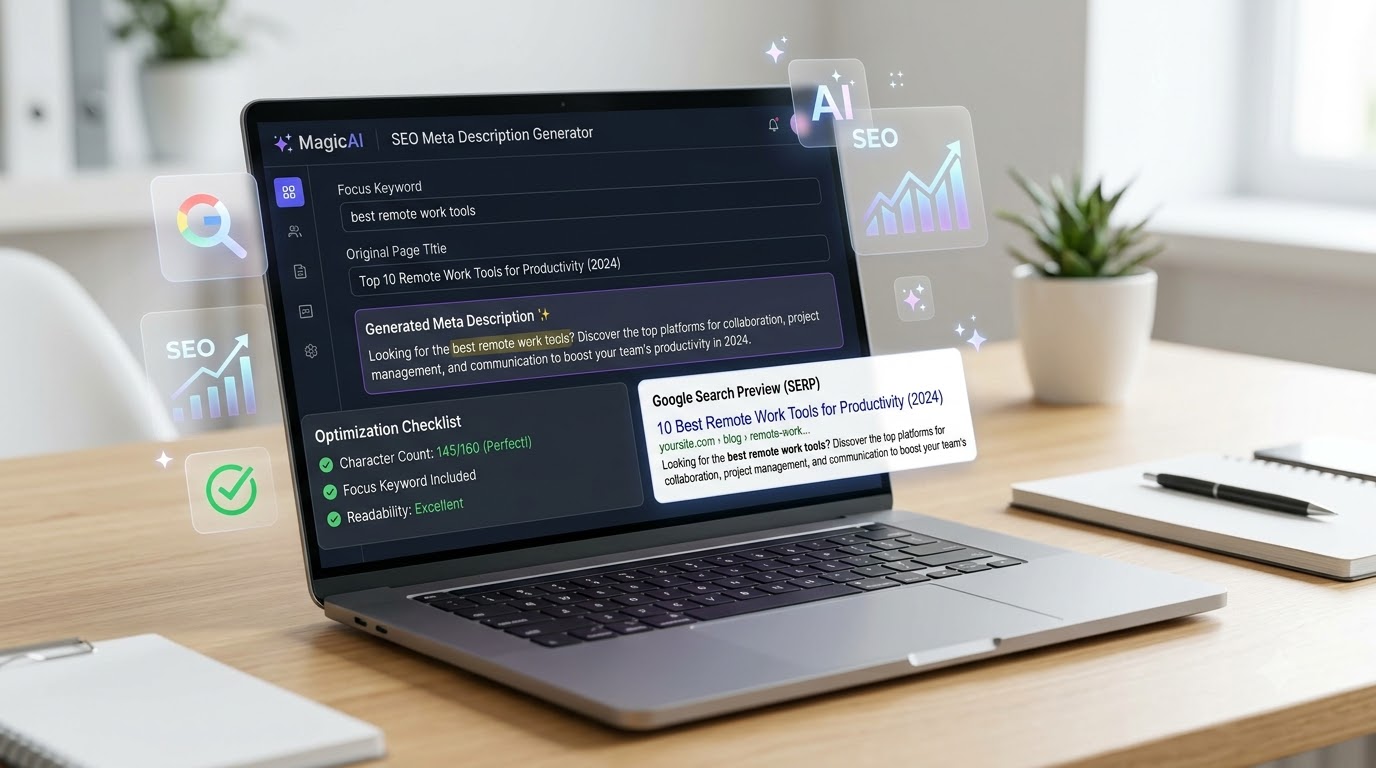

A meta description is a short summary of a webpage that appears below the page title in search engine results. While meta descriptions are not a direct ranking factor, a well-written description can improve search visibility, communicate page relevance, and encourage users to click through to your website.
Creating effective meta descriptions manually for every webpage can take considerable time, especially for websites with hundreds or thousands of pages. MagicAI can make this process faster by helping generate, refine, and optimize meta descriptions based on the page topic, target keyword, search intent, and desired tone.
This guide explains how to create SEO-friendly meta descriptions using MagicAI and how to refine AI-generated descriptions for better search performance.
What Is a Meta Description?
A meta description is an HTML attribute that provides a brief summary of a webpage.
A typical meta description looks like this:
<meta name="description" content="Learn how to create SEO-friendly meta descriptions with MagicAI and improve your website's search visibility and click-through potential.">Search engines may display this description beneath the title of a page in search results. However, search engines can sometimes generate their own snippet when they believe another section of the page better matches the user’s search query.
A good meta description should therefore accurately summarize the page while naturally incorporating important keywords and communicating a reason to visit the page.
Why Meta Descriptions Matter for SEO
Although meta descriptions are not considered a direct Google ranking factor, they are important from a search-result presentation and user-experience perspective.
1. They Explain the Page
A concise description helps searchers understand what they can expect after clicking the result.
2. They Can Improve Click-Through Rate
A useful and relevant description can make a search result more appealing compared with competing results.
3. They Reinforce Search Intent
A well-written description can demonstrate that the page addresses the user’s specific question, problem, or requirement.
4. They Support Keyword Relevance
Including the primary keyword naturally can make the search snippet more closely aligned with the query, although keyword stuffing should be avoided.
5. They Improve Search Result Presentation
A clear title combined with a compelling description creates a stronger search-result listing and can make the page easier for users to evaluate.
What Makes a Good Meta Description?
Before generating a description with MagicAI, it is important to understand the basic characteristics of an effective meta description.
A strong meta description should generally be:
- Relevant to the actual page content
- Concise and easy to understand
- Written for humans rather than search engines
- Focused on the primary search intent
- Naturally optimized around the target keyword
- Specific rather than generic
- Compelling enough to encourage a click
- Free from unnecessary keyword repetition
- Consistent with the page title and content
- Accurate and not misleading
Instead of trying to insert as many keywords as possible, focus on clearly communicating the value of the page.
How to Create Meta Descriptions Using MagicAI
MagicAI can be used as an AI writing assistant to create an initial meta description and generate alternative versions.
Step 1: Identify the Target Page
Start by identifying the exact webpage for which you need a meta description.
For example:
Page: How to Create AI Images Using MagicAI
The description should summarize this specific page rather than describing MagicAI in general.
Step 2: Identify the Primary Keyword
Determine the main keyword you want the page to target.
For example:
Primary Keyword: Create AI Images Using MagicAI
You can also identify secondary terms related to the topic, such as:
- MagicAI image generation
- AI image creation
- generate images with AI
- AI image generator
These keywords should be used naturally rather than forced into the description.
Step 3: Understand the Search Intent
Search intent is an important part of writing a useful meta description.
Ask:
What does the person searching this keyword actually want?
For example, someone searching for “how to create AI images using MagicAI” probably wants a practical tutorial.
The description should therefore communicate that the page provides instructions or a step-by-step process.
Step 4: Give MagicAI Clear Instructions
Instead of asking AI to simply “write a meta description,” provide context.
A stronger prompt could be:
Create an SEO-friendly meta description for an article titled “How to Create AI Images Using MagicAI.” The primary keyword is “Create AI Images Using MagicAI.” Write a clear, compelling description that accurately summarizes the article, matches informational search intent, naturally includes the primary keyword, and encourages users to click. Keep it concise and avoid keyword stuffing.
Providing context helps MagicAI generate a more relevant result.
Step 5: Generate Multiple Versions
One of the advantages of using AI is that you can quickly create several alternatives.
For example, MagicAI could generate variations with different approaches:
Informational Version:
Learn how to create AI images using MagicAI with practical steps, prompt tips, and optimization techniques for generating better AI visuals.
Benefit-Focused Version:
Create stunning AI images with MagicAI using effective prompts and simple techniques. Follow this practical guide to improve your AI-generated visuals.
Action-Oriented Version:
Discover how to create AI images using MagicAI, write better prompts, and generate high-quality visuals with an easy step-by-step workflow.
Generating multiple versions makes it easier to select the one that best matches the page and search intent.
How to Write a Strong MagicAI Prompt for Meta Descriptions
The quality of an AI-generated meta description depends heavily on the instructions provided.
A useful prompt should include:
Page Title
Tell MagicAI exactly what the page is about.
Primary Keyword
Specify the main keyword that should appear naturally.
Search Intent
Explain whether the page is informational, commercial, transactional, or navigational.
Target Audience
Mention who the content is intended for.
Main Benefit
Tell the AI what users will learn, achieve, or find on the page.
Length Preference
Ask for a concise search snippet rather than a long paragraph.
Tone
Specify whether the description should be professional, conversational, educational, persuasive, or technical.
Recommended MagicAI Meta Description Prompt
Use the following prompt as a reusable template:
Write an SEO-friendly meta description for the webpage titled “[PAGE TITLE]”. The primary keyword is “[PRIMARY KEYWORD]”. The page targets “[TARGET AUDIENCE]” and satisfies “[SEARCH INTENT]” search intent. Summarize the main value of the page, naturally include the primary keyword, make the description compelling and accurate, and encourage users to click. Avoid keyword stuffing, generic statements, misleading claims, and unnecessary repetition. Keep it concise and suitable for a search engine results snippet.
This template can be adapted for blog posts, product pages, category pages, landing pages, tutorials, and other types of website content.
Meta Description Examples
Example 1: Blog Article
Page Title: How to Create Meta Descriptions Using MagicAI
Primary Keyword: Create Meta Descriptions Using MagicAI
Meta Description:
Learn how to create SEO-friendly meta descriptions using MagicAI with practical prompts, optimization tips, and strategies for improving search-result click potential.
Example 2: Product Page
Page Title: Automatic Pouch Packing Machine
Primary Keyword: Automatic Pouch Packing Machine
Meta Description:
Explore automatic pouch packing machines for efficient filling, sealing, and packaging. Discover features, applications, specifications, and suitable products.
Example 3: Tutorial
Page Title: How to Generate AI Images With MagicAI
Primary Keyword: Generate AI Images With MagicAI
Meta Description:
Learn how to generate AI images with MagicAI using effective prompts, practical techniques, and a simple workflow for creating high-quality visuals.
Example 4: Commercial Page
Page Title: Best AI Writing Tools for Content Creation
Primary Keyword: AI Writing Tools
Meta Description:
Discover useful AI writing tools for creating blog posts, product descriptions, marketing content, and SEO copy while improving your content workflow.
How to Optimize AI-Generated Meta Descriptions
Generating a description is only the first step. Always review the output before publishing it.
1. Check Keyword Placement
Make sure the primary keyword appears naturally when appropriate.
Do not repeat the same keyword several times simply to make the description appear more optimized.
2. Match the Page Content
The description should accurately represent the content.
If the page provides a beginner’s tutorial, the description should not promise advanced strategies that are not covered.
3. Focus on User Benefits
Instead of describing the page with generic language, explain what the reader will gain.
Weak:
This article provides information about meta descriptions.
Better:
Learn how to create concise, keyword-focused meta descriptions that better communicate page value in search results.
4. Remove Filler Words
AI-generated descriptions can sometimes contain unnecessary phrases.
Remove words that do not add meaning and use the available space to communicate useful information.
5. Avoid Keyword Stuffing
Do not write descriptions like:
Meta descriptions, SEO meta descriptions, best meta descriptions, SEO descriptions, meta description tips, create meta descriptions.
This looks unnatural and provides little value to the searcher.
6. Avoid False Promises
Never claim that a page will guarantee:
- First-page rankings
- Guaranteed Google rankings
- Guaranteed traffic
- Guaranteed conversions
A meta description should accurately represent what the page provides.
Meta Description Length: What Should You Aim For?
There is no universal character limit that guarantees a description will display completely because search-result snippets can vary by device, query, and other factors.
Instead of obsessing over an exact character count, prioritize concise and useful copy.
A practical workflow is to ask MagicAI to create a short description and then manually review how it fits your SEO plugin or search-preview tool.
The most important goal is to communicate the page’s value quickly.
Meta Description vs. SEO Title
Meta descriptions and SEO titles work together but serve different purposes.
| SEO Element | Main Purpose |
|---|---|
| SEO Title | Identifies the page and attracts attention |
| Meta Description | Summarizes the page and encourages the click |
| Primary Keyword | Communicates the main search topic |
| URL | Provides the page address and context |
For example:
SEO Title:
How to Create Meta Descriptions Using MagicAI
Meta Description:
Learn how to create SEO-friendly meta descriptions using MagicAI with practical prompts, optimization tips, and strategies for improving search-result click potential.
The title establishes the topic, while the description explains why the searcher should consider visiting the page.
Using MagicAI for Different Page Types
MagicAI can generate different meta description styles depending on the type of page.
Blog Posts
Focus on the information or solution the reader will receive.
Product Pages
Highlight the product’s primary features, applications, or benefits.
Category Pages
Describe the type of products, services, or content users will find within the category.
Landing Pages
Emphasize the main value proposition and desired action.
Tutorials
Mention the process, techniques, or outcome users will learn.
Service Pages
Focus on the service, target customer, and key benefit.
Using page-specific instructions generally produces more useful descriptions than using the same generic prompt for every page.
A Simple MagicAI Meta Description Workflow
You can create a repeatable workflow for producing meta descriptions at scale.
Step 1: Collect Page Information
Prepare:
- Page title
- Primary keyword
- Secondary keywords
- Search intent
- Target audience
- Main benefit
- Page type
Step 2: Generate the First Draft
Provide the information to MagicAI using a structured prompt.
Step 3: Generate Alternatives
Ask MagicAI for several variations using different approaches.
Step 4: Compare the Versions
Evaluate each version for:
- Relevance
- Clarity
- Keyword usage
- User appeal
- Accuracy
- Conciseness
Step 5: Edit Manually
Make any final adjustments required for accuracy, branding, tone, or page-specific information.
Step 6: Add the Description to the Website
Place the final description in the appropriate SEO or CMS field.
Step 7: Review Search Performance
Monitor organic traffic, impressions, clicks, and click-through rate using your preferred SEO and analytics tools.
Common Mistakes When Using AI for Meta Descriptions
AI can speed up SEO work, but it should not replace human review.
Mistake 1: Using the First AI Output
The first generated description may be acceptable but not optimal. Generate and compare alternatives.
Mistake 2: Providing No Context
A prompt such as “write an SEO description” gives MagicAI very little information.
Provide the page topic, keyword, intent, and audience.
Mistake 3: Making Every Description Sound the Same
Large websites can end up with repetitive descriptions if the same template is used without customization.
Mistake 4: Overusing Keywords
AI may sometimes repeat keywords unnecessarily. Edit the final version so it reads naturally.
Mistake 5: Writing for Search Engines Instead of People
The purpose of a search snippet is to help users understand the result. Prioritize clarity and usefulness.
Mistake 6: Making Unsupported Claims
Avoid exaggerated statements such as “the world’s best,” “guaranteed rankings,” or “100% results” unless they are genuinely supported.
Mistake 7: Ignoring Search Intent
A product page, informational guide, and service page should not all use the same description structure.
Advanced Tips for Better Meta Descriptions With MagicAI
Use the Page’s Unique Selling Point
Tell MagicAI what makes the page useful or different.
For example:
Highlight that the guide includes step-by-step instructions and ready-to-use prompts.
This can create a more informative description.
Include a Relevant Action
For suitable pages, use natural action-oriented language such as:
- Learn how
- Discover
- Explore
- Compare
- Find
- Understand
- Get practical tips
Avoid making every description sound like an advertisement.
Match the Brand Voice
If your website has a professional tone, instruct MagicAI to maintain that tone.
For example:
Use a professional, clear, trustworthy tone suitable for a B2B technology website.
Create Description Variations for Testing
You can use MagicAI to produce several versions and compare their messaging.
However, changes should be made thoughtfully rather than frequently changing descriptions without enough performance data.
SEO Checklist for MagicAI Meta Descriptions
Before publishing a meta description, check the following:
- Does it accurately describe the page?
- Is the primary keyword used naturally where appropriate?
- Does it match search intent?
- Is the wording clear and concise?
- Does it communicate a useful benefit?
- Does it avoid keyword stuffing?
- Does it avoid misleading claims?
- Does it sound natural when read aloud?
- Is it different from descriptions on similar pages?
- Does it match the page title?
- Has the final AI output been manually reviewed?
How MagicAI Fits Into a Larger SEO Workflow
MagicAI should be viewed as a productivity tool within a broader SEO process.
A complete workflow can look like this:
Keyword Research → Search Intent → Content Creation → SEO Title → Meta Description → On-Page Optimization → Publishing → Performance Monitoring
MagicAI can assist with several stages of this workflow, but the final SEO decisions should still be based on the page’s purpose, audience, content quality, and actual search performance.
The best results come from combining AI assistance with human editing and SEO judgment.
FAQs About Creating Meta Descriptions Using MagicAI
1. Can MagicAI write SEO meta descriptions?
Yes. MagicAI can help generate meta description drafts based on a page title, keyword, search intent, audience, and other instructions.
2. Should I use the exact AI-generated description?
Not necessarily. AI-generated text should be reviewed for accuracy, relevance, keyword usage, and alignment with the actual page.
3. How long should a meta description be?
There is no single character length that guarantees the same display across all searches and devices. Aim for concise, useful copy and review it in your SEO workflow.
4. Should the primary keyword be included?
When it fits naturally, including the primary keyword can help make the description relevant to the search topic. It should never be forced or repeated excessively.
5. Can MagicAI create meta descriptions in bulk?
AI can significantly speed up the drafting process for multiple pages, provided each prompt or workflow contains enough page-specific information and the outputs are reviewed.
6. Are meta descriptions a direct Google ranking factor?
Meta descriptions themselves are not generally treated as a direct ranking factor. Their value comes largely from helping communicate page relevance and potentially influencing searcher behavior.
7. Can Google rewrite my meta description?
Yes. Search engines may generate a different snippet when they determine that another part of the page better matches a user’s search query.
8. Should every page have a unique meta description?
For important indexable pages, unique and relevant descriptions are generally preferable because they help distinguish individual pages in search results.
Final Verdict
Creating meta descriptions manually for every webpage can be repetitive, especially when managing a large website. MagicAI can simplify this process by generating relevant drafts quickly and helping SEO teams create multiple variations for review.
The key is not to rely blindly on AI-generated text. Provide MagicAI with the right context, including the page topic, primary keyword, search intent, target audience, and key benefit. Then review and refine the generated description before publishing it.
A strong workflow combines MagicAI’s speed with human SEO judgment. When descriptions are accurate, concise, relevant, and written for real searchers, they can create more informative search-result snippets and improve the overall presentation of your website in organic search.