
Introduction
A product description has two important jobs: explain the product clearly to potential customers and help the product page become easier for search engines to understand.
Writing descriptions that accomplish both goals can take time. Product information needs to be accurate, benefits need to be persuasive, keywords need to appear naturally, and the final copy needs to remain easy to read.
MagicAI can help streamline this process by generating product-description drafts, rewriting existing copy, organizing product information, and adapting content for different audiences.
The key is to use AI as part of a structured workflow rather than simply asking it to “write a product description.”
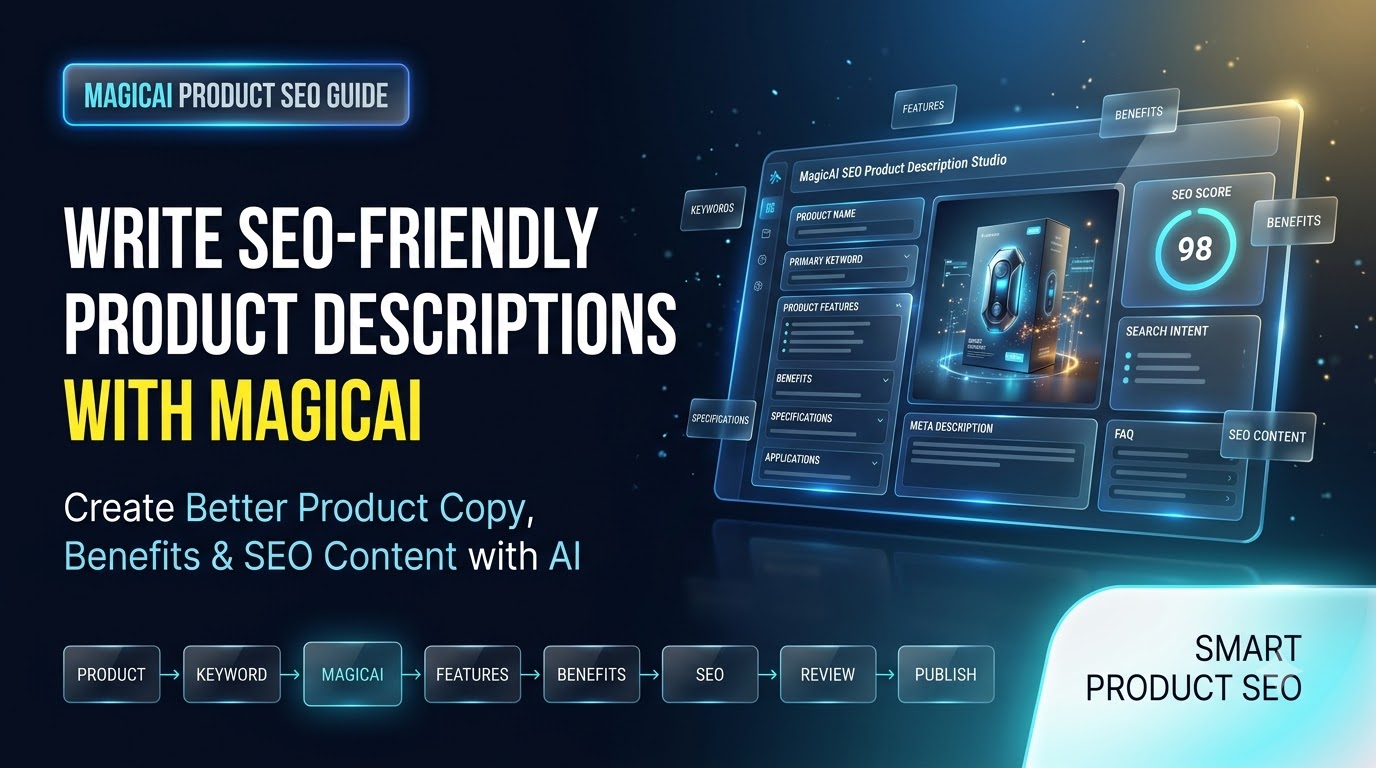
This guide explains how to write SEO-friendly product descriptions with MagicAI, including keyword planning, search intent, product features, benefits, prompts, optimization, common mistakes, and practical workflows.
What Is an SEO-Friendly Product Description?
An SEO-friendly product description is product content that is useful for customers while also providing search engines with clear, relevant information about the product.
A strong description can include:
- Product name
- Main product purpose
- Key features
- Customer benefits
- Specifications
- Applications
- Suitable users
- Use cases
- Relevant keywords
- Supporting search terms
- Calls to action
SEO should support the product information rather than make the description sound unnatural.
For example, instead of repeatedly writing:
“Industrial packaging machine, packaging machine, automatic packaging machine, best packaging machine…”
a better description naturally explains what the machine does, what products it handles, how it operates, and why the buyer may need it.
Why SEO-Friendly Product Descriptions Matter
Product descriptions can influence both search visibility and customer understanding.
1. They Explain the Product
Visitors need enough information to understand what the product is and whether it meets their requirements.
2. They Support Search Relevance
Relevant product terms help search engines understand the subject of the page.
3. They Highlight Benefits
Features describe what a product has. Benefits explain why those features matter.
4. They Improve Product-Page Quality
Detailed, useful descriptions can create a better experience than thin or repetitive product copy.
5. They Can Support Conversions
Clear information can help potential customers make purchasing or enquiry decisions.
Can MagicAI Write SEO Product Descriptions?
Yes. MagicAI can be used as an AI-assisted writing tool for generating and refining product content.
The platform provides AI writing and content-generation capabilities that can be adapted to different content requirements. Its broader content-generation workflow can help users create, edit, and refine written material based on supplied instructions.
However, product descriptions require accurate product information.
MagicAI should not be expected to invent:
- Technical specifications
- Materials
- Dimensions
- Capacities
- Certifications
- Warranty terms
- Prices
- Performance claims
- Compatibility information
Provide verified product information first, then ask MagicAI to turn it into polished SEO content.
Step 1: Collect Complete Product Information
Before opening MagicAI, collect the information needed to describe the product accurately.
For a physical product, this may include:
- Product name
- Product category
- Product type
- Main purpose
- Features
- Benefits
- Material
- Dimensions
- Weight
- Capacity
- Power requirements
- Operating method
- Applications
- Compatible products
- Target customers
- Warranty
- Available variants
For industrial equipment, you may also need:
- Production capacity
- Automation type
- Filling system
- Sealing system
- Control system
- Machine operation
- Packaging speed
- Fill-weight range
- Pouch-size range
- Power consumption
The more accurate information you provide, the more useful the generated description can become.
Step 2: Identify the Primary Keyword
Choose the main keyword that best represents the product.
For example:
Product: Automatic Pouch Packaging Machine
Primary Keyword: automatic pouch packaging machine
Possible secondary keywords:
- automatic pouch packing machine
- pouch packaging machine
- automatic pouch packing equipment
- pouch packing machine
- packaging machine for pouches
The primary keyword should match the actual product rather than simply being a high-volume phrase.
Step 3: Understand Search Intent
Before writing, consider why someone searches for the product.
A product-related search may indicate that the user wants to:
- Understand the product
- Compare products
- Check specifications
- Find applications
- Purchase the product
- Request a quotation
- Find a supplier
For example, someone searching for automatic pouch packaging machine may want information about:
- What the machine does
- Which products it can pack
- Its packaging speed
- Pouch formats
- Fill-weight range
- Automation level
- Machine operation
- Applications
Your product description should answer these questions naturally.
Step 4: Add Secondary Keywords
Secondary keywords help expand the topical coverage of the page.
For example:
Primary Keyword: powder filling machine
Secondary Keywords:
- automatic powder filling machine
- powder packing machine
- powder filling equipment
- auger filling machine
- powder packaging equipment
Do not force every keyword into the first paragraph.
Assign keywords to relevant sections.
Step 5: Ask MagicAI for a Product Description
A basic prompt can produce a starting draft.
Example MagicAI Prompt
Write an SEO-friendly product description for an automatic pouch packaging machine.
Primary keyword: automatic pouch packaging machine.
Secondary keywords: pouch packing machine, automatic pouch packing equipment, pouch packaging machine.
Explain the machine’s purpose, key features, benefits, applications, suitable products, operating method, and technical specifications.
Use professional, natural, customer-focused English.
Avoid keyword stuffing and unsupported claims.
This gives MagicAI clear instructions about both SEO and product information.
Step 6: Tell MagicAI Who the Buyer Is
Product copy becomes stronger when the target customer is clear.
For example:
Write this product description for food manufacturers, FMCG companies, packaging businesses, and industrial buyers.
For consumer products, you might specify:
Write this description for online shoppers looking for a compact kitchen appliance for everyday use.
The audience determines the vocabulary, level of detail, and benefits that should be emphasized.
Step 7: Focus on Features and Benefits
One of the most important parts of product copy is separating features from benefits.
Feature
Automatic pouch feeding
Benefit
Helps reduce manual handling and supports a more consistent packaging workflow.
Another example:
Feature
Digital control panel
Benefit
Allows operators to manage machine settings more conveniently during production.
Ask MagicAI to convert important technical features into customer-focused benefits without changing the underlying facts.
Step 8: Create a Strong Product Introduction
The first paragraph should quickly answer:
- What is the product?
- What does it do?
- Who is it for?
- What makes it useful?
Example Structure
Product name + primary function + target application + major benefit
For example:
An automatic pouch packaging machine is designed to streamline the filling and sealing of products into pre-defined pouch formats, helping manufacturers improve packaging consistency and production efficiency.
The exact claims should always match the actual machine specifications.
Step 9: Structure the Description With Headings
Long product descriptions become easier to read when information is organized into sections.
A useful structure is:
Product Overview
Explain what the product is and what it does.
Key Features
List the most important product characteristics.
Benefits
Explain how the features help the customer.
Technical Specifications
Present verified specifications in an easy-to-scan format.
Applications
Explain where the product can be used.
Suitable Products
List compatible products when applicable.
Why Choose This Product?
Summarize the practical value.
Frequently Asked Questions
Answer common buyer questions.
This structure works particularly well for technical and industrial products.
Step 10: Add Technical Specifications
Technical specifications are especially important for machinery and industrial products.
A specification table might include:
| Specification | Details |
|---|---|
| Machine Type | Automatic pouch packaging machine |
| Automation Type | Automatic |
| Application | Pouch filling and sealing |
| Filling System | Based on product/application |
| Sealing System | Based on machine configuration |
| Control System | Digital/PLC-based, where applicable |
| Machine Material | As specified |
| Production Capacity | As specified |
| Packaging Speed | As specified |
| Fill Weight Range | As specified |
| Pouch Size Range | As specified |
| Power Supply | As specified |
| Power Consumption | As specified |
Never allow AI to fill missing specifications with assumptions.
Step 11: Optimize Product Titles
The product title should be clear and descriptive.
A useful format is:
Primary Product Name + Important Differentiator
For example:
Automatic Powder Filling Machine for High-Accuracy Powder Packaging
Avoid titles that contain excessive keywords.
Step 12: Optimize the First Paragraph
The primary keyword can naturally appear early in the description.
For example:
This automatic powder filling machine is designed for efficient filling of suitable powder products into compatible packaging formats.
The keyword appears naturally because it describes the actual product.
Step 13: Use Keywords Naturally
Keyword placement can be considered in:
- Product title
- Introduction
- Relevant headings
- Feature sections
- Application sections
- Image ALT text
- Meta description
- FAQ questions
- Supporting copy
Do not insert keywords into every sentence.
Natural language should remain the priority.
Step 14: Add Product Applications
Applications help potential buyers understand where the product fits into their workflow.
For machinery, applications might include:
- Food processing
- FMCG packaging
- Pharmaceutical packaging
- Spice packaging
- Grain packaging
- Powder packaging
- Snack packaging
Only list applications supported by the actual product.
Step 15: Add Suitable Products
If the product is designed for specific materials or products, include them clearly.
For example:
Suitable Products:
- Spices
- Flour
- Pulses
- Grains
- Powder products
- Granular products
Do not claim compatibility with a product unless the machine is actually designed or configured for it.
Step 16: Generate Multiple Versions
MagicAI can be used to create different versions of the same product description.
For example:
Create three versions of this product description:
- Technical and detailed
- SEO-focused and balanced
- Short and conversion-focused
Keep all technical information accurate and unchanged.
This allows you to select the version that best matches your website.
Step 17: Rewrite Existing Product Descriptions
You can also use MagicAI when an existing product description needs improvement.
Example Prompt
Rewrite the following product description for SEO and readability. Preserve all technical specifications and factual information. Improve clarity, structure, keyword usage, benefits, and customer focus. Remove repetition and avoid making unsupported claims.
This is particularly useful when a website contains hundreds of older product pages.
Step 18: Create Short Product Excerpts
Many websites need a short excerpt in addition to the full description.
Ask MagicAI:
Create a 40–60 word product excerpt for this product. Include the primary keyword naturally and summarize the main function and benefit without repeating the product title excessively.
The excerpt should quickly communicate the product’s purpose.
Step 19: Generate Meta Titles
A product page should also have a concise SEO meta title.
Example Prompt
Create five SEO-friendly meta titles for this product. Keep them concise, include the primary keyword naturally, and make each title clear and compelling.
Choose the version that best represents the actual product.
Step 20: Generate Meta Descriptions
A meta description should summarize the page accurately.
Example Prompt
Write three concise SEO meta descriptions for this product page. Include the primary keyword naturally, communicate the main benefit, and encourage relevant users to visit the product page. Avoid unsupported claims.
Step 21: Generate Product FAQs
FAQs can address common buyer questions.
For example:
What products can this machine handle?
Answer this using the verified product compatibility information.
What is the packaging speed?
Provide the actual documented speed or range.
What pouch sizes are supported?
List the verified pouch-size range.
Is the machine automatic?
Explain the actual automation configuration.
FAQs should provide useful information rather than simply repeating keywords.
Step 22: Create Image SEO Information
MagicAI can also help create supporting image information.
For example:
Image Filename: automatic-pouch-packaging-machine.jpg
ALT Text: Automatic pouch packaging machine for efficient pouch filling and sealing
Image Title: Automatic Pouch Packaging Machine
The ALT text should describe the actual image rather than act as a keyword list.
Step 23: Create Product Tags
Product tags can help organize a large ecommerce or industrial website.
For example:
- Automatic Packaging Machine
- Pouch Packaging Machine
- Pouch Packing Machine
- Filling Machine
- Sealing Machine
- Packaging Equipment
- Automatic Packing Equipment
Keep tags relevant and consistent with the site’s taxonomy.
Step 24: Ask MagicAI to Improve Readability
After generating the first draft, ask MagicAI to improve the writing.
Example Prompt
Review this product description for readability. Make the language professional, clear, concise, and customer-focused. Remove unnecessary repetition, improve sentence flow, preserve all technical facts, and keep the SEO keywords natural.
This is often more useful than repeatedly asking for a completely new description.
Step 25: Fact-Check the Final Description
This is one of the most important steps.
Compare the AI-generated content with your actual product information.
Check:
- Product name
- Model
- Dimensions
- Material
- Capacity
- Speed
- Power
- Weight range
- Compatible products
- Applications
- Automation level
- Technical specifications
- Warranty
- Certifications
Remove anything MagicAI added that cannot be verified.
Master MagicAI Prompt for SEO Product Descriptions
Use this reusable prompt:
Write a detailed SEO-friendly product description for “[PRODUCT NAME].”
Product category: [CATEGORY]
Primary keyword: [PRIMARY KEYWORD]
Secondary keywords: [SECONDARY KEYWORDS]
Target audience: [TARGET AUDIENCE]
Main application: [APPLICATION]
Key features: [FEATURES]
Product benefits: [BENEFITS]
Technical specifications: [SPECIFICATIONS]Create the content using the following structure:
- Product Overview
- Key Features
- Product Benefits
- Technical Specifications
- Applications
- Suitable Products
- Why Choose This Product
- Frequently Asked Questions
Use professional, natural, persuasive English. Include the primary keyword naturally and use secondary keywords only where relevant. Do not keyword-stuff. Do not invent specifications, certifications, performance claims, applications, prices, or features. Keep all provided technical information accurate.
Example Product Description Workflow
For an industrial packaging product, use:
PRODUCT INFORMATION → TARGET CUSTOMER → PRIMARY KEYWORD → SECONDARY KEYWORDS → SEARCH INTENT → MAGICAI DRAFT → FEATURES → BENEFITS → SPECIFICATIONS → APPLICATIONS → FAQ → SEO OPTIMIZATION → FACT-CHECK → HUMAN EDITING → FINAL REVIEW → PUBLISH
This workflow keeps SEO, product accuracy, and customer communication connected.
Common Mistakes to Avoid
1. Giving MagicAI Too Little Information
If you provide only the product name, the generated copy may be generic.
2. Allowing AI to Invent Specifications
Never accept unverified technical information.
3. Keyword Stuffing
Repeating the same keyword excessively makes the content unnatural.
4. Writing Only About Features
Customers also need to understand the practical benefits.
5. Ignoring Search Intent
A buyer looking for specifications needs different information from someone simply researching a product category.
6. Creating Very Short Descriptions
Thin product pages may fail to answer important customer questions.
7. Making Unsupported Marketing Claims
Avoid claims such as “best,” “number one,” “100% guaranteed,” or “highest quality” unless they can be substantiated.
8. Copying the Same Description Across Products
Similar products may need related structures, but each page should accurately describe its specific product.
9. Ignoring Human Editing
AI-generated content should be reviewed before publication.
Benefits of Using MagicAI for Product Descriptions
MagicAI can help businesses:
- Create product drafts faster
- Rewrite outdated descriptions
- Generate multiple copy variations
- Improve readability
- Organize technical information
- Create SEO-focused content
- Generate product excerpts
- Develop FAQs
- Create meta titles and descriptions
- Adapt content for different audiences
- Standardize product-page structures
For businesses managing large product catalogs, a consistent AI-assisted workflow can significantly simplify content production.
MagicAI vs Manual Product Description Writing
| Factor | Manual Writing | MagicAI-Assisted Writing |
|---|---|---|
| First draft | Time-consuming | Faster |
| Product structure | Manual | AI-assisted |
| Keyword integration | Manual | AI-assisted |
| Feature-to-benefit conversion | Manual | Faster |
| Multiple variations | Time-consuming | Easy |
| FAQs | Manual | Fast generation |
| Meta copy | Manual | Fast generation |
| Technical accuracy | Human controlled | Must be verified |
| Final editing | Human | Human |
The best approach is not AI versus human writing. It is AI-assisted writing with human control over product accuracy and SEO strategy.
SEO Product Description Checklist
Before publishing, check:
- Product name is correct
- Primary keyword is relevant
- Secondary keywords are natural
- Search intent is addressed
- Product purpose is clear
- Features are accurate
- Benefits are clearly explained
- Technical specifications are verified
- Applications are accurate
- Suitable products are correct
- Product title is optimized
- Meta title is prepared
- Meta description is prepared
- Image ALT text is descriptive
- FAQs are useful
- Internal links are considered
- Keyword stuffing has been removed
- AI-generated claims have been fact-checked
- Final content has been human-reviewed
Frequently Asked Questions
Can MagicAI create SEO-friendly product descriptions?
Yes. MagicAI can assist with drafting and refining product descriptions when you provide accurate product information and clear SEO instructions.
What information should I give MagicAI?
Provide the product name, category, features, benefits, specifications, applications, target audience, primary keyword, and relevant secondary keywords.
Can MagicAI write descriptions for industrial machines?
Yes. It can help structure technical product information into readable descriptions, but all machine specifications and performance claims should be verified manually.
Should the primary keyword appear multiple times?
It can appear naturally in important areas such as the title, introduction, relevant headings, and body copy. Excessive repetition should be avoided.
Can MagicAI rewrite existing product descriptions?
Yes. You can provide an existing description and ask MagicAI to improve clarity, structure, readability, and SEO while preserving factual information.
Can MagicAI create product FAQs?
Yes. You can ask it to generate relevant customer questions and answers based on the verified product information.
Can MagicAI generate meta titles and descriptions?
Yes. It can generate multiple options that can then be reviewed and refined for relevance and clarity.
Should AI-generated product descriptions be published without editing?
No. Always review AI-generated product content, especially technical specifications, applications, compatibility, certifications, and performance claims.
Final Verdict
Learning how to write SEO-friendly product descriptions with MagicAI can make product-content creation faster and more organized.
The most effective process starts with accurate product information. From there, define the primary keyword, understand search intent, provide secondary keywords, generate the first draft with MagicAI, organize features and benefits, add technical specifications, create FAQs and metadata, and then perform a careful human review.
For technical and industrial products, accuracy should always come before creative wording. MagicAI can help transform verified information into clearer, more structured, SEO-friendly content, but it should not be allowed to invent product facts.
A strong product description combines accurate information + natural SEO + clear benefits + useful structure + human review.